


A closely divided US Supreme Court outlawed the death penalty for juvenile criminals, writing of a national consensus that such executions were unconstitutionally cruel.
Tuesday's ruling ended a practice that had brought international condemnation.
The 5-4 decision, which overturns a 1989 high court ruling, throws out the death sentences of 72 murderers who committed their crimes as juveniles and bars states from seeking to execute others. Nineteen states had allowed death sentences for people who killed when they were under 18.
The ruling was greeted with enthusiasm by numerous death penalty opponents in the US and abroad.
Justice Anthony Kennedy, writing for the majority, said many juveniles lack sufficient maturity and intellectual development to understand ramifications of their actions.
"The age of 18 is the point where society draws the line for many purposes between childhood and adulthood. It is, we conclude, the age at which the line for death eligibility ought to rest," Kennedy said.
The US has stood almost alone in the world in officially sanctioning juvenile executions, a "stark reality" that can't be ignored, Kennedy wrote. Juvenile offenders have been put to death in recent years in only a few other countries, including Iran, Pakistan, China and Saudi Arabia.
"It is proper that we acknowledge the overwhelming weight of international opinion against the juvenile death penalty, resting in large part on the understanding that the instability and emotional imbalance of young people may often be a factor in the crime," Kennedy wrote.
In an angry dissent, Justice Antonin Scalia disputed that a "national consensus" exists and said the majority opinion was based on the "flimsiest of grounds." The appropriateness of capital punishment should be determined by individual states, not "the subjective views of five members of this court and like-minded foreigners," he wrote.
The ruling continues the court's practice of narrowing the scope of the death penalty, which it reinstated as permissible punishment in 1976. Execution of those 15 and younger when they committed their crimes was outlawed in 1988. Three years ago, justices banned execution of the mentally retarded, citing a "national consensus" against putting to death a killer who may lack the intelligence to fully understand his crime.
In finding a similar consensus against juvenile executions, the court noted that most states bar them and those that allow them do so infrequently. Only three states -- Oklahoma, Texas and Virginia -- have executed people who committed crimes as juveniles in the past 10 years.
Legal experts said the ruling could have widespread ramifications for the future of capital punishment, with courts empowered to strike down the practice on evolving notions of decency.
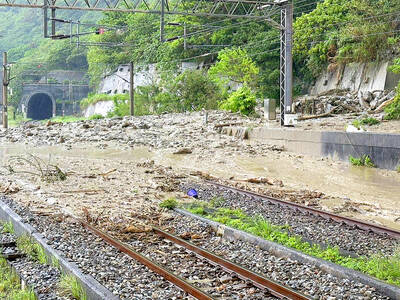
ROLLER-COASTER RIDE: More than five earthquakes ranging from magnitude 4.4 to 5.5 on the Richter scale shook eastern Taiwan in rapid succession yesterday afternoon Back-to-back weather fronts are forecast to hit Taiwan this week, resulting in rain across the nation in the coming days, the Central Weather Administration said yesterday, as it also warned residents in mountainous regions to be wary of landslides and rockfalls. As the first front approached, sporadic rainfall began in central and northern parts of Taiwan yesterday, the agency said, adding that rain is forecast to intensify in those regions today, while brief showers would also affect other parts of the nation. A second weather system is forecast to arrive on Thursday, bringing additional rain to the whole nation until Sunday, it

LANDSLIDES POSSIBLE: The agency advised the public to avoid visiting mountainous regions due to more expected aftershocks and rainfall from a series of weather fronts A series of earthquakes over the past few days were likely aftershocks of the April 3 earthquake in Hualien County, with further aftershocks to be expected for up to a year, the Central Weather Administration (CWA) said yesterday. Based on the nation’s experience after the quake on Sept. 21, 1999, more aftershocks are possible over the next six months to a year, the agency said. A total of 103 earthquakes of magnitude 4 on the local magnitude scale or higher hit Hualien County from 5:08pm on Monday to 10:27am yesterday, with 27 of them exceeding magnitude 5. They included two, of magnitude

CONDITIONAL: The PRC imposes secret requirements that the funding it provides cannot be spent in states with diplomatic relations with Taiwan, Emma Reilly said China has been bribing UN officials to obtain “special benefits” and to block funding from countries that have diplomatic ties with Taiwan, a former UN employee told the British House of Commons on Tuesday. At a House of Commons Foreign Affairs Committee hearing into “international relations within the multilateral system,” former Office of the UN High Commissioner for Human Rights (OHCHR) employee Emma Reilly said in a written statement that “Beijing paid bribes to the two successive Presidents of the [UN] General Assembly” during the two-year negotiation of the Sustainable Development Goals. Another way China exercises influence within the UN Secretariat is

Taiwan’s first drag queen to compete on the internationally acclaimed RuPaul’s Drag Race, Nymphia Wind (妮妃雅), was on Friday crowned the “Next Drag Superstar.” Dressed in a sparkling banana dress, Nymphia Wind swept onto the stage for the final, and stole the show. “Taiwan this is for you,” she said right after show host RuPaul announced her as the winner. “To those who feel like they don’t belong, just remember to live fearlessly and to live their truth,” she said on stage. One of the frontrunners for the past 15 episodes, the 28-year-old breezed through to the final after weeks of showcasing her unique


 RSS
RSS