


US Secretary of State Condoleezza Rice was to press her hardline case over Iran's nuclear ambitions with Russia yesterday after saying the US had no plans for an imminent attack on the Islamic republic.
On her first trip abroad as the top US diplomat, the Soviet specialist will meet her Russian counterpart, Sergei Lavrov, in Turkey as the Bush administration pressures Moscow to keep on hold a fuel-supply deal for an Iranian reactor.
"We, of course, have worked ... with the Russians. And their efforts to cooperate with the Iranians on civilian nuclear power have been much more attuned recently to [our] concerns about the proliferation risk," Rice said on Friday in Britain on the first leg of a 10-stop trip to Europe and the Middle East.
"While it does not eliminate the proliferation risk, it certainly does help to mitigate [it]," she added.
Washington fears any Russian fuel supply to a reactor Iran is building in its southern port of Bushehr would move Tehran closer to acquiring a bomb under the cover of a civilian program.
Oil-rich Iran denies it is developing such a weapon and says its nuclear programs are for peaceful power generation needed to meet the energy demands of its growing population.
Rice, who has sought to allay fears of a possible military strike, says Russia's decision against delivering the fuel is part of the international community's diplomatic strategy against Tehran.
Asked in London if the US was considering military action to end Iran's programs, Rice said, "The question is simply not on the agenda at this point in time -- we have diplomatic means to do this."
Her response was unlikely to reduce global tensions over a nation US President George W. Bush said was part of an "axis of evil" with pre-war Iraq and North Korea.
Europe -- with US acquiescence -- has offered economic incentives to Iran in a proposed deal to ensure Iran does not pursue the atomic bomb.
And if those talks fail -- as similar ones did last year -- the US wants Iran reported to the UN Security Council for possible international sanctions that would have to be approved by Russia.
Some hardline US officials see the Russian supply deal as crucial to avoiding an escalation of the crisis.
They warn that Israel might strike its longtime foe should any deliveries be made, noting the country hit Iraqi facilities when former Iraqi president Saddam Hussein reached a similar stage in nuclear development decades ago.
Rice's week-long trip also seeks to repair ties with nations like Russia that were frayed because of the US-led invasion of Iraq last year.
She was to fly from Germany, which opposed the war, to Poland yesterday to thank Warsaw for sending its troops to Iraq.
Rice was also to discuss with Lavrov yesterday the Kremlin's pace of democratic reform amid complaints by Washington.
The Russian foreign ministry said in a statement this week that the talks would prepare for a summit meeting between Bush and Russian President Vladimir Putin to be held on Feb. 24 in the Slovak capital of Bratislava.
Rice warned Moscow on Tuesday that it would have to accelerate its democratic reforms if it hoped to truly deepen its relationship with the US. She said Washington had to balance cooperation with Moscow on several fronts with what she called the Kremlin's "uneven" moves toward democracy.
US-Russian ties have soured amid complaints over several anti-democratic actions by Putin, including his move against the oil giant Yukos, a crackdown on the press and alleged interference in the Ukraine election.
Rice said the Bush administration had not begun any systematic review of its relations with Russia but added, "we're constantly looking at the policies and trying to determine where we go from here."

‘NO SECURITY RISK’: The Railway Bureau reassured the public that the technicians’ activities were limited to technical guidance and did not involve sensitive systems The Railway Bureau yesterday said it had invited eight Chinese technicians to assist with an airport MRT construction project. The bureau issued the confirmation after an Internet user said Chinese nationals had entered the construction zone of Taiwan Taoyuan International Airport’s Terminal 3 project. They asked why “individuals from an enemy state” were allowed access to such a major national infrastructure project, which raised serious concerns over Taiwan’s industrial safety, sensitive systems and information security. The bureau’s Northern Region Engineering Branch Office said subcontractor Taiwan Handle Industrial Co (台灣手把工業) of the Taoyuan airport MRT’s “Contract No. CU05 Project A14 Station Civil, MEP &

The National Chungshan Institute of Science and Technology yesterday showcased its locally developed variants of the Vision 60 robotic patrol dog, which it plans to deploy on the nation’s outlying territories in the South China Sea. The variants were produced under the Joint Lab project — created by the institute and domestic companies — and assembled with domestically produced motors, lenses and artificial intelligence (AI) systems alongside licensed tech from the US, Missile and Rocket Systems Research Division deputy director Jen Kuo-kang (任國光) told the media event at a military base in Taipei’s Dazhi (大直) area. Taiwan has built up its strengths
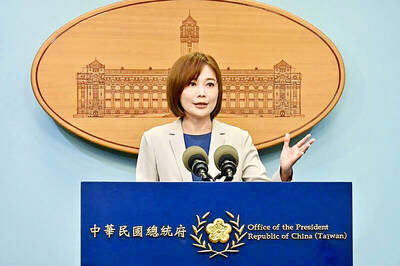
TIT-FOR-TAT: The US allegedly revoked the visa of a Chinese national working at Xinhua News Agency in the US in response to Beijing’s expulsion of Vivian Wang The Presidential Office yesterday condemned China for expelling a New York Times correspondent from Beijing following the newspaper’s interview with President William Lai (賴清德), saying the move highlighted Beijing’s suppression of press freedom and its threat to international news media. Taiwan has noted a series of recent incidents in which Beijing used similar tactics to “threaten and pressure international media outlets and journalists,” Presidential Office spokeswoman Karen Kuo (郭雅慧) said in a statement. “This concerns not only press freedom and freedom of expression, but also the safety of journalists, and Taiwan and relevant partners are paying close attention to the situation,” she
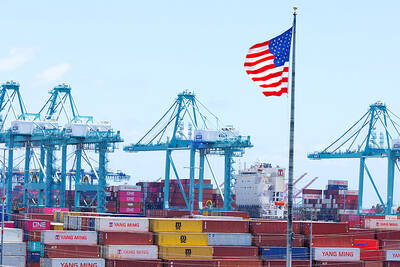
NOT IMMEDIATE: Taiwan has a chance to appeal the proposed 10 percent tariff before it starts, while other countries face a 12.5 percent tariff from the trade office Taiwan is among 60 economies determined by the US to have failed to impose or enforce a ban on the importation of goods produced with forced labor, according to a notice released on Tuesday by the Office of the US Trade Representative (USTR), which proposed imposing an additional 10 percent or more tariff on them. The USTR in a statement said that following an investigation, it had determined under Section 301 of the Trade Act of 1974 that the failure of the 60 economies to impose and effectively enforce a prohibition on the importation of goods produced with forced labor is


 RSS
RSS