


Thousands of volunteers around the nation yesterday cleaned streets in different cities as a prelude to "National Cleanup Week," an annual project for the leadup to the Lunar New Year designed by the Environmental Protection Administration (EPA). The project begins tomorrow and lasts until Feb. 7.
According to the tradition, people usually throw away filthy articles and unwanted pieces of furniture prior to the arrival of Lunar New Year in order to bring good luck and make a whole new beginning for the next year.
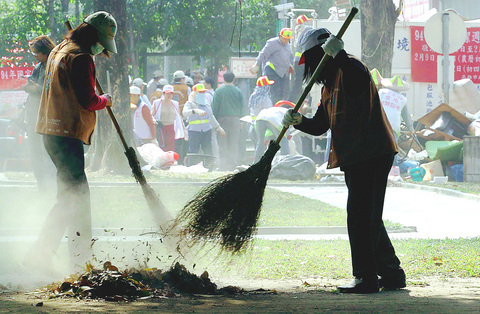
PHOTO: CHANG CHUNG-YI, TAIPEI TIMES
The warm-up cleanup task was carried out in Kaohsiung City, Kaohsiung County, Taichung City, Changhua County, and Taipei County.
In Kaohsiung City, Environmental Protection Administrator Chang Juu-en (張祖恩) and premier-designate Frank Hsieh (謝長廷) led high-ranking officials in reminding residents of the importance of keeping the environment neat.
During the cleanup week, local governments will provide the free service of taking away large pieces of unwanted furniture.
According to Chang, keeping streets neat and clean is one indicator of a country's degree of modernization.
"Efforts to keep the environment neat should be made continuously," Chang said. "In addition to the cleanup prior to Lunar New Year, residents should repeat this regular cleanup activity promoted by local governments on the first Saturday of every month."
Yesterday, Chang visited hundreds of volunteers working on the environmental cleanup in different communities.
He stressed that in this year's cleanup program, the role played by the public in fighting dengue fever in the south was highlighted.
Residents in Kaohsiung yesterday were urged by environmental officials to diligently clean up possible breeding sites for mosquitoes, which are responsible for spreading the disease.
Hsieh said that the city has put a lot of effort into fighting the spread of dengue fever.
"We should seize the wintertime, when lower temperatures make it less suitable for the mosquito to breed, to remove as many breeding grounds as possible," Hsieh said.
Officials urged the public to throw away all unwanted containers, which could become ideal breeding sites when water accumulates in them.
Hsieh also stressed yesterday that he would work hard to ensure that Kaohsiung residents have a comfortable Lunar New Year holiday in terms of traffic control and security.
EPA officials said yesterday that each local community should take responsibility for the cleanliness of an entire area within 4km of its borough office. That way, the cleanliness narrow alleys, small lanes, and escape canals can be ensured, they said.
Also see story:

‘NO SECURITY RISK’: The Railway Bureau reassured the public that the technicians’ activities were limited to technical guidance and did not involve sensitive systems The Railway Bureau yesterday said it had invited eight Chinese technicians to assist with an airport MRT construction project. The bureau issued the confirmation after an Internet user said Chinese nationals had entered the construction zone of Taiwan Taoyuan International Airport’s Terminal 3 project. They asked why “individuals from an enemy state” were allowed access to such a major national infrastructure project, which raised serious concerns over Taiwan’s industrial safety, sensitive systems and information security. The bureau’s Northern Region Engineering Branch Office said subcontractor Taiwan Handle Industrial Co (台灣手把工業) of the Taoyuan airport MRT’s “Contract No. CU05 Project A14 Station Civil, MEP &

The National Chungshan Institute of Science and Technology yesterday showcased its locally developed variants of the Vision 60 robotic patrol dog, which it plans to deploy on the nation’s outlying territories in the South China Sea. The variants were produced under the Joint Lab project — created by the institute and domestic companies — and assembled with domestically produced motors, lenses and artificial intelligence (AI) systems alongside licensed tech from the US, Missile and Rocket Systems Research Division deputy director Jen Kuo-kang (任國光) told the media event at a military base in Taipei’s Dazhi (大直) area. Taiwan has built up its strengths

NOT IMMEDIATE: Taiwan has a chance to appeal the proposed 10 percent tariff before it starts, while other countries face a 12.5 percent tariff from the trade office Taiwan is among 60 economies determined by the US to have failed to impose or enforce a ban on the importation of goods produced with forced labor, according to a notice released on Tuesday by the Office of the US Trade Representative (USTR), which proposed imposing an additional 10 percent or more tariff on them. The USTR in a statement said that following an investigation, it had determined under Section 301 of the Trade Act of 1974 that the failure of the 60 economies to impose and effectively enforce a prohibition on the importation of goods produced with forced labor is

RIGHT DIRECTION: Taiwan’s efforts to prevent forced labor include a proposal to ‘fully prohibit’ employers from withholding workers’ documents, an official said Taiwan is to establish a mechanism to restrict imports of goods linked to forced labor, the Executive Yuan said yesterday, after the US proposed imposing additional tariffs on Taiwanese goods over labor concerns. “The Ministry of Labor and the Ministry of Economic Affairs are to establish an interministerial review procedure,” Executive Yuan spokesperson Michelle Lee (李慧芝) said at a news briefing in Taipei. “The government is to use the Foreign Trade Act [貿易法] as the legal basis to restrict imports of goods produced with forced labor” and bring its supply chain governance more in line with international standards on human rights, resilience


 RSS
RSS