


The Bush administration on Wednesday moved to quell concerns over remarks earlier in the week by US Deputy Secretary of State Richard Armitage by saying that he had simply reiterated existing Taiwan policy in different language.
But Armitage's statement that the US was not legally bound to defend Taiwan against a Chinese attack has prompted a frenzied round of speculation among China watchers and Taiwan supporters in the US capital.
State Department spokesman Richard Boucher said all Armitage had done was to "restate US policy in very familiar terms."
But Boucher stopped short of saying that US policy toward Taiwan was unchanged, a normal mantra the department repeats when questioned about comments made by senior officials that appear inconsistent with administration policy.
Meanwhile, China and Taiwan specialists in Washington appear divided on the implications of Armitage's remarks.
During an interview on Monday on the PBS network, Armitage said that the Taiwan Relations Act (TRA) did not require the US to defend Taiwan in case of Chinese military action, and that it only committed Washington to sell defensive arms to Taiwan and maintain sufficient force to deter a Chinese attack.
"We are not required to defend," he said.
He also stated that the decision to defend Taiwan rests not with the administration, but with Congress, and said Taiwan was emerging as a "landmine" in US-China relations,
Further, he said, "we all agree that there is but one China, and Taiwan is part of China."
The last remark reminded many observers of Secretary of State Colin Powell's recent statement that the US supported reunification of Taiwan with China, a statement Powell later distanced himself from.
However, several leading China watchers in the US say that Armitage's statements simply reflected reality and were a proper reading of the Taiwan Relations Act.
"It is a fact," said Bonnie Glaser, an expert on US-Taiwan-China relations.
"He didn't embellish US policy, he did not misstate US policy. He stated the facts," Glaser said.
"I don't think that this is an attempt to signal China that if Taiwan takes provocative action and you use force, that the US is not going to come to Taiwan's defense," she said.
For several months, some China specialists have speculated that the Bush administration has gone back on its earlier firm support of Taiwan, and now feels that the US is not committed to defend Taiwan against China under all circumstances.
Soon after taking office, Bush declared in an April 2001 TV interview that his administration would do "whatever it took" to help defend Taiwan.
That position was reiterated last December after Bush's White House meeting with Chinese Premier Wen Jiabao (溫家寶), in which Bush publicly berated President Chen Shui-bian (陳水扁) for pushing an election-day referendum.
After the meeting with Wen, however, a high-level official told reporters that the "whatever it took" policy still stood.
And as recently as July, the commander of US forces in the Pacific, Admiral Thomas Fargo, backed that stance when meeting top Chinese officials in Beijing.
Glaser said she was told as much by Chinese analysts during a visit to Beijing in August, shortly after Fargo's trip.
The administration has sent "clear signals" to the Chinese that "there is no circumstance to which it can use force and the US would look the other way ... that Washington would not tolerate any force by China," she said.
During Fargo's talks with the officials, "that was one of the messages he conveyed quite clearly," the Chinese analysts told Glaser.
But Armitage's remarks have highlighted a feeling in recent weeks that the administration is backing down from its earlier, unequivocally pro-Taiwan stance.
The remarks "underscore the steady deterioration of US/Taiwan relations under the Bush/Chen administrations since 2001," said this week's edition of the influential inside-Washington newsletter, the Nelson Report.
"Clearly, a player as sophisticated as Armitage knows the difference between misstatements and nuance in singing the `one China mantra,'" editor Chris Nelson wrote, especially in view of Powell's earlier statement.
Indeed, Nelson wrote, Bush "himself has led a concerted effort to make it clear to Taipei that the US almost certainly will not defend the island if it is the actions of Taiwan which seemingly provoked a Chinese attack."
Nevertheless, he wrote, "the Bush administration is not `abandoning' Taiwan," but that the trend under Bush is that the administration has worked actively "to res-train what it sees as the dangerous tendencies of Chen Shui-bian and the pro-independence political factions on Taiwan."
In his comments to reporters on Wednesday, Boucher reiterated US support for renewed cross-strait dialogue.
"It's an issue we spend a lot of time working on, and we try to help people move towards a peaceful dialogue and a peaceful resolution of the issues," he said.
He said he did not know whether the administration was holding discussions with Taiwan's officials on the remark by Armitage.
Taiwan's Foreign Ministry on Wednesday said that it would ask its top representative in Washington, David Lee (李大維), to seek official clarification of Armitage's remarks.
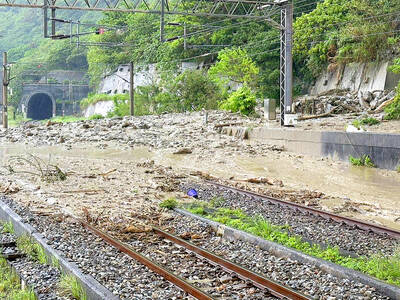
ROLLER-COASTER RIDE: More than five earthquakes ranging from magnitude 4.4 to 5.5 on the Richter scale shook eastern Taiwan in rapid succession yesterday afternoon Back-to-back weather fronts are forecast to hit Taiwan this week, resulting in rain across the nation in the coming days, the Central Weather Administration said yesterday, as it also warned residents in mountainous regions to be wary of landslides and rockfalls. As the first front approached, sporadic rainfall began in central and northern parts of Taiwan yesterday, the agency said, adding that rain is forecast to intensify in those regions today, while brief showers would also affect other parts of the nation. A second weather system is forecast to arrive on Thursday, bringing additional rain to the whole nation until Sunday, it
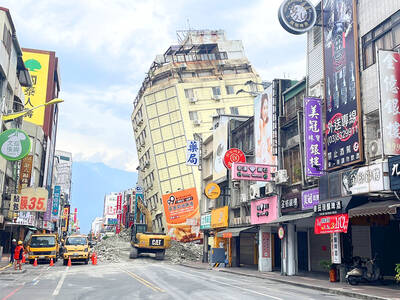
LANDSLIDES POSSIBLE: The agency advised the public to avoid visiting mountainous regions due to more expected aftershocks and rainfall from a series of weather fronts A series of earthquakes over the past few days were likely aftershocks of the April 3 earthquake in Hualien County, with further aftershocks to be expected for up to a year, the Central Weather Administration (CWA) said yesterday. Based on the nation’s experience after the quake on Sept. 21, 1999, more aftershocks are possible over the next six months to a year, the agency said. A total of 103 earthquakes of magnitude 4 on the local magnitude scale or higher hit Hualien County from 5:08pm on Monday to 10:27am yesterday, with 27 of them exceeding magnitude 5. They included two, of magnitude
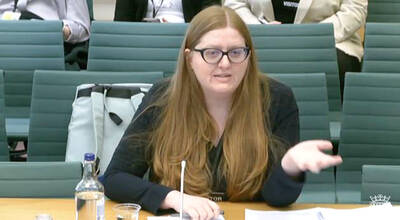
CONDITIONAL: The PRC imposes secret requirements that the funding it provides cannot be spent in states with diplomatic relations with Taiwan, Emma Reilly said China has been bribing UN officials to obtain “special benefits” and to block funding from countries that have diplomatic ties with Taiwan, a former UN employee told the British House of Commons on Tuesday. At a House of Commons Foreign Affairs Committee hearing into “international relations within the multilateral system,” former Office of the UN High Commissioner for Human Rights (OHCHR) employee Emma Reilly said in a written statement that “Beijing paid bribes to the two successive Presidents of the [UN] General Assembly” during the two-year negotiation of the Sustainable Development Goals. Another way China exercises influence within the UN Secretariat is

Taiwan’s first drag queen to compete on the internationally acclaimed RuPaul’s Drag Race, Nymphia Wind (妮妃雅), was on Friday crowned the “Next Drag Superstar.” Dressed in a sparkling banana dress, Nymphia Wind swept onto the stage for the final, and stole the show. “Taiwan this is for you,” she said right after show host RuPaul announced her as the winner. “To those who feel like they don’t belong, just remember to live fearlessly and to live their truth,” she said on stage. One of the frontrunners for the past 15 episodes, the 28-year-old breezed through to the final after weeks of showcasing her unique


 RSS
RSS