


President Chen Shui-bian (陳水扁) is expected to step down as chairman of the Democratic Progressive Party (DPP) today to shoulder responsibility for the pan-green camp's failure to win a legislative majority in Saturday's poll.
"The president will tender his resignation before [today's] weekly Central Standing Committee meeting to assume full responsibility for the election," DPP legislative caucus leader Ker Chien-ming (柯建銘) told reporters after speaking with Chen at the Presidential Office last night. "The resignation of party officials and their replacements will be dealt with by the new chairman."
It is understood that the acting chairman will be elected from among the members of the Central Standing Committee.
Chen remained in the Presidential Office yesterday morning and canceled all afternoon activities. He called in party heavyweights to the Presidential Office for talks in the afternoon.
They included Vice President Annette Lu (
DPP members have been calling for Chen's resignation as party chairman since Saturday night.
"If he can't be held responsible, who can?" asked DPP Legislator Tony Jian (
Jian attributed the party's lackluster performance to Chen's choice of campaign topics and slogans.
"Take the `soft coup' theory for example. Hadn't he wanted harmony between the ruling and opposition parties and didn't he keep calling for reconciliation with them?" he asked. "His provocative and aggressive approach to the campaign simply made centrist voters so sick and tired of the party that they decided not to cast their ballots."
Jian said that party operations would not be interrupted even if Chen did resign from the chairmanship, because Central Standing Committee members were the highest decision-making body in the party.
Echoing Jian's argument, DPP Legislator Lee Chun-yee (
"Nobody wants the president to step down from the presidency but he should quit the [chairmanship] and take full responsibility for defeat in accordance with party tradition," he said.
DPP Legislator Lin Yu-sheng (
"If he has any political wisdom, he should relinquish control and let younger talent take over at the party's helm," he said.
Saying the issue was sensitive, unseated DPP Legislator Chiu Chui-chen (
The DPP nominated seven candidates and the Taiwan Solidarity Union (TSU) nominated two candidates in Chiu's electorate of Taoyuan County, but together the pan-green camp won only five of the 13 seats. The pan-blue camp nominated 10 and eight were elected.
When asked by the media yesterday if Chen or Yu should be held responsible for the election, Annette Lu said that it was unfair to ask individuals to assume all of the responsibility for the election when the matter still required thorough examination.

The Tourism Administration yesterday announced that it would reward repeat international visitors with incentives of up to NT$8,000 to boost inbound tourism. The incentives are available to all international tourists, it said, adding that repeat visitors would be rewarded with NT$5,000 and would receive an additional NT$3,000 if they bring travel companions. The nation received 2,990,657 inbound visitors during the first quarter, marking a 3.8 percent increase from the same period last year, agency data showed. Japanese nationals are among groups visiting Taiwan the most. About 1.48 million Japanese tourists arrived last year, a year-on-year increase of more than 12
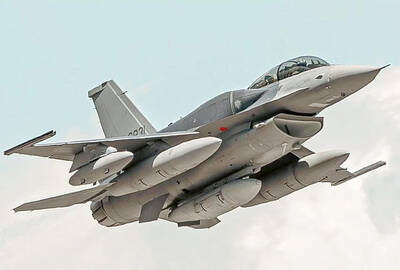
66 FIGHTER JETS: The aircraft is likely undergoing preparations for its transfer to Taiwan — a significant step forward in the nation’s modernization program, a lawmaker said The first of Taiwan’s order of F-16V Block 70 aircraft has been sighted in Texas ahead of delivery, Democratic Progressive Party (DPP) Legislator Wang Ting-yu (王定宇) said. Taiwan’s first F-16V Block 70 two-seat aircraft, tail number 6831, was seen flying from Lockheed Martin’s production facility in Greenville, South Carolina, to Naval Air Station Joint Reserve Base Fort Worth in Texas, Wang wrote on Facebook yesterday. The plane is likely undergoing preparations for its transfer to Taiwan, marking a significant step forward in the Republic of China Air Force’s modernization program, Wang said, citing military analysts. The F-16V Block 70 is a new-build version
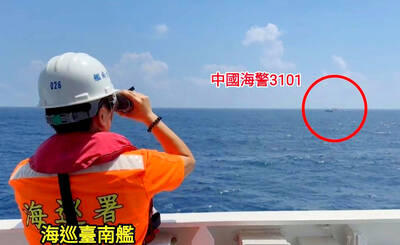
‘BRAZEN’: The holiday did not stop China from activities that infringe on Taiwan’s maritime jurisdiction, but the CGA is ready to defend the nation, Kuan Bi-ling said Beijing is intensifying maritime pressure on Taiwan, but the nation will never yield, Ocean Affairs Council Deputy Minister Sung Chen-en (宋承恩) said. The Coast Guard Administration (CGA) has adopted a “shadowing and monitoring” approach to avoid falling into a Chinese trap to escalate tensions and deepen the conflict, Sung said in an interview published yesterday in the Chinese-language Liberty Times (the Taipei Times’ sister newspaper). China Coast Guard formations patrolling waters east of Taiwan, as well as official Chinese vessels entering areas around Itu Aba Island (Taiping Island, 太平島) and Pratas Islands (Dongsha Islands, 東沙群島) show Beijing’s attempts to significantly step up
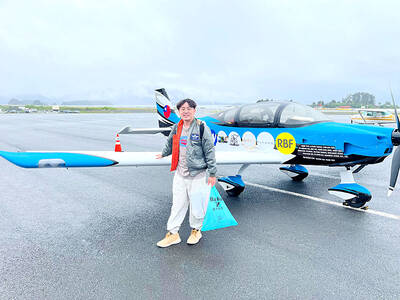
Taiwanese aviator Roger Lin (林睿哲) returned to Taiwan on Saturday after completing a nine-day round-the-world journey in a single-engine aircraft, becoming the first Taiwanese pilot to achieve the feat. Lin departed on June 5 from Los Angeles, California, and continued through Alaska, Japan, Taiwan, the Philippines, Indonesia, Malaysia, Thailand, Nepal, Jordan, Norway, Iceland and Canada before landing at the Taipei International Airport (Songshan) via Los Angeles and Japan. Lin shared numerous photos and videos of his journey on a Facebook page titled “Pilot Roger’s Around the World Flight,” including a video showing his aircraft flying over the Danjiang Bridge and


 RSS
RSS