


A car bomb exploded yesterday near the Ministry of Education in a busy commercial area in northern Baghdad, killing at least eight people, according to the Interior Ministry and hospital officials.
The blast in the mainly Sunni Adhamiya district badly damaged the Education Ministry building and destroyed 31 cars. The body of an elderly man lay on the ground on fire after the explosion, which scattered body parts across the street.
The bomb exploded in a side-street near a ministry building wall at about 9:30am, gouging a big crater in the tarmac. Water from burst pipes flooded the street.
Interior Ministry spokesman Colonel Adnan Abdul-Rahman said the blast was caused by a car bomb.
Hospital officials said a woman was among the dead and a child was among the wounded.
Among the casualties was Abbas Kadhim, 32, who was hit in the stomach by fragments of concrete as he sat in his car.
He wept after being treated at the nearby Noman hospital.
"I'm not crying because I'm wounded, but because of my brother. I was with him and I don't know what happened to him," he said.
There was no immediate claim of responsibility for the attack.
Insurgents also captured a US soldier in the city of Samarra, north of Baghdad, an Iraqi police spokesman said yesterday.
Lieutenant Colonel Mohammed Ahmed told reporters the soldier had been seized on Monday night by gunmen in two Opel cars. He said US troops were out in force in the streets of the Sunni Muslim city yesterday.
A US military spokesman said he had no information on the incident. Ahmed said the Americans had alerted Iraqi security forces and asked them to look out for the missing soldier.
In other developments, saboteurs also mounted the biggest attacks yet on Iraq's oil infrastructure, blowing up three pipelines in the north on Monday night and halting exports via Turkey, oil officials said.
A roadside bomb exploded near a convoy of Iraqi National Guard vehicles near Abu Ghraib, in Baghdad's western outskirts, wounding two guardsmen, an Interior Ministry spokesman said.
The US military said an air strike on Monday night had destroyed an arms cache in a southeastern part of Falluja. Hospital officials said five people were wounded in the raid.
US Marines are poised for a new offensive against Falluja and its sister city of Ramadi, where hospital staff said 10 people were killed and nine wounded in clashes on Monday.
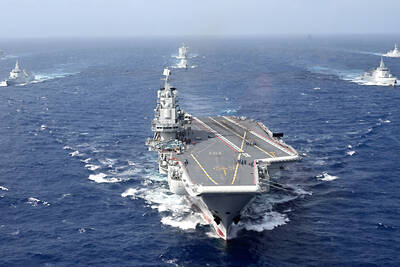
PROVOCATIVE: Chinese Deputy Ambassador to the UN Sun Lei accused Japan of sending military vessels to deliberately provoke tensions in the Taiwan Strait China denounced remarks by Japan and the EU about the South China Sea at a UN Security Council meeting on Monday, and accused Tokyo of provocative behavior in the Taiwan Strait and planning military expansion. Ayano Kunimitsu, a Japanese vice foreign minister, told the Council meeting on maritime security that Tokyo was seriously concerned about the situation in the East China and South China seas, and reiterated Japan’s opposition to any attempt to change the “status quo” by force, and obstruction of freedom of navigation and overflight. Stavros Lambrinidis, head of the EU delegation to the UN, also highlighted South China Sea
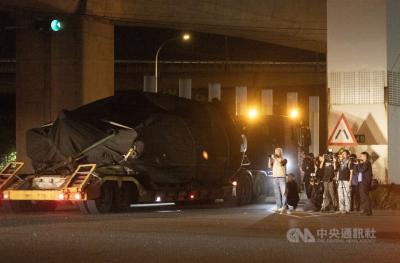
The final batch of 28 M1A2T Abrams tanks purchased from the US arrived at Taipei Port last night and were transported to the Armor Training Command in Hsinchu County’s Hukou Township (湖口), completing the military’s multi-year procurement of 108 of the tanks. Starting at 12:10am today, reporters observed more than a dozen civilian flatbed trailers departing from Taipei Port, each carrying an M1A2T tank covered with black waterproof tarps. Escorted by military vehicles, the convoy traveled via the West Coast Expressway to the Armor Training Command, with police implementing traffic control. The army operates about 1,000 tanks, including CM-11 Brave Tiger
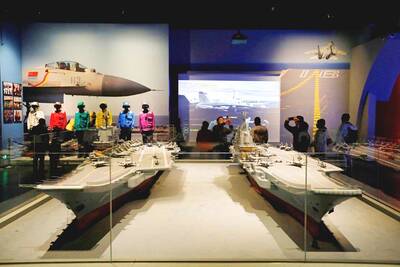
China on Wednesday teased in a video an aircraft carrier that could be its fourth, and the first using nuclear power, while making an allusion to Taiwan and vowing to further build up its islands, as it looks to boost maritime power, secure resources and bolster territorial claims. The video, issued on the eve of the 77th founding anniversary of the Chinese People’s Liberation Army Navy, featured fictional officers with names that are homophones of three commissioned aircraft carriers, the Liaoning (遼寧), Shandong (山東) and Fujian (福建). Titled Into the Deep, it showed a 19-year-old named “Hejian” (何劍) joining the group, sparking
Taiwan Semiconductor Manufacturing Co (TSMC, 台積電), the world’s largest contract chipmaker, said it expects its 2-nanometer (2nm) chip capacity to grow at a compound annual rate of 70 percent from this year to 2028. The projection comes as five fabs begin volume production of 2-nanometer chips this year — two in Hsinchu and three in Kaohsiung — TSMC senior vice president and deputy cochief operating officer Cliff Hou (侯永清) said at the company’s annual technology symposium in Silicon Valley, California, last week. Output in the first year of 2-nanometer production, which began in the fourth quarter of last year, is expected to


 RSS
RSS