


Oil prices stayed near historic peaks at US$51 a barrel in Asian trading yesterday as analysts warned US$60 was "within reach" if the northern winter turns out colder than expected.
At 3:50pm, the benchmark light sweet crude for November delivery was at US$50.97 a barrel, down from its record close of US$51.09 at the New York Mercantile Exchange on Tuesday.
"If the winter turns out to be colder than anticipated, the markets will run," said Esa Ramasamy, director for Asian oil markets reporting at Platts, an energy agency whose analyses are widely used as benchmarks for international spot trading.
"If this happens, you will see 55 dollars as not a problem any more. It becomes a reality and US$60 dollars is within reach,"Ramasamy said.
The winter months in the northern hemisphere traditionally drive up demand for kerosene and diesel, which are used for heating.
Ramasamy said refineries have already started building up their inventories for diesel and kerosene, leading to a sharp rise in demand.
"No refinery will keep low on inventories in winter. And because the refining margin is so good, every refinery is running full capacity, and once that happens there is a natural demand for crude," he said.
On the flip side, Ramasamy said a warmer than expected winter should cause prices to fall due to the high level of inventories.
Ng Weng Hong, editor of industry publication EnergyAsia.com, agreed that a colder winter than expected will further drive prices up, with the continued violence in Iraq and other potential disruptions to oil supplies contributing to the volatility.
"It's going to go up, it's going to be one-way traffic," he said.
"I think the immediate target is US$55 but whether we hit it or not is another matter," he said.
"Winter is coming in North America and geopolitical problems have not been solved. All you need is a couple of terrorists to inflict effective damage on a pipeline and this will shake up the market further," he said.
Ng also noted that, even at US$50 a barrel, there has been no let-up in oil demand.
The high prices, instead of dampening demand, have sparked panic buying and further pushed prices higher, he added.
"There are more guys buying because they think it's going to go to US$60 a barrel. Nobody is letting up," he said.
Ng disputed arguments by some analysts that current prices were in reality lower than levels seen during the oil shock in the 1970s and 1980s if inflation was factored in.
"We're going to be in for a very serious shock. This is giving a lot of false comfort because the conditions now compared with the conditions then are very different," he said.
"Back in the '70s and '80s, there was no China or India factor to look at. There was a lot of spare capacity then," he said
China's huge demand for fuel to power its rapidly growing ecomony is soaking up supply, while more oil is needed to meet the requirements of India's own economic growth, analysts say.
Ramasamy also said speculators had a role to play in driving prices higher.
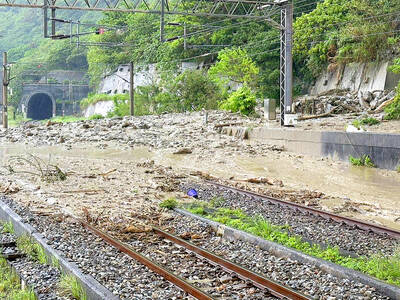
ROLLER-COASTER RIDE: More than five earthquakes ranging from magnitude 4.4 to 5.5 on the Richter scale shook eastern Taiwan in rapid succession yesterday afternoon Back-to-back weather fronts are forecast to hit Taiwan this week, resulting in rain across the nation in the coming days, the Central Weather Administration said yesterday, as it also warned residents in mountainous regions to be wary of landslides and rockfalls. As the first front approached, sporadic rainfall began in central and northern parts of Taiwan yesterday, the agency said, adding that rain is forecast to intensify in those regions today, while brief showers would also affect other parts of the nation. A second weather system is forecast to arrive on Thursday, bringing additional rain to the whole nation until Sunday, it

LANDSLIDES POSSIBLE: The agency advised the public to avoid visiting mountainous regions due to more expected aftershocks and rainfall from a series of weather fronts A series of earthquakes over the past few days were likely aftershocks of the April 3 earthquake in Hualien County, with further aftershocks to be expected for up to a year, the Central Weather Administration (CWA) said yesterday. Based on the nation’s experience after the quake on Sept. 21, 1999, more aftershocks are possible over the next six months to a year, the agency said. A total of 103 earthquakes of magnitude 4 on the local magnitude scale or higher hit Hualien County from 5:08pm on Monday to 10:27am yesterday, with 27 of them exceeding magnitude 5. They included two, of magnitude

CONDITIONAL: The PRC imposes secret requirements that the funding it provides cannot be spent in states with diplomatic relations with Taiwan, Emma Reilly said China has been bribing UN officials to obtain “special benefits” and to block funding from countries that have diplomatic ties with Taiwan, a former UN employee told the British House of Commons on Tuesday. At a House of Commons Foreign Affairs Committee hearing into “international relations within the multilateral system,” former Office of the UN High Commissioner for Human Rights (OHCHR) employee Emma Reilly said in a written statement that “Beijing paid bribes to the two successive Presidents of the [UN] General Assembly” during the two-year negotiation of the Sustainable Development Goals. Another way China exercises influence within the UN Secretariat is

Taiwan’s first drag queen to compete on the internationally acclaimed RuPaul’s Drag Race, Nymphia Wind (妮妃雅), was on Friday crowned the “Next Drag Superstar.” Dressed in a sparkling banana dress, Nymphia Wind swept onto the stage for the final, and stole the show. “Taiwan this is for you,” she said right after show host RuPaul announced her as the winner. “To those who feel like they don’t belong, just remember to live fearlessly and to live their truth,” she said on stage. One of the frontrunners for the past 15 episodes, the 28-year-old breezed through to the final after weeks of showcasing her unique


 RSS
RSS