


Former legislative speaker and People First Party (PFP) Legislator Liu Sung-fan (劉松藩) yesterday resigned his seat after the Taiwan High Court's Taichung Branch sentenced him to four years in jail for corruption.
"[Lu's] resignation is in accordance with the appropriate procedures and has been referred to the Central Election Commission," Legislative Speaker Wang Jin-pyng (
Liu is understood to have instructed his staff to submit a letter of resignation in his absence.
In addition to the jail time, Liu has been given a NT$30 million fine. The verdict cannot be appealed.
The court said that Liu received NT$150 million in kickbacks from Tseng Cheng-jen (曾正仁), president of the Kuangsan Enterprise Group and chairman of the board at the Taichung Business Bank, a Kuangsan subsidiary.
Tseng was sentenced to 11 years' imprisonment in June. Upon learning of the verdict, Tseng fled the country with his wife. He is thought to be living in Shanghai.
The court yesterday issued an order preventing Liu from leaving the country. But Liu has been reported to be attending the Republican Party convention in the US.
"If Liu isn't in Taiwan, we hope that he will return to serve his sentence. If the sentence cannot be executed, a warrant will be issued for his arrest and will be valid for 15 years," court spokesman Chen Chi-kang (
In October 1992, Liu became president of the Bank of Taichung -- later renamed the Taichung Business Bank -- until October 1998, when Tseng took over the position.
Taichung prosecutors alleged in 2001 that Tseng had abused his position as president of the bank in November 1998 to push through loans worth more than NT$9 billion. He also kept dummy accounts in six companies to facilitate the illegal transactions.
The court yesterday determined that Liu had served as a middleman in these activities. Liu conspired with a private firm, the Chihching Company, to harbor one of Tseng's dummy accounts. The company, which at the time only had capital of NT$2 million, managed to secure a loan of NT$1.5 billion from Taichung Business Bank.
In return, Liu was paid NT$150 million as a kickback.
According to a Chinese-language newspaper report, Liu claimed that when the Chihching loan was secured, he was not holding any position at the Taichung Business Bank and was therefore not able to have any influence on the board's decision to grant the loan.
Liu had also claimed that the NT$150 million check he received from Tseng was money borrowed personally from Tseng for his election campaign fund.
As Liu is a legislator-at-large, the PFP will be able to replace him with another party member.
The next candidate on the PFP's legislator-at-large list for this legislative term is Chen Fei-lung (陳飛龍), the chairman of the Namchow Group.
The candidate following Chen is PFP Chairman James Soong (
Additional reporting by Debby Wu
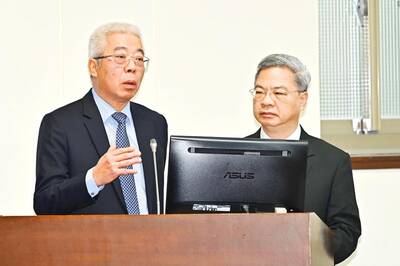
Taiwan has arranged for about 8 million barrels of crude oil, or about one-third of its monthly needs, to be shipped from the Red Sea this month to bypass the Strait of Hormuz and ease domestic supply pressures, CPC Corp, Taiwan (CPC, 台灣中油) said yesterday. The state-run oil company has worked with Middle Eastern suppliers to secure routes other than the Strait of Hormuz, through which about 20 percent of the world’s oil and liquefied natural gas typically passes, CPC chairman Fang Jeng-zen (方振仁) said at a meeting of the legislature’s Economics Committee in Taipei. Suppliers in Saudi Arabia have indicated they
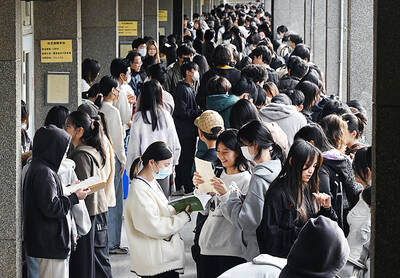
A global survey showed that 60 percent of Taiwanese had attained higher education, second only to Canada, the Ministry of the Interior said. Taiwan easily surpassed the global average of 43 percent and ranked ahead of major economies, including Japan, South Korea and the US, data from the Organisation for Economic Co-operation and Development (OECD) for 2024 showed. Taiwan has a high literacy rate, data released by the ministry showed. As of the end of last year, Taiwan had 20.617 million people aged 15 or older, accounting for 88.5 percent of the total population, with a literacy rate of 99.4 percent, the data
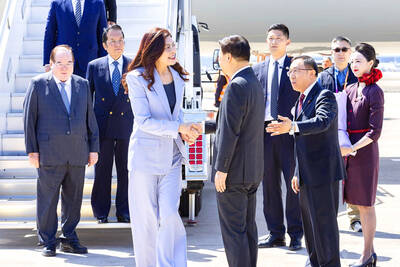
CCP ‘PAWN’? Beijing could use the KMT chairwoman’s visit to signal to the world that many people in Taiwan support the ‘one China’ principle, an academic said Chinese Nationalist Party (KMT) Chairwoman Cheng Li-wun (鄭麗文) yesterday arrived in China for a “peace” mission and potential meeting with Chinese President Xi Jinping (習近平), while a Taiwanese minister detailed the number of Chinese warships currently deployed around the nation. Cheng is visiting at a time of increased Chinese military pressure on Taiwan, as the opposition-dominated Legislative Yuan stalls a government plan for US$40 billion in extra defense spending. Speaking to reporters before going to the airport, Cheng said she was going on a “historic journey for peace,” but added that some people felt uneasy about her trip. “If you truly love Taiwan,

South Korea has adjusted its electronic arrival card system to no longer list Taiwan as a part of China, a move that the Ministry of Foreign Affairs said would help facilitate exchanges between the two sides. South Korea previously listed “Taiwan” as “Taiwan (China)” in the drop-down menus of its online arrival card system, where people had to fill out where they came from and their next destination. The ministry had requested South Korea make a revision and said it would change South Korea’s name on Taiwan’s online immigration system from “Republic of Korea” to “Korea (South),” should the issue not be


 RSS
RSS