


US Marines backed by tanks and aircraft seized the heart of the holy Iraqi city of Najaf yesterday in a major assault on Shiite rebels, but they kept out of a site sacred to millions of Shiites around the world.
Warplanes and attack helicopters pounded militia positions in a cemetery near the Imam Ali Mosque, igniting protests in at least two other cities as an uprising that has killed hundreds across southern and central Iraq entered its second week.

PHOTO: REUTERS
The assault against the Mehdi Army of radical cleric Moqtada al-Sadr and growing anger among the majority Shiite community could spark a firestorm for interim Prime Minister Ayad Allawi should holy sites be damaged or the death toll escalate.
Thick black smoke poured into the sky as helicopters skimmed mud-brick rooftops in the heart of Najaf. Soon after midday, Marines controlled the city center and had blocked entry to the mosque, one of Shiite Islam's holiest sites, a witness said.
In the southeastern city of Kut, at least 72 people were killed in US air raids and fighting between Iraqi police and the Mehdi Army yesterday, the Health Ministry said.
It said 25 people were killed in clashes in Baghdad and 21 in other cities in the past 24 hours. There were no immediate casualty figures from the Najaf offensive.
Protests broke out in Baghdad and the southern city of Basra after the offensive began, aimed at crushing the heart of a radical Shiite Muslim rebellion that has hit seven cities.
The US military said the assault would exclude the Imam Ali Mosque. A spokesman for Iraq's Interior Ministry told CNN that Iraqi forces alone would disarm militia holed up inside.
But the Mehdi Army raised the prospect of a bloody battle, vowing no surrender and saying Sadr was leading the defence at the shrine and vast cemetery, one of the Middle East's largest.
"The morale of the fighters is very high," said Ahmed al-Shibani, a senior Sadr spokesman in Najaf.
US Marines made clear their intentions, broadcasting a message in Arabic from Humvees that said: "To the residents of Najaf: Coalition forces are purging the city of the Mehdi Army."
A threat by Sadr's militia kept a main southern oil export pipeline shut on Thursday although crews had repaired it after sabotage stopped operations for three days, an official said.
A senior official from Sadr's Mehdi Army, Sheikh Asaad al-Basri, had warned that militiamen would blow up pipelines in the south if US forces tried to storm their Najaf bases.
Militiamen responded to the American assault in Najaf with rocket-propelled grenades and mortar bombs, firing at times from inside the walls of the Imam Ali Mosque.
Witnesses said thousands of civilians fled the centre of the southern city. The US military said the figure was much lower. Some residents escaped on carts pulled by donkeys and by late morning many streets were deserted.
Analysts warned of a backlash even if the shrine was undamaged and the militia beaten in Najaf. They said resentment could fester and pose long-term consequences for Allawi, who has said nothing publicly on the crisis since Sunday.
Some 2,000 US servicemen and 1,800 Iraq security men are deployed around Najaf, a city of 600,000 about 160km south of Baghdad.
As news of the offensive filtered in, thousands of Shiites took to the streets in Basra and a Baghdad district to protest.
"Long live Sadr, America and Allawi are infidels," thousands of protesters in Basra chanted. A similar protest took place in Baghdad's Shiite neighbourhood of Kadhimiyah.
A photographer said he had seen dozens of dead militiamen in civilian houses in Najaf. He said the bodies had been taken from the battle zone and covered in ice to preserve them before burial. It was unclear when they had been killed.
Iraq's most influential Shiite cleric, who is in London undergoing medical treatment, called for the holy city of Najaf, his hometown, to be respected, an aide said.
"Ayatollah Ali al-Sistani is pained and very sad about what is happening in holy Najaf," Murtada al-Kashmiri told reporters.
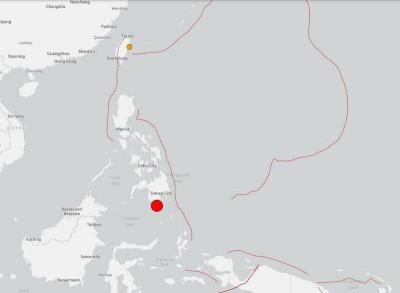
A magnitude 7.8 earthquake struck off the southern coast of Mindanao in the Philippines at 7:38am today, prompting the US Tsunami Warning System to issue an alert for neighboring countries, including Taiwan. The system issued a purple alert indicating a "tsunami threat." The potential threat zone includes Taiwan, the Philippines, Papua New Guinea, Yap and Palau. Philippine authorities were assessing the damage from the quake, with the office of civil defense seeking to verifying initial reports that 15 people had been killed and 129 injured in the region, mostly from falling debris. Arlene Hollero, disaster chief of Maasim town in the Philippines' Sarangani Province,
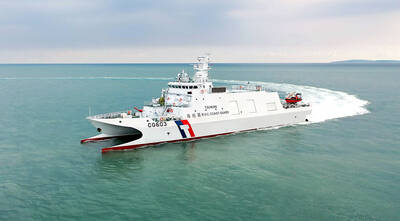
‘GRAY ZONE’ PRESSURE: Beijing’s activities are intended to create the deceitful impression that China has jurisdiction over the area around Taiwan, the CGA said Taiwan’s rights over its territorial waters and exclusive economic zone must not be violated by any country, the Mainland Affairs Council said yesterday, adding that it will not accept any unprovoked actions. The council issued the remarks in response to the China Coast Guard conducting maritime enforcement drills near eastern Taiwan and claiming to fully exercise China’s maritime administrative law enforcement authority. The Coast Guard Administration (CGA) has been closely monitoring the situation and is taking concrete steps to defend the nation’s sovereignty and secure its waters, the council said. China has no sovereign rights over the waters off eastern
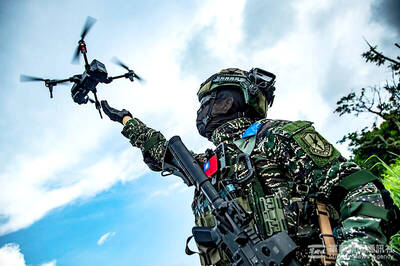
RESILIENCE: Taiwan plays a key role in semiconductors, energy, information infrastructure and advanced manufacturing, AIT Director Raymond Greene said Taiwan’s continued investment in deterrence and resilience remains vital, especially in uncrewed systems and other emerging technologies, American Institute in Taiwan (AIT) Director Raymond Greene said yesterday. Greene made the remarks at the annual National Strategic Summit on Supply Chain Resilience held by the Research Institute for Democracy, Society and Emerging Technology (DSET), a government-backed think tank. As Taiwan last year became the US’ fourth-largest trading partner and supply chain security is becoming more important, cooperation in emerging technologies continues to deepen between the two countries, he said. The US is committed to accelerating innovation, building key infrastructure, strengthening cooperation

The National Chungshan Institute of Science and Technology yesterday showcased its locally developed variants of the Vision 60 robotic patrol dog, which it plans to deploy on the nation’s outlying territories in the South China Sea. The variants were produced under the Joint Lab project — created by the institute and domestic companies — and assembled with domestically produced motors, lenses and artificial intelligence (AI) systems alongside licensed tech from the US, Missile and Rocket Systems Research Division deputy director Jen Kuo-kang (任國光) told the media event at a military base in Taipei’s Dazhi (大直) area. Taiwan has built up its strengths


 RSS
RSS