


The Government Information Office (GIO) yesterday dismissed claims that its decision to increase scrutiny of joint radio broadcasts is politically motivated or targeted at any particular station.
"Please don't politicize the entire issue. Our policy is not aimed at any particular station," Director-General Lin Chia-lung (林佳龍) told reporters yesterday afternoon.
"As the supervisory body of the nation's media industry, we're duty bound to create an environment where competition is fair and public interest is safeguarded," Lin said.
Lin said that the GIO is merely carrying out the policy in accordance with the law.
It is a common practise for cooperating radio stations with a shorter range to simultaneously broadcast the same program to reach a greater audience. According to the Broadcasting and Television Law (
Lin made the remark in response to criticism by UFO Radio chairman Jaw Shaw-kong (
Jaw said that the GIO should stay out of the matter, because it would soon be stripped of its responsibility of governing the media industry.
"It's very inappropriate for the GIO to make such a major policy decision before it's dissolved and transfers its responsibilities to the proposed national communication council [NCC]," Jaw said.
The Cabinet approved two draft amendments in September last year aimed at abolishing the GIO and laying the foundation for its successor, the NCC.
Claiming that he was not surprised that Lin had singled out UFO for scrutiny because of the station's pro-unification stance, Jaw criticized the GIO's plan to legalize underground radio stations.
"It doesn't make sense to legalize underground radio stations while strictly regulating the legal ones," he told his audience.
"I'm very curious to know why all of the nation's TV stations and newspapers are broadcast or circulated nationwide, but radio stations cannot provide their services to the entire nation," he said.
The GIO announced in June that it was planning to legalize the nation's 93 underground radio stations by the end of next year. The GIO will start accepting illegal radio stations' applications from the beginning of next month.
Opposition lawmakers have said that the GIO decided to legalize underground radio stations due to pressure from former president Lee Teng-hui (李登輝). Lee reportedly promised to help lobby the government to legalize underground radio stations in exchange for these stations' support for the Taiwan Solidarity Union (TSU), of which he is the spiritual leader.

ROLLER-COASTER RIDE: More than five earthquakes ranging from magnitude 4.4 to 5.5 on the Richter scale shook eastern Taiwan in rapid succession yesterday afternoon Back-to-back weather fronts are forecast to hit Taiwan this week, resulting in rain across the nation in the coming days, the Central Weather Administration said yesterday, as it also warned residents in mountainous regions to be wary of landslides and rockfalls. As the first front approached, sporadic rainfall began in central and northern parts of Taiwan yesterday, the agency said, adding that rain is forecast to intensify in those regions today, while brief showers would also affect other parts of the nation. A second weather system is forecast to arrive on Thursday, bringing additional rain to the whole nation until Sunday, it

LANDSLIDES POSSIBLE: The agency advised the public to avoid visiting mountainous regions due to more expected aftershocks and rainfall from a series of weather fronts A series of earthquakes over the past few days were likely aftershocks of the April 3 earthquake in Hualien County, with further aftershocks to be expected for up to a year, the Central Weather Administration (CWA) said yesterday. Based on the nation’s experience after the quake on Sept. 21, 1999, more aftershocks are possible over the next six months to a year, the agency said. A total of 103 earthquakes of magnitude 4 on the local magnitude scale or higher hit Hualien County from 5:08pm on Monday to 10:27am yesterday, with 27 of them exceeding magnitude 5. They included two, of magnitude
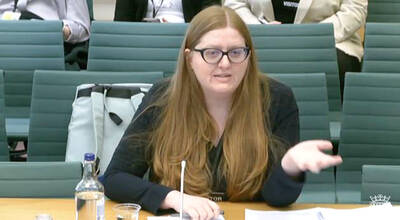
CONDITIONAL: The PRC imposes secret requirements that the funding it provides cannot be spent in states with diplomatic relations with Taiwan, Emma Reilly said China has been bribing UN officials to obtain “special benefits” and to block funding from countries that have diplomatic ties with Taiwan, a former UN employee told the British House of Commons on Tuesday. At a House of Commons Foreign Affairs Committee hearing into “international relations within the multilateral system,” former Office of the UN High Commissioner for Human Rights (OHCHR) employee Emma Reilly said in a written statement that “Beijing paid bribes to the two successive Presidents of the [UN] General Assembly” during the two-year negotiation of the Sustainable Development Goals. Another way China exercises influence within the UN Secretariat is

Taiwan’s first drag queen to compete on the internationally acclaimed RuPaul’s Drag Race, Nymphia Wind (妮妃雅), was on Friday crowned the “Next Drag Superstar.” Dressed in a sparkling banana dress, Nymphia Wind swept onto the stage for the final, and stole the show. “Taiwan this is for you,” she said right after show host RuPaul announced her as the winner. “To those who feel like they don’t belong, just remember to live fearlessly and to live their truth,” she said on stage. One of the frontrunners for the past 15 episodes, the 28-year-old breezed through to the final after weeks of showcasing her unique


 RSS
RSS