


Taiwan's legislative delegation, led by Legislative Speaker Wang Jin-pyng (
Delegation members quote the US Deputy Secretary of Defense Paul Wolfowitz as having firmly nixed any suggestion that Taiwan's China Shipbuilding Corporation take part in the construction of the vessels.
US officials conceded, however, that China Shipbuilding could be involved in maintenance and logistics support for the submarines, according to Wang and others.
Letting China Shipbuilding build some of the subs would be a "waste of resources," Wolfowitz reportedly maintained.
The US will not help Taiwan to "build" the vessels, but will only "help them buy" them, delegates said.
NEW DIFFERENCES
New differences between Taiwan and the US over the question of Taiwan acquisition of diesel-powered submarines came into sharp focus this week during talks between delegation members and American officials, delegation members revealed in Washington on Wednesday.
The lawmakers were clearly unhappy with the responses they received from the Americans during three days of talks with Pentagon, Department of State and other US officials, the delegates said in a meeting with Taiwanese reporters at the end of the visit.
Wang and nearly two dozen other lawmakers and government defense and foreign officials spent three days in high-level talks with US officials on arms purchases, mainly those covered by the US$18 billion special budget the Cabinet has approved.
However, in a process outlined by the Americans, which is alien to Taiwan's usual practices, the US said that Taiwan should give performance specifications to all potential companies bidding for the contract to build the subs and conduct competitive bidding to see who could build the best and cheapest vessels.
That would leave the cost of the eight vessels the government seeks to purchase -- estimated by Taiwanese experts at about US$12 billion -- up in the air.
How Taipei would arrange payment is also a matter of dispute. The legislators want Washington to provide detailed quotes for the price of the equipment and then use those figures to pass a special arms procurement budget.
On the other hand, the US wants Taiwan to pass the budget first, and then go out to bid for individual items.
The legislators complain that during this week's talks, the Americans provided only vague, two-page summaries of the costs, using which it is impossible to make policy decisions.
These, and other disagreements, left a bad feeling among the delegation.
People First Party (PFP) Legislator Lin Yu-fang (
Lin wondered whether the US thinks it is in its interest that the confrontation between Taiwan and China "should continue, short of military confrontation."
He said that Wang conveyed a message from President Chen Shui-bian (陳水扁) to US officials during a Monday breakfast meeting at the American Institute for Taiwan seeking US help in facilitating direct links and the US revival of an offer by former Chinese president Jiang Zemin (江澤民) in his 2002 meeting with Bush to reduce the number of missiles facing Taiwan in exchange for a slowdown in US arms sales to Taipei.
The US reaction was "negative," Lin said, quoting US officials as saying the issues are for Taiwan and China themselves to resolve. There would be no US role, the Americans said.
However, Lin said, "this is the first inning in a long ball game," indicating that the jockeying between Taipei and Washington still has a long way to go before resolution.
The lawmakers reached a consensus on two issues, Wang said.
First, the US side should come up with a new, cheaper quotation for the subs' price. Second, the Americans should assure Taiwan that the subs are delivered sooner than earlier estimates.
While the time frames varied, Wang said Taiwan is seeking a delivery date two to three years earlier than previous dates.
However, a Taiwanese military official said that the new timetable would see delivery within 10 years, compared with the previously estimated 15 years. That 15 year time frame is much longer than estimates provided by both sides earlier.
Prices and procurement procedures for the other weapons systems on the shopping list eight P-3C anti-submarine aircraft, and six PAC-III Patriot anti-missile systems do not seem to be as much of an issue, since both of those systems already exist.
Also see story:
Defense minister says price of arms package not final
Editorial:Buy arms, but not at any price
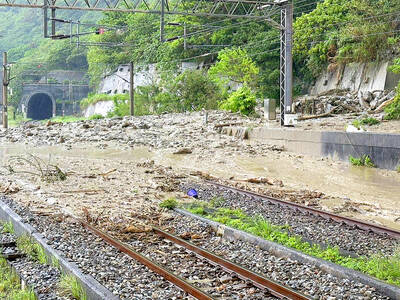
ROLLER-COASTER RIDE: More than five earthquakes ranging from magnitude 4.4 to 5.5 on the Richter scale shook eastern Taiwan in rapid succession yesterday afternoon Back-to-back weather fronts are forecast to hit Taiwan this week, resulting in rain across the nation in the coming days, the Central Weather Administration said yesterday, as it also warned residents in mountainous regions to be wary of landslides and rockfalls. As the first front approached, sporadic rainfall began in central and northern parts of Taiwan yesterday, the agency said, adding that rain is forecast to intensify in those regions today, while brief showers would also affect other parts of the nation. A second weather system is forecast to arrive on Thursday, bringing additional rain to the whole nation until Sunday, it
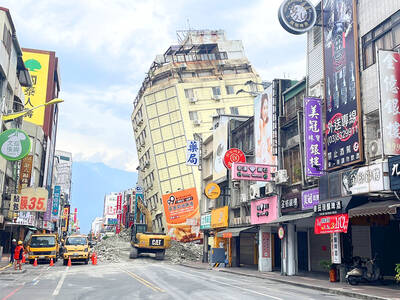
LANDSLIDES POSSIBLE: The agency advised the public to avoid visiting mountainous regions due to more expected aftershocks and rainfall from a series of weather fronts A series of earthquakes over the past few days were likely aftershocks of the April 3 earthquake in Hualien County, with further aftershocks to be expected for up to a year, the Central Weather Administration (CWA) said yesterday. Based on the nation’s experience after the quake on Sept. 21, 1999, more aftershocks are possible over the next six months to a year, the agency said. A total of 103 earthquakes of magnitude 4 on the local magnitude scale or higher hit Hualien County from 5:08pm on Monday to 10:27am yesterday, with 27 of them exceeding magnitude 5. They included two, of magnitude
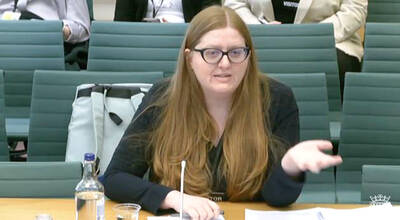
CONDITIONAL: The PRC imposes secret requirements that the funding it provides cannot be spent in states with diplomatic relations with Taiwan, Emma Reilly said China has been bribing UN officials to obtain “special benefits” and to block funding from countries that have diplomatic ties with Taiwan, a former UN employee told the British House of Commons on Tuesday. At a House of Commons Foreign Affairs Committee hearing into “international relations within the multilateral system,” former Office of the UN High Commissioner for Human Rights (OHCHR) employee Emma Reilly said in a written statement that “Beijing paid bribes to the two successive Presidents of the [UN] General Assembly” during the two-year negotiation of the Sustainable Development Goals. Another way China exercises influence within the UN Secretariat is

Taiwan’s first drag queen to compete on the internationally acclaimed RuPaul’s Drag Race, Nymphia Wind (妮妃雅), was on Friday crowned the “Next Drag Superstar.” Dressed in a sparkling banana dress, Nymphia Wind swept onto the stage for the final, and stole the show. “Taiwan this is for you,” she said right after show host RuPaul announced her as the winner. “To those who feel like they don’t belong, just remember to live fearlessly and to live their truth,” she said on stage. One of the frontrunners for the past 15 episodes, the 28-year-old breezed through to the final after weeks of showcasing her unique


 RSS
RSS