


US Deputy Secretary of Defense Paul Wolfowitz has expressed serious concern about Taiwan's ability to protect itself against possible attacks by China, and urged Taiwan to strengthen its defenses with the proposed arms purchase, according to a Taiwanese legislator visiting Washington.
According to Democratic Progressive Party (DPP) Legislator Lee Wen-chung (
Wolfowitz said that if Taiwan did not take action as soon as possible to strengthen its defenses, China would be encouraged to invest more on military equipment, Lee told the Taipei Times after he and a multi-party legislative delegation headed by Legislative Speaker Wang Jin-pyng (王金平) spent a day in Washington discussing Taiwan's arms procurement budget with top defense and State Department officials.
The 15-member delegation was briefed by 25 US military and civilian officials during a breakfast meeting on the first day of a three-day visit on Monday morning, and then went off to separate meetings at the Pentagon and the State Department.
Although Wang is from the pan-blue camp, he still showed support for the purchase.
"The balance of military power on the two sides [of the Taiwan Strait] is necessary to the area's peace, stability and prosperity," Wang said.
The delegation was to attend a congressional meeting yesterday to discuss the prospects for a measure before the US Congress to enhance military relations between the US and Taiwan through greater joint activities and mutual visits by top officials who are currently barred from such visits by long-term US policy.
That measure, proposed by Senator Sam Brownback, is expected to come up for a vote this week. The House recently approved a parallel bill.
On Monday, American officials were "vague" about the US' commitment to help Taiwan fend off an attack from China, Chinese Nationalist Party (KMT) Legislator Sun Kuo-hua (
After the US officials insisted that it would be in Taiwan's best interests to buy the weapons stipulated in the special budget package -- diesel submarines, P-3C anti-submarine aircraft and Patriot anti-missile systems -- the legislators received somewhat unsatisfactory answers to their questions, Sun said.
When asked if the US would come to Taiwan's defense against China if it were to buy all the weapons, the US side was "vague," Sun said, "because they couldn't say they wouldn't come to our defense, because if they said that, Beijing would say, `Okay, let's attack.'"
"I think the United States is keeping that deliberately vague," he said.
Washington has long been pressuring Taiwan to buy the robust weapons package US President George W. Bush promised in April 2001.
Meanwhile, Pentagon officials were still unable to provide details on the design and cost of the eight diesel submarines included in the package, Sun said.
"We didn't even see a configuration for the submarines ... there's a lot of uncertainties in the cost estimates," he said. "The United States Navy doesn't know."
Sun indicated that Washington was still looking toward various European countries to provide the designs.
But the US officials "gave no indication where the subs will come from" and could not provide a price estimate, Sun said.
"They could only give a rough estimate. We want them to be more accurate," he said.
"How can we approve the cost in the budget if we don't know?" he said.
US shipbuilding companies, "cannot build diesel submarines," because they have not manufactured any for more than 40 years, Sun said.
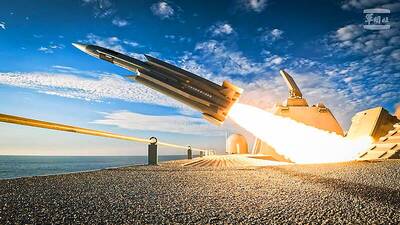
DETERRENCE: With 1,000 indigenous Hsiung Feng II and III missiles and 400 Harpoon missiles, the nation would boast the highest anti-ship missile density in the world With Taiwan wrapping up mass production of Hsiung Feng II and III missiles by December and an influx of Harpoon missiles from the US, Taiwan would have the highest density of anti-ship missiles in the world, a source said yesterday. Taiwan is to wrap up mass production of the indigenous anti-ship missiles by the end of year, as the Chungshan Institute of Science and Technology has been meeting production targets ahead of schedule, a defense official with knowledge of the matter said. Combined with the 400 Harpoon anti-ship missiles Taiwan expects to receive from the US by 2028, the nation would have

POSSIBILITIES EMERGE: With Taiwan’s victory and Japan’s narrow win over Australia, Taiwan now have a chance to advance if South Korea also beat the Aussies Taiwan has high hopes that the national baseball team would advance to the World Baseball Classic (WBC) quarter-finals after clinching a crucial 5-4 victory over South Korea in a nail-biting extra-inning game at the Tokyo Dome yesterday. Boosted by three home runs — two solo shots by Yu Chang (張育成) and Cheng Tsung-che (鄭宗哲) and a two-run homer by Stuart Fairchild — the triumph gave Taiwan a much-needed second victory in the five-team Pool C, where only the top two finishers would advance to the knockout stage in Miami, Florida. Entering extra innings with the game tied at four apiece, Taiwan scored
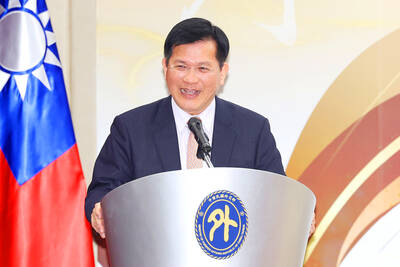
MISSION OF PEACE: The foreign minister urged Beijing to respect Taiwan’s existence as an independent nation, and work together to ensure peace and stability in the region Minister of Foreign Affairs Lin Chia-lung (林佳龍) yesterday rejected Chinese Minister of Foreign Affairs Wang Yi’s (王毅) comments about Taiwan, criticizing China as a “troublemaker” in the international community and a disruptor of cross-strait peace. Speaking at a news conference on the sidelines of the Chinese National People’s Congress, Wang said that Taiwan has always been a territory of China and that it would be impossible for it to become its own country. The “return” of Taiwan to China was the natural outcome of the Chinese people’s resistance against Japan in World War II, and that any pursuit of independence was “doomed

‘UNWAVERING FRIENDSHIP’: A representative of a Japanese group that co-organized a memorial, said he hopes Japanese never forget Taiwan’s kindness President William Lai (賴清德) yesterday marked the 15th anniversary of the Tohoku earthquake and tsunami, urging continued cooperation between Taiwan and Japan on disaster prevention and humanitarian assistance. Lai wrote on social media that Taiwan and Japan have always helped each other in the aftermath of major disasters. The magnitude 9 earthquake struck northeastern Japan on March 11, 2011, triggering a massive tsunami that claimed more than 19,000 lives, according to data from Japanese authorities. Following the disaster, Taiwan donated more than US$240 million in aid, making it one of the largest contributors of financial assistance to Japan. In addition to cash donations and


 RSS
RSS