


The Presidential Office yesterday denied a report in Singapore's Straits Times newspaper, according to which China has rejected an offer by President Chen Shui-bian (陳水扁) to employ secret envoys. The office said such groundless speculation would lead to misunderstandings not only among the public but also in the international community.
"The report was completely untrue. We have noticed lately that the Straits Times continues to dish up sensational articles on the cross-strait relations issue without providing concrete evidence," said James Huang (黃志芳), spokesman of the Presidential Office.
"It is absolutely inappropriate for the media to write groundless reports or publish wild guesses on the sensitive cross-strait issue," Huang said.
"We therefore urge the newspaper in Singapore not to follow the example of some media institutions in Hong Kong and serve as a mouthpiece for particular political forces," Huang said.
The secret-envoy issue has been mentioned ever since Chen displayed a piece of paper in January during a televised interview as proof that there once was a secret link between himself and Chinese President Jiang Zemin (江澤民).
"The Beijing leader's message was passed on to me by a political heavyweight before my first inauguration on May 20, 2000," Chen said in the interview.
"The message was `one China' [in Chinese], which meant that the other side of the Taiwan Strait expected me to mention the issue in my inauguration speech," Chen said.
According to a Straits Times report from Hong Kong, Chen recently put out feelers about sending senior Democratic Progressive Party (DPP) officials, academics or businessmen with good connections to China as a goodwill gesture before his inauguration.
Their task would be to find out what Beijing wants him to say in his inaugural speech, as he had done four years ago.
The paper, citing an anonymous source, says China has rejected Chen's offer and also made it clear that it does not want to know what he plans to say in his May 20 inauguration speech.
Though the Presidential Office denied the report, senior government officials told the Taipei Times that since Chen won his second term on March 20, China has turned down requests for visits by several representatives close to the DPP who had delivered Chen's messages to China over the past four years.
"One of them, a former head of a Cabinet-level institute related to diplomatic affairs, is now an academic. He originally prepared to attend a forum in China and was authorized to obtain the Beijing leadership's suggestions, as well as to express Chen's goodwill," the source said.
"But Chinese officials refused to allow him to attend the forum in Beijing," the source said.
The source said that during testimony at a US Congress hearing on Taiwan last month, James Kelly, assistant secretary of state for East Asian and Pacific affairs, urgently appealed to both sides of the strait to resume communication.
"Kelly said that the US government continues to urge Beijing and Taipei to pursue dialogue as soon as possible through any available channels, without pre-conditions," the official said.
"During the past four years, there were certain representatives, including academics, politicians, DPP members and business leaders, who carried messages between Taipei and Beijing. However, Beijing recently tightened its control over permitting Taiwan's messengers into the country," the source said.
Another source from the DPP legislative caucus said as some cross-strait communication channels are still operating, both sides would continue to try to exchange thoughts about future cross-strait relationships, and especially over the content of Chen's inauguration speech.
Also See Story:
Legislator: Report on envoys is wrong

NO-LIMITS PARTNERSHIP: ‘The bottom line’ is that if the US were to have a conflict with China or Russia it would likely open up a second front with the other, a US senator said Beijing and Moscow could cooperate in a conflict over Taiwan, the top US intelligence chief told the US Senate this week. “We see China and Russia, for the first time, exercising together in relation to Taiwan and recognizing that this is a place where China definitely wants Russia to be working with them, and we see no reason why they wouldn’t,” US Director of National Intelligence Avril Haines told a US Senate Committee on Armed Services hearing on Thursday. US Senator Mike Rounds asked Haines about such a potential scenario. He also asked US Defense Intelligence Agency Director Lieutenant General Jeffrey Kruse

INSPIRING: Taiwan has been a model in the Asia-Pacific region with its democratic transition, free and fair elections and open society, the vice president-elect said Taiwan can play a leadership role in the Asia-Pacific region, vice president-elect Hsiao Bi-khim (蕭美琴) told a forum in Taipei yesterday, highlighting the nation’s resilience in the face of geopolitical challenges. “Not only can Taiwan help, but Taiwan can lead ... not only can Taiwan play a leadership role, but Taiwan’s leadership is important to the world,” Hsiao told the annual forum hosted by the Center for Asia-Pacific Resilience and Innovation think tank. Hsiao thanked Taiwan’s international friends for their long-term support, citing the example of US President Joe Biden last month signing into law a bill to provide aid to Taiwan,
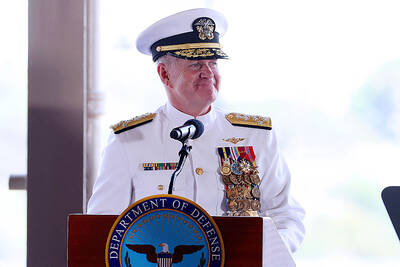
China’s intrusive and territorial claims in the Indo-Pacific region are “illegal, coercive, aggressive and deceptive,” new US Indo-Pacific Commander Admiral Samuel Paparo said on Friday, adding that he would continue working with allies and partners to keep the area free and open. Paparo made the remarks at a change-of-command ceremony at Joint Base Pearl Harbor-Hickam in Hawaii, where he took over the command from Admiral John Aquilino. “Our world faces a complex problem set in the troubling actions of the People’s Republic of China [PRC] and its rapid buildup of forces. We must be ready to answer the PRC’s increasingly intrusive and
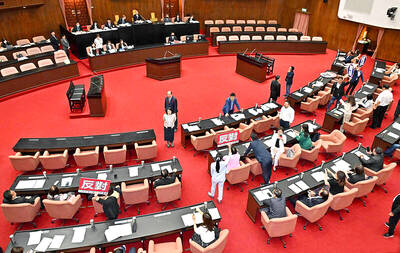
STATE OF THE NATION: The legislature should invite the president to deliver an address every year, the TPP said, adding that Lai should also have to answer legislators’ questions The Chinese Nationalist Party (KMT) yesterday proposed inviting president-elect William Lai (賴清德) to make a historic first state of the nation address at the legislature following his inauguration on May 20. Lai is expected to face many domestic and international challenges, and should clarify his intended policies with the public’s representatives, KMT caucus secretary-general Hung Meng-kai (洪孟楷) said when making the proposal at a meeting of the legislature’s Procedure Committee. The committee voted to add the item to the agenda for Friday, along with another similar proposal put forward by the Taiwan People’s Party (TPP). The invitation is in line with Article 15-2


 RSS
RSS