


A UN plan to reunify the war-divided island of Cyprus collapsed despite European and American support when Greek Cypriots rejected the proposal in one referendum and Turkish Cypriots endorsed it in another.
Saturday's referendum outcomes mean Cyprus will not join the EU on May 1 as a united state. Rather, EU laws and benefits will apply only to Greek Cypriots living in the island's south, according to a deal negotiated with European leaders.
Cyprus has been split into a Greek Cypriot-controlled south and a Turkish-occupied north since Turkey invaded in 1974 af-ter a coup by supporters of a union with Greece. The breakaway state is recognized only by Turkey, which maintains 40,000 troops there.
The reunification plan was drawn up by UN Secretary-General Kofi Annan.
In Washington, State Department spokesman Richard Boucher said the US was "disappointed" by the Greek Cypriot vote, calling it a "setback" to those seeking a united Cyprus. Washington had warned of repercussions if the plan was defeated, potentially jeopardizing hundreds of millions of dollars in US aid.
Greek Cypriots largely objec-ted to limits on the right of Greek Cypriot refugees to return to homes they fled when the island was divided, while allowing tens of thousands of Turkish settlers who arrived after the 1974 invasion by Turkey to remain.
Cypriot President Tassos Papadopoulos said the plan's defeat did not mean that Greek Cypriots were "turning their backs" on Turkish Cypriots.
"They have simply rejected this particular solution for many reasons, but mainly because they did not believe that this solution provides the necessary safeguards for its full implementation," said Papadopoulos, who campaigned against the plan.
"The only real beneficiary of this plan would have been Turkey."
The plan foresaw a federation of two politically equal states -- one for the 643,000 Greek Cypriots and one for the 180,000 Turks and Turkish Cypriots -- under a weak central government.
It would have reduced the area under Turkish control, requiring entire villages to relocate so houses could be returned to their original Greek Cypriot owners.
The number of foreign troops -- 40,000 Turks and 6,000 Greeks -- would have been reduced to no more than 1,600 by 2018.
Turkey's government has been pushing for a solution to the island's division, hoping a resolution could improve Turkey's own chances at joining the EU. The US, the EU and others backed the plan.
But official results showed almost 76 percent of Greek Cypriot voters rejected it. About 65 percent of Turkish Cypriot voters supported it.
Greek Cypriot Ioannis Kyriakides, a 55-year-old chemical engineer, said he voted against the plan because it did not guarantee protection against another Turkish invasion.
Turkish Cypriots favored the plan because they saw it as a means to greater prosperity and EU membership. Cem Aydan, a 35-year-old businessman, said he voted for the plan "for the future of my son and for the future of all the children of the island."
Turnouts were at least 88 percent in the south and 87 percent in the north, election officials said.

PROVOCATIVE: Chinese Deputy Ambassador to the UN Sun Lei accused Japan of sending military vessels to deliberately provoke tensions in the Taiwan Strait China denounced remarks by Japan and the EU about the South China Sea at a UN Security Council meeting on Monday, and accused Tokyo of provocative behavior in the Taiwan Strait and planning military expansion. Ayano Kunimitsu, a Japanese vice foreign minister, told the Council meeting on maritime security that Tokyo was seriously concerned about the situation in the East China and South China seas, and reiterated Japan’s opposition to any attempt to change the “status quo” by force, and obstruction of freedom of navigation and overflight. Stavros Lambrinidis, head of the EU delegation to the UN, also highlighted South China Sea
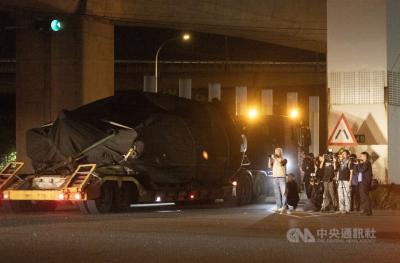
The final batch of 28 M1A2T Abrams tanks purchased from the US arrived at Taipei Port last night and were transported to the Armor Training Command in Hsinchu County’s Hukou Township (湖口), completing the military’s multi-year procurement of 108 of the tanks. Starting at 12:10am today, reporters observed more than a dozen civilian flatbed trailers departing from Taipei Port, each carrying an M1A2T tank covered with black waterproof tarps. Escorted by military vehicles, the convoy traveled via the West Coast Expressway to the Armor Training Command, with police implementing traffic control. The army operates about 1,000 tanks, including CM-11 Brave Tiger
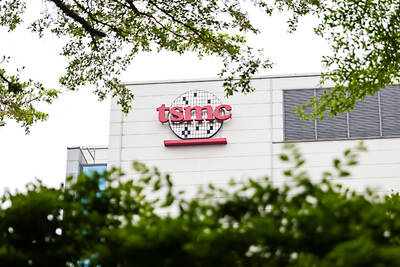
Taiwan Semiconductor Manufacturing Co (TSMC, 台積電), the world’s largest contract chipmaker, said it expects its 2-nanometer (2nm) chip capacity to grow at a compound annual rate of 70 percent from this year to 2028. The projection comes as five fabs begin volume production of 2-nanometer chips this year — two in Hsinchu and three in Kaohsiung — TSMC senior vice president and deputy cochief operating officer Cliff Hou (侯永清) said at the company’s annual technology symposium in Silicon Valley, California, last week. Output in the first year of 2-nanometer production, which began in the fourth quarter of last year, is expected to

Taiwan’s drone exports surged past US$100 million in the first quarter, exceeding last year’s full-year total, with the Czech Republic emerging as the largest buyer, the Ministry of Economic Affairs said. Exports of complete drones reached US$115.85 million in the period, about 1.2 times the total recorded for all of last year, the ministry said in a report. Exports to the Czech Republic accounted for about US$100 million, far outpacing other markets. Poland, last year’s top destination, recorded about US$11.75 million in the first quarter. Taiwan’s drone exports have expanded rapidly in the past few years, with last year’s total


 RSS
RSS