


Refusing to be outshined by its election rivals, the Democratic Progressive Party (DPP) is planning a campaign rally in Taichung on Sunday to express the public's wish for peace and democracy and opposition to missiles and war, organizers said yesterday.
"While the pan-blue camp plans to hold a nationwide march on Saturday to oppose President Chen Shui-bian (陳水扁) for their own political gain, we're launching this `thumbs-up' rally to counter its initiative, which lacks appropriateness and legitimacy," DPP Deputy Secretary-General Lee Ying-yuan (李應元), also the organizer of the rally, said yesterday.
Lee said the DPP hopes to see a turnout of about 500,000, although the original target was 200,000.
"We're thinking of having participants give a thumbs-up sign at 3:20pm at the rally to signify their support for Chen during the March 20 presidential election and for the first national referendum," Lee said.
Slogans for the event include "Taiwan's first, the world is watching," "No missiles, no `black gold,' no vote-buying," and "yes peace, yes democracy, love Taiwan."
Rehearsal
To warm up for the Sunday event, Lee said, a rehearsal will be held at 3:20pm on Saturday.
Another campaign rally will take place in Kaohsiung on Saturday. Organizers hope to see a turnout of 500,000 for the Saturday event.
Chen, who attended yesterday's press conference to announce the Sunday rally, called on the public to take part in the event to show their support for the referendum.
"This is the nation's first national referendum and the world is keeping an eye on this historic event," Chen said. "I believe it will prevail because we love this land and this country and we'll forever safeguard its safety and prosperity."
For the referendum to be considered valid, at least 8 million eligible voters must cast ballots. The Referendum Law (
Meanwhile, Chen, who also doubles as the DPP's chairman, lambasted the pan-blue alliance's campaign to oppose the election-day referendum.
Chen said the pan-blue camp calls on the public to boycott the referendum while also suggesting that the referendum would cause a riot and intimidating the public by saying people would be fined for wrongfully casting their ballots for the presidential election in the referendum ballot boxes.
`Ersatz democracy'
"It only proves that they believe in nothing but ersatz democracy and that they set a very bad example on our way to democracy," he said.
If the opposition camp considers the referendum "illegal," Chen said, it should have requested a constitutional interpretation from the Council of Grand Justices like he did in 1990 during his stint as a lawmaker.
To push for the comprehensive election of lawmakers, whose term mandated by the Constitution was three years but was extended to 40 years during Chinese Nationalist Party (KMT) rule, Chen requested that grand justices rule on the legitimacy of lawmakers' long-term occupancy of their seats. The first comprehensive legislative election took place in 1992.
Chen yesterday also expressed his hope to see law enforcement officers devote themselves to preventing vote-buying and election violence.
He also called on the opposition parties to stop intimidating the public by suggesting election riots are a possibility.
"As we're already a mature democratic country, we should trust the wisdom of the electorate. No matter the result of the election, I believe supporters of the two camps will face it rationally and maturely."

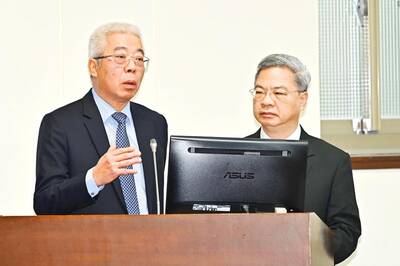
Taiwan has arranged for about 8 million barrels of crude oil, or about one-third of its monthly needs, to be shipped from the Red Sea this month to bypass the Strait of Hormuz and ease domestic supply pressures, CPC Corp, Taiwan (CPC, 台灣中油) said yesterday. The state-run oil company has worked with Middle Eastern suppliers to secure routes other than the Strait of Hormuz, through which about 20 percent of the world’s oil and liquefied natural gas typically passes, CPC chairman Fang Jeng-zen (方振仁) said at a meeting of the legislature’s Economics Committee in Taipei. Suppliers in Saudi Arabia have indicated they
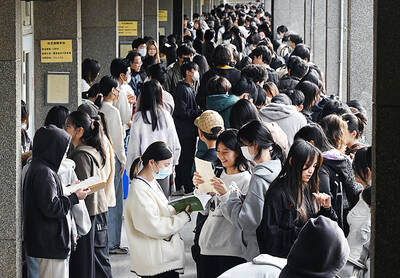
A global survey showed that 60 percent of Taiwanese had attained higher education, second only to Canada, the Ministry of the Interior said. Taiwan easily surpassed the global average of 43 percent and ranked ahead of major economies, including Japan, South Korea and the US, data from the Organisation for Economic Co-operation and Development (OECD) for 2024 showed. Taiwan has a high literacy rate, data released by the ministry showed. As of the end of last year, Taiwan had 20.617 million people aged 15 or older, accounting for 88.5 percent of the total population, with a literacy rate of 99.4 percent, the data

CCP ‘PAWN’? Beijing could use the KMT chairwoman’s visit to signal to the world that many people in Taiwan support the ‘one China’ principle, an academic said Chinese Nationalist Party (KMT) Chairwoman Cheng Li-wun (鄭麗文) yesterday arrived in China for a “peace” mission and potential meeting with Chinese President Xi Jinping (習近平), while a Taiwanese minister detailed the number of Chinese warships currently deployed around the nation. Cheng is visiting at a time of increased Chinese military pressure on Taiwan, as the opposition-dominated Legislative Yuan stalls a government plan for US$40 billion in extra defense spending. Speaking to reporters before going to the airport, Cheng said she was going on a “historic journey for peace,” but added that some people felt uneasy about her trip. “If you truly love Taiwan,

NEW LOW: The council in 2024 based predictions on a pessimistic estimate for the nation’s total fertility rate of 0.84, but last year that rate was 0.69, 17 percent lower An expected National Development Council (NDC) report expects the nation’s population to drop below 12 million by 2065, with the old-age dependency ratio to top 100 percent sooner than 2070, sources said yesterday. The council is slated to release its latest population projections in August, using an ultra-low fertility model, the sources said. The previous report projected that Taiwan’s population would fall to 14.37 million by 2070, but based on a new estimate of the total fertility rate (TFR) — the average number of children born to a woman over her lifetime — the population is expected to reach 12 million by


 RSS
RSS