


Haiti's brutal conflict moved from the streets to the political arena after rebels rolled into the capital to cheering crowds, and US Marines and French troops secured key sites around the city.
But the aftershocks of former president Jean-Bertrand Aristide's departure were still echoing from the streets of Port-au-Prince to the halls of Washington, as rebels refused to fade into the background and Aristide's accusations that he was forced out by the Americans dogged US officials.
Aristide told reporters in a telephone interview Monday that he was "forced to leave" Haiti by US military forces. He added that they would "start shooting and be killing" if he refused, but it was unclear if he was referring to rebels or US agents.
American officials dismissed Aristide's claim. US Secretary of State Colin Powell called the allegations "absolutely baseless, absurd." But US officials acknowledged privately that Aristide was told that if he remained in Haiti, US forces would not protect him from the rebels who had threatened to kill him.
Aristide, the country's first democratically elected president since independence from French rule, resigned Sunday and left Haiti for exile, arriving in the impoverished Central African Republic early Monday, after rebels began an uprising earlier this month seeking his ouster. Supreme Court Justice Boniface Alexandre became the interim president.
US plans for a quiet, orderly transition appeared threatened, despite the arrival of hundreds of American, French and Canadian soldiers as an interim peacekeeping force.
Rebels had promised to lay down their arms if their main demand -- Aristide's resignation -- was met, but they instead swaggered into the capital on Monday and hinted they were here to stay. They said they would just tolerate police and international peacekeepers, while enforcing their own kind of justice.
One young rebel told a reporter he had shot looters Sunday and predicted militant members of Aristide's Lavalas party would be executed.
"I shot some looters yesterday. They have to be shot," said the rebel, who goes by the nom-de-guerre "Faustin."
"There are some very minimal numbers of Lavalas who cannot be saved," he said.
"We don't need peacekeepers, we need military help. We need more guns," said second-tier rebel leader Paul Arcelin, as the motley crew of former police and military officers settled into the police headquarters in front of the National Palace, patrolled by US Marines just a few hundred meters away.
The rebels said they intended to return the old building to its previous function as army HQ, revive the army that ousted Aristide in 1991 and which he disbanded in 1995, and enforce a curfew.
Scattered looting continued, police cleared the city of almost all the rebel barricades, but gunfire remained in some neighborhoods and bound, executed bodies continued to show up in the streets.
In the capital, there were reports of reprisal killings of militant Aristide supporters who had been accused of terrorizing people during his rule. A reporter saw four bodies at a Carrefour store on the outskirts of the capital, three of them with hands tied and shot in the head.
Aristide's home in the suburb of Tabarre was looted and trashed.
Several hundred US, French and Canadian troops have arrived in Haiti to form an international force authorized on Sunday by the UN Security Council. The troops began securing diplomatic missions and key sites, but they said they were not in Haiti as police.
US Marine Colonel Dave Berger said his 200 troops would neither disarm rebels nor pro-Aristide militants, nor police the city.
US Defense Secretary Donald Rumsfeld estimated that between 1,500 and 2,000 US troops would go to Haiti for a "relatively short period." They would participate in an interim force, which could include as many as 5,000 troops from several countries, that would stay until a UN peacekeeping force arrived.
Amnesty International called for the arrest of rebel leaders Louis-Jodel Chamblain and Jean Pierre Baptiste, who escaped from jail. Both have been convicted of murder.
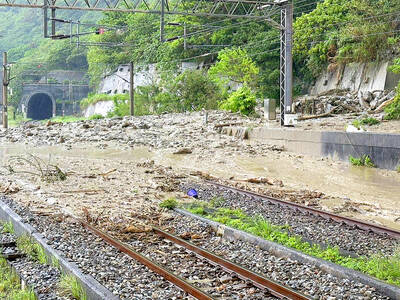
ROLLER-COASTER RIDE: More than five earthquakes ranging from magnitude 4.4 to 5.5 on the Richter scale shook eastern Taiwan in rapid succession yesterday afternoon Back-to-back weather fronts are forecast to hit Taiwan this week, resulting in rain across the nation in the coming days, the Central Weather Administration said yesterday, as it also warned residents in mountainous regions to be wary of landslides and rockfalls. As the first front approached, sporadic rainfall began in central and northern parts of Taiwan yesterday, the agency said, adding that rain is forecast to intensify in those regions today, while brief showers would also affect other parts of the nation. A second weather system is forecast to arrive on Thursday, bringing additional rain to the whole nation until Sunday, it
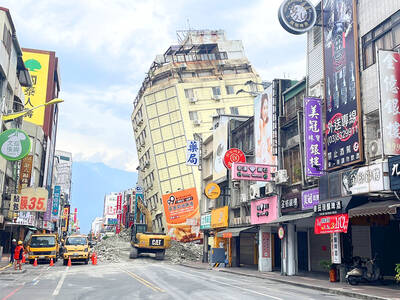
LANDSLIDES POSSIBLE: The agency advised the public to avoid visiting mountainous regions due to more expected aftershocks and rainfall from a series of weather fronts A series of earthquakes over the past few days were likely aftershocks of the April 3 earthquake in Hualien County, with further aftershocks to be expected for up to a year, the Central Weather Administration (CWA) said yesterday. Based on the nation’s experience after the quake on Sept. 21, 1999, more aftershocks are possible over the next six months to a year, the agency said. A total of 103 earthquakes of magnitude 4 on the local magnitude scale or higher hit Hualien County from 5:08pm on Monday to 10:27am yesterday, with 27 of them exceeding magnitude 5. They included two, of magnitude

CONDITIONAL: The PRC imposes secret requirements that the funding it provides cannot be spent in states with diplomatic relations with Taiwan, Emma Reilly said China has been bribing UN officials to obtain “special benefits” and to block funding from countries that have diplomatic ties with Taiwan, a former UN employee told the British House of Commons on Tuesday. At a House of Commons Foreign Affairs Committee hearing into “international relations within the multilateral system,” former Office of the UN High Commissioner for Human Rights (OHCHR) employee Emma Reilly said in a written statement that “Beijing paid bribes to the two successive Presidents of the [UN] General Assembly” during the two-year negotiation of the Sustainable Development Goals. Another way China exercises influence within the UN Secretariat is

Taiwan’s first drag queen to compete on the internationally acclaimed RuPaul’s Drag Race, Nymphia Wind (妮妃雅), was on Friday crowned the “Next Drag Superstar.” Dressed in a sparkling banana dress, Nymphia Wind swept onto the stage for the final, and stole the show. “Taiwan this is for you,” she said right after show host RuPaul announced her as the winner. “To those who feel like they don’t belong, just remember to live fearlessly and to live their truth,” she said on stage. One of the frontrunners for the past 15 episodes, the 28-year-old breezed through to the final after weeks of showcasing her unique


 RSS
RSS