


At least 2 million people yesterday joined together to form an island-long human chain to protest China's military threats and to give the world a clear message that the people of Taiwan want peace, not war, organizers of the rally said.
If the number is accurate, it would set a new record for the size of a demonstration in Taiwan. The participants of the human chain linked hands at 2:28pm yesterday and chanted slogans such as "Love Peace. Oppose missiles."
President Chen Shui-bian (
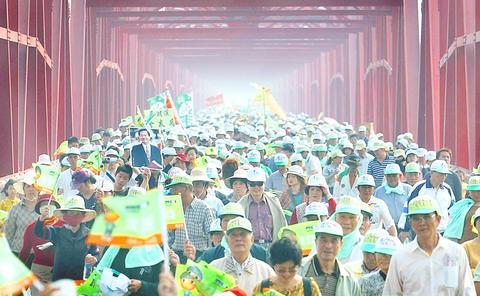
PHOTO: AP
"More than 1 million people have joined hands together to form a democratic great wall. This is a historic attempt by the people to show the world their love for Taiwan and the power that people have to write history with their own hands," Chen said at the rally yesterday.
Chen sent his regards to the participants, saying they had made this event possible, despite the doubts of some that the event would be successful.
Chen said the people of Taiwan had used the mildest, most joyful and dignified way to proclaim their solidarity and determination for peace to the world.
"However, this is just the beginning. We must continue our effort and cast referendum ballots on election day to maintain Taiwan's security," Chen said.
Lee said "seeing a big spectacle like this, in which more than 1 million people have come out to show their love for Taiwan, is the most touching moment I have ever witnessed in my life."
"Such is the power of the people, and this is a victory for the people of Taiwan," Lee said.
Although he appeared to be ailing slightly, Lee said that "the success of the 228 Hand-in-Hand Rally is the people's affirmation of Taiwan's national identity and a rejection of China's missile threats."
The massive human chain began in the north at Hoping Island near Keelung, and stretched 500km through 18 cities and counties in western Taiwan, ending at Changlung in Chiatung township, Pingtung County. The characters for "Hoping" and "Changlung" mean peace and prosperity.
Analyzing the event's influence on Chen's re-election prospects, Cheng Wen-tsan (
"This is also a very big victory for the DPP, as the party has emerged to represent mainstream opinion, as shown by the success of this massive rally. At this moment, we want to ask where the Chinese Nationalist Party (KMT) has been?" Cheng said.
The event also attracted numerous foreign reporters to Taiwan to cover the human chain.
Estonian reporter Mart Laane-mets said "through the event, people feel more and more that they are the bosses of the country, not politicians nor some party."
"When I saw a sign in the rally which said `In 1991, Bush says yes to Baltic States, in 2004, Bush says yes to Taiwan,' I, as a citizen of Estonia, felt very touched and proud and I hope the Baltic experience will be successful for Taiwan as well," Lannemets said.
On Aug. 23, 1989, the three Baltic states, Lithuania, Latvia and Estonia formed a 2 million-person human chain covering 600km to protest the former Soviet Union's occupation. Following the human chain protest, the three countries successfully held referendums to declare their independence from Russia.
Related Photos at Taiwan News Page
Also See Stories:
Remembering 228: Human chain bears message of peace
Remembering 228: Kaohsiung County surprises organizers
Remembering 228: Families and dogs bring festive atmosphere to Taipei
Remembering 228: Taipei County forms 22km-long link in the human chain
Remembering 228: Japanese Christians join Indonesians in Tainan County
Hearts and hugs mark blue-camp rally
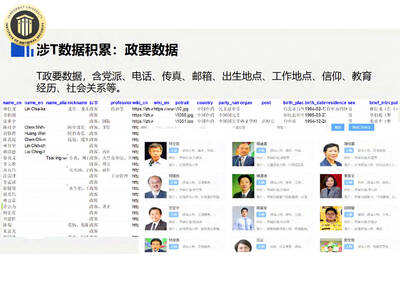
NETWORK-MAPPING PROJECT: The database contains 170 detailed files of Taiwanese politicians and about 23 million records of household registration data in Taiwan China has developed a network-mapping project targeting political figures and parties in Taiwan to monitor public opinion during elections and to craft tailored influence campaigns aimed at dividing Taiwanese society, according to documents leaked by Chinese technology firm GoLaxy (中科天璣). The documents, collected by Taipei-based Doublethink Lab, showed a database was specifically created to gather detailed information on Taiwanese political figures, including their political affiliations, job histories, birthplaces, residences, education, religion and a brief biography about them. Several notable Taiwanese politicians are in the database, including President William Lai (賴清德), former president Tsai Ing-wen (蔡英文), Minister of Foreign Affairs Lin Chia-lung (林佳龍),
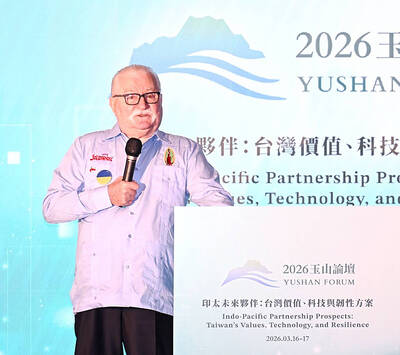
RECOGNITION: Former Fijian prime minister Mahendra Chaudhry said that Taiwan’s New Southbound Policy serves as a stabilizing force in the Indo-Pacific region Taiwan can lead the unification of the Chinese people, Nobel Peace Prize laureate and former Polish president Lech Walesa said in Taipei yesterday, adding that as the world order is changing, peaceful discussion would find good solutions, and that the use of force and coercion would always fail. Walesa made the remarks during his keynote address at a luncheon of the Yushan Forum in Taipei, titled “Indo-Pacific Partnership Prospects: Taiwan’s Values, Technology and Resilience,” organized by the Taiwan-Asia Exchange Foundation with the Ministry of Foreign Affairs. Walesa said that he had been at the forefront of a big peaceful revolution and “if
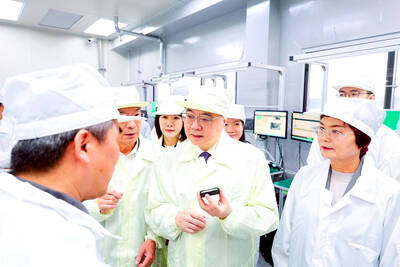
KEY INDUSTRY: The vice premier discussed a plan to create a non-red drone supply chain by next year, which has been allocated a budget of more than NT$7.2 billion The government has budgeted NT$44.2 billion (US$1.38 billion) to cultivate Taiwan’s uncrewed aerial vehicle (UAV) industry over the next five years, which would make the nation a major player in the industry’s democratic supply chain in the Asia-Pacific region, Premier Cho Jung-tai (卓榮泰) said yesterday. Cho made the remarks during a visit to the facilities of Cub Elecparts Inc (為升電裝). Democratic Progressive Party (DPP) Legislator Chen Su-yueh (陳素月) and Chinese Nationalist Party (KMT) Legislator Hsieh Yi-fong (謝依鳳) also participated in the trip. Cub Elecparts has transitioned from the automotive industry to the defense industry, which is the top priority among the nation’s
UPGRADED MISSILE: The Chungshan Institute of Science and Technology is reportedly to conduct a live-fire test of the Hsiung Feng III anti-ship missile on Thursday next week The US Army is planning to build new facilities to boost explosives production and strengthen its supply chain, a move aimed at addressing munitions shortages and supporting obligations to partners including Taiwan, Ukraine and Israel, Defense News reported. The army has issued a sources sought notice for a proposed Center of Excellence at the Blue Grass Army Depot in Kentucky, the report said. The facility would serve as a hub within the US industrial base for the production of key military explosives, including research department explosives (RDX) and high melting explosives (HMX), while also supporting research and development of next-generation materials. The proposed


 RSS
RSS