


President Chen Shui-bian (陳水扁) tried to reassure foreign investors yesterday that the March 20 referendum was the basis for stability and continued economic growth.
Speaking to members of the American Chamber of Commerce (AmCham) at the annual Hsieh Nien Fan dinner in Taipei, Chen said, "I have no doubt that, after the March 20 referendum and my re-election, the two sides [of the Taiwan Strait] will work actively and pragmatically to pursue such issues as the establishment of a framework for cross-strait interaction and stability, the protection of investment and the opening of trade and transport."
At yesterday's dinner, the de facto US ambassador, American Institute in Taiwan Director Douglas Paal, did not mention the referendum in his speech, and when questioned by reporters, AmCham president Andrea Wu (吳王小珍) said the chamber did not comment on political issues.
Paal concentrated instead on Taiwan's record on intellectual property rights (IPR), acknowledging recent improvements in the government's cracking down on infringements, but calling for sustained efforts in the fight against piracy.
"Taiwan has made some good progress in the past year -- passing the amendments to the Copyright Law and cracking down on producers of pirated optical disks [CDs, VCDs and DVDs]," Paal said.
"While the situation in Taiwan is far from where it can be, we recognize there have been some real improvements from where it was. We look forward to continued and sustained enforcement and efforts by the Taiwan government to improve their ability to protect intellectual property over the next year," he said.
The Chen administration has been trying hard to shake off Taiwan's reputation for lax IPR protection as the government tries to move from a manufacturing-based economy to a more high-technology design and services oriented one.
For the past three years, Taiwan has been placed on the US government's Special 301 Priority Watch List of serious IPR violators due to the high number of pirated optical disk seizures in the US that originate from Taiwan. The list is up for review in April.
Chen highlighted a report by the Business Software Alliance published last June that said the rate of pirated software here fell from 53 percent of all disks sold in 2001 to 43 percent in 2002, the highest drop of all developed nations. The global average is 39 percent, alliance figures show.
Chen also pointed to improvements in the economy, citing growth of 5.17 percent in the last three months of last year, adding that with new government construction projects, he hoped economic growth would top 5.5 percent this year. Most analysts have predicted growth of around 5 percent in Taiwan this year.
However, Chen's comments may not be enough to satisfy foreign businesses who lament the lack of direct transportation links between Taiwan and China, protectionist practices that exclude overseas companies from large-scale infrastructure projects here, and the high level of non-performing loans in domestic banks.
Chen pledged last night to improve these areas in line with the chamber's concerns.
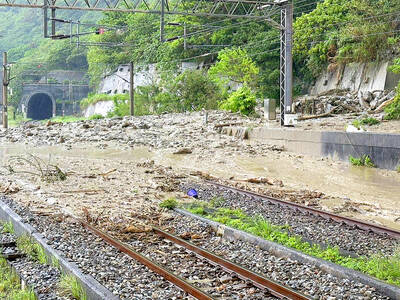
ROLLER-COASTER RIDE: More than five earthquakes ranging from magnitude 4.4 to 5.5 on the Richter scale shook eastern Taiwan in rapid succession yesterday afternoon Back-to-back weather fronts are forecast to hit Taiwan this week, resulting in rain across the nation in the coming days, the Central Weather Administration said yesterday, as it also warned residents in mountainous regions to be wary of landslides and rockfalls. As the first front approached, sporadic rainfall began in central and northern parts of Taiwan yesterday, the agency said, adding that rain is forecast to intensify in those regions today, while brief showers would also affect other parts of the nation. A second weather system is forecast to arrive on Thursday, bringing additional rain to the whole nation until Sunday, it

LANDSLIDES POSSIBLE: The agency advised the public to avoid visiting mountainous regions due to more expected aftershocks and rainfall from a series of weather fronts A series of earthquakes over the past few days were likely aftershocks of the April 3 earthquake in Hualien County, with further aftershocks to be expected for up to a year, the Central Weather Administration (CWA) said yesterday. Based on the nation’s experience after the quake on Sept. 21, 1999, more aftershocks are possible over the next six months to a year, the agency said. A total of 103 earthquakes of magnitude 4 on the local magnitude scale or higher hit Hualien County from 5:08pm on Monday to 10:27am yesterday, with 27 of them exceeding magnitude 5. They included two, of magnitude

CONDITIONAL: The PRC imposes secret requirements that the funding it provides cannot be spent in states with diplomatic relations with Taiwan, Emma Reilly said China has been bribing UN officials to obtain “special benefits” and to block funding from countries that have diplomatic ties with Taiwan, a former UN employee told the British House of Commons on Tuesday. At a House of Commons Foreign Affairs Committee hearing into “international relations within the multilateral system,” former Office of the UN High Commissioner for Human Rights (OHCHR) employee Emma Reilly said in a written statement that “Beijing paid bribes to the two successive Presidents of the [UN] General Assembly” during the two-year negotiation of the Sustainable Development Goals. Another way China exercises influence within the UN Secretariat is

Taiwan’s first drag queen to compete on the internationally acclaimed RuPaul’s Drag Race, Nymphia Wind (妮妃雅), was on Friday crowned the “Next Drag Superstar.” Dressed in a sparkling banana dress, Nymphia Wind swept onto the stage for the final, and stole the show. “Taiwan this is for you,” she said right after show host RuPaul announced her as the winner. “To those who feel like they don’t belong, just remember to live fearlessly and to live their truth,” she said on stage. One of the frontrunners for the past 15 episodes, the 28-year-old breezed through to the final after weeks of showcasing her unique


 RSS
RSS