


Nuclear-armed rivals India and Pakistan began historic meetings yesterday to prepare for a sustained peace dialogue on Kashmir and other disputes that have kept the neighbors at loggerheads for decades.
But violence continued in Kash-mir, with suspected militants killing a local politician in India's part of the Himalayan territory. In Paki-stan's portion, more than 500 people protested the meeting, saying neither country cared for the fate of Kashmiris.
Pakistan is keen to show quick progress during the three days of talks, which also are likely to cover confidence-building measures in the nuclear field to avoid an accident -- especially considering admissions of leaks of nuclear technology by the father of Pakistan's nuclear program.
The dialogue between the countries was first agreed to in 1997 and reaffirmed by Indian Prime Minister Atal Bihari Vajpa-yee and Pakistani President Pervez Musharraf during a January meeting in Islamabad on the fringes of a regional summit.
The two leaders had previously met for a failed peace summit in July 2001 in Agra, India.
Jalil Abbas Jilani, a director-general in Pakistan's Foreign Ministry, and Arun Kumar Singh, a joint secretary in India's External Affairs Ministry, shook hands and smiled before the start of yesterday's meeting. The sides met for nearly two hours in the morning before breaking for lunch.
In New Delhi, India's External Affairs Minister Yashwant Sinha expressed hope for the talks' success.
"I am quite optimistic over the outcome of this round of talks," which he noted would deal with the future agenda and other details for later meetings, the Press Trust of India news agency reported.
In the latest violence, suspected separatist rebels shot and killed a local politician yesterday in Srinagar, the summer capital of India's Jammu-Kashmir state, police said.
Two police officers nearby raced to the scene and opened fire on the assailants. One officer was killed and the other wounded. The attackers fled.

NO-LIMITS PARTNERSHIP: ‘The bottom line’ is that if the US were to have a conflict with China or Russia it would likely open up a second front with the other, a US senator said Beijing and Moscow could cooperate in a conflict over Taiwan, the top US intelligence chief told the US Senate this week. “We see China and Russia, for the first time, exercising together in relation to Taiwan and recognizing that this is a place where China definitely wants Russia to be working with them, and we see no reason why they wouldn’t,” US Director of National Intelligence Avril Haines told a US Senate Committee on Armed Services hearing on Thursday. US Senator Mike Rounds asked Haines about such a potential scenario. He also asked US Defense Intelligence Agency Director Lieutenant General Jeffrey Kruse

INSPIRING: Taiwan has been a model in the Asia-Pacific region with its democratic transition, free and fair elections and open society, the vice president-elect said Taiwan can play a leadership role in the Asia-Pacific region, vice president-elect Hsiao Bi-khim (蕭美琴) told a forum in Taipei yesterday, highlighting the nation’s resilience in the face of geopolitical challenges. “Not only can Taiwan help, but Taiwan can lead ... not only can Taiwan play a leadership role, but Taiwan’s leadership is important to the world,” Hsiao told the annual forum hosted by the Center for Asia-Pacific Resilience and Innovation think tank. Hsiao thanked Taiwan’s international friends for their long-term support, citing the example of US President Joe Biden last month signing into law a bill to provide aid to Taiwan,
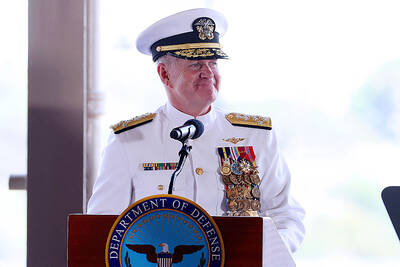
China’s intrusive and territorial claims in the Indo-Pacific region are “illegal, coercive, aggressive and deceptive,” new US Indo-Pacific Commander Admiral Samuel Paparo said on Friday, adding that he would continue working with allies and partners to keep the area free and open. Paparo made the remarks at a change-of-command ceremony at Joint Base Pearl Harbor-Hickam in Hawaii, where he took over the command from Admiral John Aquilino. “Our world faces a complex problem set in the troubling actions of the People’s Republic of China [PRC] and its rapid buildup of forces. We must be ready to answer the PRC’s increasingly intrusive and
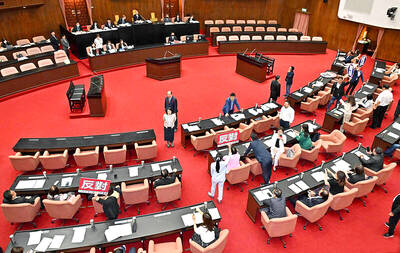
STATE OF THE NATION: The legislature should invite the president to deliver an address every year, the TPP said, adding that Lai should also have to answer legislators’ questions The Chinese Nationalist Party (KMT) yesterday proposed inviting president-elect William Lai (賴清德) to make a historic first state of the nation address at the legislature following his inauguration on May 20. Lai is expected to face many domestic and international challenges, and should clarify his intended policies with the public’s representatives, KMT caucus secretary-general Hung Meng-kai (洪孟楷) said when making the proposal at a meeting of the legislature’s Procedure Committee. The committee voted to add the item to the agenda for Friday, along with another similar proposal put forward by the Taiwan People’s Party (TPP). The invitation is in line with Article 15-2


 RSS
RSS