


"I don't want to go," were the words that eight-year-old Iruan Ergui Wu (
The police were trying to enforce a Supreme Court order in the long-running custody dispute regarding the Taiwanese-Brazilian boy's legal guardian.
The boy, the orphaned son of a Taiwanese fishing boat captain and his Brazilian wife, had been due to start a 40-hour journey to Brazil via Hong Kong and Johannesburg today, after the judge gave his uncle an ultimatum on Friday.
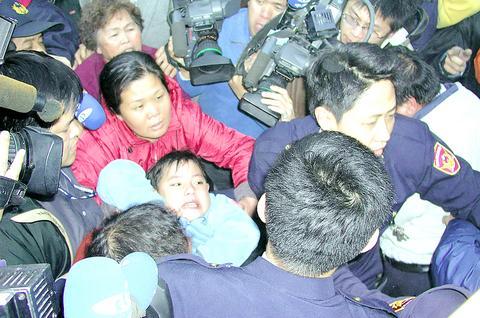
PHOTO: REUTERS
The custody battle between the child's uncle, Wu Huo-yen, and his Brazilian grandmother began three years ago.
The uncle, Wu Huo-yen (吳火眼), refused to hand over Iruan, but police seized the child and began carrying him away from Wu's house.
But intervention by neighbors, who scuffled with police at the scene while Iruan sat down on a sofa in the living room and began to cry, forced the police to retreat.
Although police officers said they would enforce the law no matter what, they were clearly unprepared for the angry mob of residents and swarm of journalists that surrounded them as they tried to get away with the child. To mollify the crowd, the police decided to leave Iruan at a neighbor's residence next to Wu's to comfort the boy while they awaited further instructions.
Yesterday was the deadline by which Iruan's uncle was ordered by the court to hand over the boy to Brazil Business Center Director Paulo Pinto, who is representing Iruan's grandmother, Rosa Ergui.
But the Taiwanese-Brazilian boy did not catch his flight.
Kaohsiung District Court Judge Liao Cheng-hsiung (
But, adding to the farce, the judge and his superior, Huang Guo-chuan (黃國川), negotiated with Wu's wife, Lee Su-hua (李素華), to let Iruan stay in Kaohsiung last night in police custody.
Pinto said in response that Iruan should have been in his custody. At press time, Pinto was waiting to learn where Iruan would be kept so that he could stay with him overnight before accompanying him to Kaohsiung International Airport.
Liao and Pinto had arrived at the Wu residence at 10am last Friday to carry out the court order stating that custody of Iruan belongs to Ergui and that the boy should be escorted back to his home in Porto Alegre, Brazil.
However, Iruan's uncle insisted that the legal process was not complete and said that Liao had no right to take Iruan away.
According to the district court, an official notice was delivered to Wu in person by police officers on Jan. 5. In accordance with the Civil Code (
Wu Huo-yen, however, insisted that he never signed any official notice.
Liao immediately handed another official notice to Wu Huo-yen at the scene and asked him to hand the boy over to the district court at 11am yesterday. Again, Wu Huo-yen and Iruan did not show up on time.
In the meantime, Lin Hsien-tung (林憲同), a lawyer who was hired by Wu on Sunday night, filed a request to keep Iruan in Taiwan until April.
The request was immediately rejected. In addition, Liao decided to issue an arrest warrant for Wu Huo-yen.
When approached by reporters, Pinto, however, said that the entire process was like a joke to him.
"They [the Wus] don't have to do this. We have prepared five visas for the Wu family members as well as Iruan's teacher. They can fly to Brazil with us as soon as they have their photos attached to these visas," he said.

‘NO SECURITY RISK’: The Railway Bureau reassured the public that the technicians’ activities were limited to technical guidance and did not involve sensitive systems The Railway Bureau yesterday said it had invited eight Chinese technicians to assist with an airport MRT construction project. The bureau issued the confirmation after an Internet user said Chinese nationals had entered the construction zone of Taiwan Taoyuan International Airport’s Terminal 3 project. They asked why “individuals from an enemy state” were allowed access to such a major national infrastructure project, which raised serious concerns over Taiwan’s industrial safety, sensitive systems and information security. The bureau’s Northern Region Engineering Branch Office said subcontractor Taiwan Handle Industrial Co (台灣手把工業) of the Taoyuan airport MRT’s “Contract No. CU05 Project A14 Station Civil, MEP &

The National Chungshan Institute of Science and Technology yesterday showcased its locally developed variants of the Vision 60 robotic patrol dog, which it plans to deploy on the nation’s outlying territories in the South China Sea. The variants were produced under the Joint Lab project — created by the institute and domestic companies — and assembled with domestically produced motors, lenses and artificial intelligence (AI) systems alongside licensed tech from the US, Missile and Rocket Systems Research Division deputy director Jen Kuo-kang (任國光) told the media event at a military base in Taipei’s Dazhi (大直) area. Taiwan has built up its strengths

NOT IMMEDIATE: Taiwan has a chance to appeal the proposed 10 percent tariff before it starts, while other countries face a 12.5 percent tariff from the trade office Taiwan is among 60 economies determined by the US to have failed to impose or enforce a ban on the importation of goods produced with forced labor, according to a notice released on Tuesday by the Office of the US Trade Representative (USTR), which proposed imposing an additional 10 percent or more tariff on them. The USTR in a statement said that following an investigation, it had determined under Section 301 of the Trade Act of 1974 that the failure of the 60 economies to impose and effectively enforce a prohibition on the importation of goods produced with forced labor is

TIT-FOR-TAT: The US allegedly revoked the visa of a Chinese national working at Xinhua News Agency in the US in response to Beijing’s expulsion of Vivian Wang The Presidential Office yesterday condemned China for expelling a New York Times correspondent from Beijing following the newspaper’s interview with President William Lai (賴清德), saying the move highlighted Beijing’s suppression of press freedom and its threat to international news media. Taiwan has noted a series of recent incidents in which Beijing used similar tactics to “threaten and pressure international media outlets and journalists,” Presidential Office spokeswoman Karen Kuo (郭雅慧) said in a statement. “This concerns not only press freedom and freedom of expression, but also the safety of journalists, and Taiwan and relevant partners are paying close attention to the situation,” she


 RSS
RSS