


Sri Lanka's president has dissolved parliament, paving the way for elections nearly three years ahead of schedule, a top presidential official said.
Janadasa Peiris, a senior aide to President Chandrika Kumaratunga, said Saturday the vote would be held April 2 and the new parliament would meet April 23.
Peiris did not give a reason for the president's decision to dissolve the 225-member legislature and call early elections, but said she would address the nation soon.
The next parliamentary elections were due in 2007.
The move came amid the president's bitter political battle with Prime Minister Ranil Wickreme-singhe, which started Nov. 4 when Kumaratunga seized control of the key defense, media and interior ministries from the prime minister's Cabinet.
Kumaratunga used her wide executive powers to create two new Cabinet appointments some five hours before the dissolution -- a step seen as potentially worsening the rift between the feuding leaders. They belong to rival political parties and were elected separately.
Peiris said that Lakshman Kadirgamar, a former foreign minister, was appointed as minister of information and telecommunications, while D.M. Jayarathne was appointed as minister of posts and communication.
Kumaratunga has broad executive powers and heads the security forces, while Wickremesinghe heads the legislature and runs day-to-day political affairs.
Wickremesinghe and his Cabinet now will assume caretaker functions with no power to make key decisions.
However, Kumaratunga is likely to sack some other ministers in coming days and restrict the caretaker government, an official said on condition of anonymity.
There are about 30 ministers in Wickremesinghe's Cabinet, in addition to about 20 more non-cabinet ministers.
Following the dissolution, Wickremesinghe immediately canceled a planned trip to Thailand.
"I will not go to Thailand as caretaker prime minister," Wickre-mesinghe said after Kumaratunga's move was announced.
Early elections had been expected since Kumaratunga's November power grab, and became more likely when her Sri Lanka Freedom Party formed an alliance -- the United People's Freedom Alliance -- with a powerful Marxist political party last month.
The new alliance has put pressure on Kumaratunga to call elections, the third since 2000, aimed at overthrowing Wickremesinghe's government.
The alliance claims the government has jeopardized the island's security by making too many concessions to Tamil Tiger rebels.
The dissolution could prompt more violence. The guerrillas have warned that an uncertain political situation may lead to a resumption of fighting.
The prime minister and Tamil rebels signed a Norwegian-brokered truce in February 2002, bringing a halt to 19 years of fighting that had killed nearly 65,000 people.
The truce led to peace talks between the two sides but negotiations are currently on hold because of the power struggle.
Kumaratunga and Wickreme-singhe disagree as to how the conflict should be resolved.
The Tamil Tigers launched their violent campaign for a separate Tamil homeland in 1983, claiming discrimination at the hands of the Sinhalese majority.
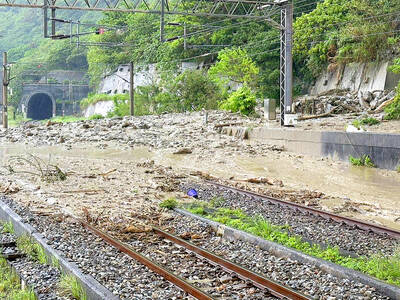
ROLLER-COASTER RIDE: More than five earthquakes ranging from magnitude 4.4 to 5.5 on the Richter scale shook eastern Taiwan in rapid succession yesterday afternoon Back-to-back weather fronts are forecast to hit Taiwan this week, resulting in rain across the nation in the coming days, the Central Weather Administration said yesterday, as it also warned residents in mountainous regions to be wary of landslides and rockfalls. As the first front approached, sporadic rainfall began in central and northern parts of Taiwan yesterday, the agency said, adding that rain is forecast to intensify in those regions today, while brief showers would also affect other parts of the nation. A second weather system is forecast to arrive on Thursday, bringing additional rain to the whole nation until Sunday, it
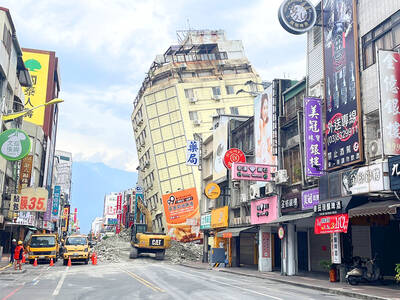
LANDSLIDES POSSIBLE: The agency advised the public to avoid visiting mountainous regions due to more expected aftershocks and rainfall from a series of weather fronts A series of earthquakes over the past few days were likely aftershocks of the April 3 earthquake in Hualien County, with further aftershocks to be expected for up to a year, the Central Weather Administration (CWA) said yesterday. Based on the nation’s experience after the quake on Sept. 21, 1999, more aftershocks are possible over the next six months to a year, the agency said. A total of 103 earthquakes of magnitude 4 on the local magnitude scale or higher hit Hualien County from 5:08pm on Monday to 10:27am yesterday, with 27 of them exceeding magnitude 5. They included two, of magnitude

CONDITIONAL: The PRC imposes secret requirements that the funding it provides cannot be spent in states with diplomatic relations with Taiwan, Emma Reilly said China has been bribing UN officials to obtain “special benefits” and to block funding from countries that have diplomatic ties with Taiwan, a former UN employee told the British House of Commons on Tuesday. At a House of Commons Foreign Affairs Committee hearing into “international relations within the multilateral system,” former Office of the UN High Commissioner for Human Rights (OHCHR) employee Emma Reilly said in a written statement that “Beijing paid bribes to the two successive Presidents of the [UN] General Assembly” during the two-year negotiation of the Sustainable Development Goals. Another way China exercises influence within the UN Secretariat is

Taiwan’s first drag queen to compete on the internationally acclaimed RuPaul’s Drag Race, Nymphia Wind (妮妃雅), was on Friday crowned the “Next Drag Superstar.” Dressed in a sparkling banana dress, Nymphia Wind swept onto the stage for the final, and stole the show. “Taiwan this is for you,” she said right after show host RuPaul announced her as the winner. “To those who feel like they don’t belong, just remember to live fearlessly and to live their truth,” she said on stage. One of the frontrunners for the past 15 episodes, the 28-year-old breezed through to the final after weeks of showcasing her unique


 RSS
RSS