


An agreement on scheduling the first televised debates in the history of Taiwanese presidential politics was reached yesterday by the Democratic Progressive Party (DPP) and the Chinese Nationalist Party (KMT)-People First Party (PFP) alliance.
Two debates between the presidential candidates -- President Chen Shui-bian (

PHOTO: LUO PEI-TEH, TAIPEI TIMES
The afternoon of Feb. 21 had originally been set aside by the Central Election Commission for the presidential candidates to elaborate on their platforms, but the pan-blue and pan-green camps have decided to skip this event in order to make room for one of the two debates.
The two sides agreed that the topic of the debates would be national policies. This broad topic was agreed upon after the two sides failed to come to terms on more specific topics.
According to the agreement, anything relating to the topic can be discussed, including the upcoming referendum.
Each debate will be divided into four sections.
In the first section, each candidate will have eight minutes in which to speak about his vision of the country's future.
In the second section, five questioners will ask the candidates about their platforms.
In the third section, the candidates will be able to pose questions to one another.
In the final section, the candidates will each have eight minutes in which to make a concluding statement.
The moderator of the debate and the individuals who will ask questions of the candidates will be selected by the debate's co-sponsors -- based on the principles of professionalism and impartiality. Both camps will be consulted before the choices for moderator and questioners are finalized.
The debate's co-sponsors are the Taipei Society (
The agreement was reached yesterday when representatives from the DPP, the KMT-PFP alliance and the debate's co-sponsors resumed earlier negotiations that had been abandoned when the DPP refused to participate due to the absence from the negotiations of Taipei Mayor and pan-blue campaign manager Ma Ying-jeou (馬英九). The DPP said that the pan-blue camp had not demonstrated good faith because it had sent to the negotiations three representatives whose stature was not commensurate with that of the DPP's representatives.
At yesterday's negotiating session the pan-blue alliance was represented by Ma, KMT policy convener Tseng Yung-chuan (曾永權), KMT Legislator Yu Tzu-shiang (游梓翔) and PFP caucus leader Chou Hsi-wei (周錫瑋).
The DPP was represented by its national campaign chief Wu Nai-jen (吳乃仁), Taipei County Commissioner and DPP campaign manager Su Tseng-chang (蘇貞昌) and legislators Cho Jung-tai (卓榮泰) and Lo Wen-chia (羅文嘉).
During yesterday's negotiations, the pan-blue camp originally proposed holding only one televised debate, concentrating on economic issues.
The DPP proposed holding at least four debates, concentrating on national development, political reform, economics and social welfare.
In the end the parties agreed to two debates organized around the broad topic of national policies.
"Although we are not satisfied with the result, we can accept it," Su said.
"We still hope that there is a possibility for more televised debates." Su said.
Ma on the other hand expressed satisfaction with the result.
"On behalf of the pan-blue alliance, I am satisfied with the conclusion," Ma said.
Both camps expressed willingness to discuss the possibility of debates involving the vice presidential candidates, though no concrete proposals for such debates were made during the negotiating session.
Also see story:
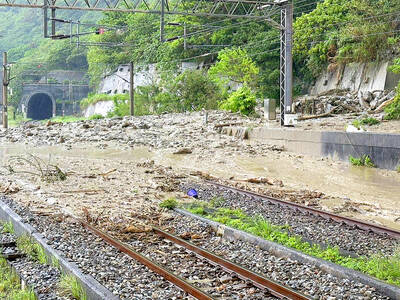
ROLLER-COASTER RIDE: More than five earthquakes ranging from magnitude 4.4 to 5.5 on the Richter scale shook eastern Taiwan in rapid succession yesterday afternoon Back-to-back weather fronts are forecast to hit Taiwan this week, resulting in rain across the nation in the coming days, the Central Weather Administration said yesterday, as it also warned residents in mountainous regions to be wary of landslides and rockfalls. As the first front approached, sporadic rainfall began in central and northern parts of Taiwan yesterday, the agency said, adding that rain is forecast to intensify in those regions today, while brief showers would also affect other parts of the nation. A second weather system is forecast to arrive on Thursday, bringing additional rain to the whole nation until Sunday, it
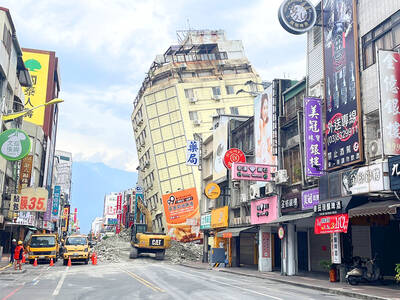
LANDSLIDES POSSIBLE: The agency advised the public to avoid visiting mountainous regions due to more expected aftershocks and rainfall from a series of weather fronts A series of earthquakes over the past few days were likely aftershocks of the April 3 earthquake in Hualien County, with further aftershocks to be expected for up to a year, the Central Weather Administration (CWA) said yesterday. Based on the nation’s experience after the quake on Sept. 21, 1999, more aftershocks are possible over the next six months to a year, the agency said. A total of 103 earthquakes of magnitude 4 on the local magnitude scale or higher hit Hualien County from 5:08pm on Monday to 10:27am yesterday, with 27 of them exceeding magnitude 5. They included two, of magnitude

CONDITIONAL: The PRC imposes secret requirements that the funding it provides cannot be spent in states with diplomatic relations with Taiwan, Emma Reilly said China has been bribing UN officials to obtain “special benefits” and to block funding from countries that have diplomatic ties with Taiwan, a former UN employee told the British House of Commons on Tuesday. At a House of Commons Foreign Affairs Committee hearing into “international relations within the multilateral system,” former Office of the UN High Commissioner for Human Rights (OHCHR) employee Emma Reilly said in a written statement that “Beijing paid bribes to the two successive Presidents of the [UN] General Assembly” during the two-year negotiation of the Sustainable Development Goals. Another way China exercises influence within the UN Secretariat is

Taiwan’s first drag queen to compete on the internationally acclaimed RuPaul’s Drag Race, Nymphia Wind (妮妃雅), was on Friday crowned the “Next Drag Superstar.” Dressed in a sparkling banana dress, Nymphia Wind swept onto the stage for the final, and stole the show. “Taiwan this is for you,” she said right after show host RuPaul announced her as the winner. “To those who feel like they don’t belong, just remember to live fearlessly and to live their truth,” she said on stage. One of the frontrunners for the past 15 episodes, the 28-year-old breezed through to the final after weeks of showcasing her unique


 RSS
RSS