


An Iraqi military defector identified as unreliable by the Defense Intelligence Agency (DIA) provided some of the information that went into US intelligence estimates that Iraq had stockpiles of biological weapons at the time of the US invasion last March, senior government officials said on Friday.
A classified "fabrication notification" about the defector, a former Iraqi major, was issued by the DIA to other US intelligence agencies in May 2002, but it was then repeatedly overlooked, three senior intelligence officials said. Intelligence agencies use such notifications to alert other agencies to information they consider unreliable because its source is suspected of making up or embellishing information.
Because the warning went unheeded, the officials said, the defector's claims that Iraq had built mobile research laboratories to produce biological weapons were mistakenly included in, among other findings, the National Intelligence Estimate of October 2002, which concluded that Iraq most likely had significant biological stockpiles.
Intelligence officers from the DIA interviewed the defector twice in early 2002 and circulated reports based on those debriefings. They concluded he had no firsthand information and might have been coached by the Iraqi National Congress, the officials said. That group, headed by Ahmad Chalabi, who had close ties to the Pentagon and Vice President Dick Cheney, had introduced the defector to US intelligence, the officials said.
Nevertheless, because of what the officials described as a mistake, the defector was among four sources cited by Secretary of State Colin Powell in his presentation to the UN Security Council last February as having provided "eyewitness accounts" about mobile biological weapons facilities in Iraq, the officials said. The defector had described mobile biological research laboratories, as distinct from the mobile biological production factories mounted on trailers that were described by other sources.
The intelligence about the mobile facilities was central to the prewar conclusion that Iraq was producing biological arms, senior intelligence officials have said. No such arms or production facilities have been found in Iraq since the war, and David Kay, the former chief weapons inspector, has said he believes that Iraq never produced large stockpiles of the weapons during the 1990s.
Soon after the invasion, US troops in Iraq discovered suspicious trailers that were initially described by the CIA as having been designed as factories for biological weapons. But most analysts have since concluded that they were used to make hydrogen for weather balloons.
Kay reported in October that American inspectors had found "a network of laboratories and safe houses controlled by Iraqi intelligence and security services" that contained equipment for chemical and biological research. But US officials have not described any discovery of the mobile laboratories described by the Iraqi major.
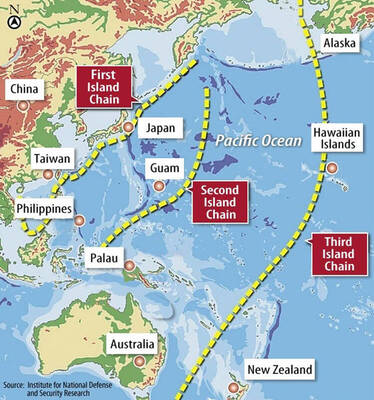
The US government has signed defense cooperation agreements with Japan and the Philippines to boost the deterrence capabilities of countries in the first island chain, a report by the National Security Bureau (NSB) showed. The main countries on the first island chain include the two nations and Taiwan. The bureau is to present the report at a meeting of the legislature’s Foreign Affairs and National Defense Committee tomorrow. The US military has deployed Typhon missile systems to Japan’s Yamaguchi Prefecture and Zambales province in the Philippines during their joint military exercises. It has also installed NMESIS anti-ship systems in Japan’s Okinawa

‘WIN-WIN’: The Philippines, and central and eastern European countries are important potential drone cooperation partners, Minister of Foreign Affairs Lin Chia-lung said Minister of Foreign Affairs Lin Chia-lung (林佳龍) in an interview published yesterday confirmed that there are joint ventures between Taiwan and Poland in the drone industry. Lin made the remark in an exclusive interview with the Chinese-language Liberty Times (the Taipei Times’ sister paper). The government-backed Taiwan Excellence Drone International Business Opportunities Alliance and the Polish Chamber of Unmanned Systems on Wednesday last week signed a memorandum of understanding in Poland to develop a “non-China” supply chain for drones and work together on key technologies. Asked if Taiwan prioritized Poland among central and eastern European countries in drone collaboration, Lin

Renewed border fighting between Thailand and Cambodia showed no signs of abating yesterday, leaving hundreds of thousands of displaced people in both countries living in strained conditions as more flooded into temporary shelters. Reporters on the Thai side of the border heard sounds of outgoing, indirect fire yesterday. About 400,000 people have been evacuated from affected areas in Thailand and about 700 schools closed while fighting was ongoing in four border provinces, said Thai Rear Admiral Surasant Kongsiri, a spokesman for the military. Cambodia evacuated more than 127,000 villagers and closed hundreds of schools, the Thai Ministry of Defense said. Thailand’s military announced that

CABINET APPROVAL: People seeking assisted reproduction must be assessed to determine whether they would be adequate parents, the planned changes say Proposed amendments to the Assisted Reproduction Act (人工生殖法) advanced yesterday by the Executive Yuan would grant married lesbian couples and single women access to legal assisted reproductive services. The proposed revisions are “based on the fundamental principle of respecting women’s reproductive autonomy,” Cabinet spokesperson Michelle Lee (李慧芝) quoted Vice Premier Cheng Li-chiun (鄭麗君), who presided over a Cabinet meeting earlier yesterday, as saying at the briefing. The draft amendment would be submitted to the legislature for review. The Ministry of Health and Welfare, which proposed the amendments, said that experts on children’s rights, gender equality, law and medicine attended cross-disciplinary meetings, adding that


 RSS
RSS