


The George W. Bush administration is "relieved" that President Chen Shui-bian (
But officials note that overall US-Taiwan relations extend far beyond the referendum issue, and describe the relationship as "very strong."
They also say that the referendum wording Chen unveiled last week appears to remove what Washington saw as the threat to the status quo in cross-strait relations contained in Chen's earlier referendum plan, which was aimed directly at China's missile buildup across the Strait.
Such a threat was Bush's main concern when he slammed Chen and his referendum plan after meeting with Chinese Premier Wen Jiabao (
Nevertheless, while the administration will not oppose the new wording, it will not endorse it either, said one senior US official.
The US government's response to the new referendum wording, conveyed by US officials, seems to portray an administration still worried about Chen's aims and concerned that the referendum issue could still blow up into a problem for cross-strait issues and the US-China-Taiwan triangular equation.
What comes out of one interview the Taipei Times conducted with a senior official is a range of uncertainties that Chen has not answered, and deep questioning of Chen's leadership ability in calling for a public opinion poll on issues he, as president, should decide himself.
On the first question that the planned referendum proposes to ask whether Taiwan should spend more on arms in view of the missile threat, a US official noted Washington's efforts over recent years to convince Taiwan to spend more on defense and buy the weapons Bush promised in April 2001.
"We're willing to work with them on that," the official said.
"So this strikes me more as a question of leadership, then going to the public of Taiwan to ask for its opinion of this. This requires real leadership," he said.
"There's a threat there, and it requires expending resources and making decisions in Taiwan. That's what leaders need to do.
"We want to see more leadership out of Taiwan authorities on questions of defense, and turning it over to a question to the public I don't see as terribly helpful," he said.
He said the second referendum question on resuming cross-strait talks also is matter for the leaders to decide.
"We think both sides should take steps to resume a dialogue that has been stopped for years, or in the absence of a formal dialogue, finding ways to promote peace and stability between the two sides."
Saying that the administration still has not decided what to make of the new referendum formulation, the official said, "it depends on what your standard of measurement is."
"If your standard of measurement is `Is this a normal and genuine attempt to use the referendum in a way democracies normally do to settle contentious issues?' it's not really that.
"It still remains in the category of a highly symbolic move, and it is primarily designed to promote the domestic political fortunes of one candidate," he said.
"It could have been a lot worse. So I think officially what the United States is going to say is we don't endorse any particular referendum, but it's not something that we are going to oppose. We'll write it off as Taiwan's own business and their domestic politics."
The US will judge the referendum on more than just its wording, the official said. Washington will look at it in a broader way.
"It's not just the words. It's the actions and the context that Chen and others are going to put to this. So, we'll see how he pitches things to a variety of audiences. Like a good politician, he has been known to speak to his core supporters in one way, and others in other ways," the official said.
The referendum issue is not likely to be a long-lasting irritant to US-Taiwan relations, officials say. "We've never wanted to define our relationship through the prism of a referendum. It's a more comprehensive relationship than just that," the official said.
Bush, the official said, in his rebuff to Chen's earlier referendum plan, "was clear in what he thought was going on and directed himself at what he thought the leader of Taiwan was going to do."
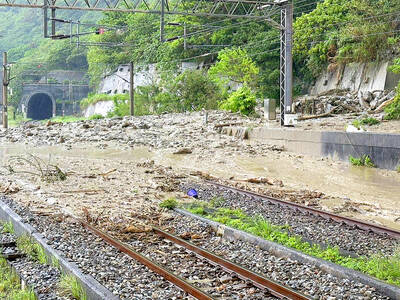
ROLLER-COASTER RIDE: More than five earthquakes ranging from magnitude 4.4 to 5.5 on the Richter scale shook eastern Taiwan in rapid succession yesterday afternoon Back-to-back weather fronts are forecast to hit Taiwan this week, resulting in rain across the nation in the coming days, the Central Weather Administration said yesterday, as it also warned residents in mountainous regions to be wary of landslides and rockfalls. As the first front approached, sporadic rainfall began in central and northern parts of Taiwan yesterday, the agency said, adding that rain is forecast to intensify in those regions today, while brief showers would also affect other parts of the nation. A second weather system is forecast to arrive on Thursday, bringing additional rain to the whole nation until Sunday, it
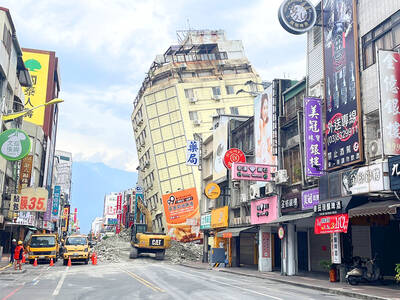
LANDSLIDES POSSIBLE: The agency advised the public to avoid visiting mountainous regions due to more expected aftershocks and rainfall from a series of weather fronts A series of earthquakes over the past few days were likely aftershocks of the April 3 earthquake in Hualien County, with further aftershocks to be expected for up to a year, the Central Weather Administration (CWA) said yesterday. Based on the nation’s experience after the quake on Sept. 21, 1999, more aftershocks are possible over the next six months to a year, the agency said. A total of 103 earthquakes of magnitude 4 on the local magnitude scale or higher hit Hualien County from 5:08pm on Monday to 10:27am yesterday, with 27 of them exceeding magnitude 5. They included two, of magnitude
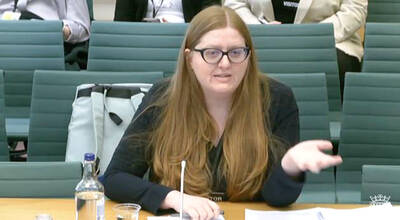
CONDITIONAL: The PRC imposes secret requirements that the funding it provides cannot be spent in states with diplomatic relations with Taiwan, Emma Reilly said China has been bribing UN officials to obtain “special benefits” and to block funding from countries that have diplomatic ties with Taiwan, a former UN employee told the British House of Commons on Tuesday. At a House of Commons Foreign Affairs Committee hearing into “international relations within the multilateral system,” former Office of the UN High Commissioner for Human Rights (OHCHR) employee Emma Reilly said in a written statement that “Beijing paid bribes to the two successive Presidents of the [UN] General Assembly” during the two-year negotiation of the Sustainable Development Goals. Another way China exercises influence within the UN Secretariat is
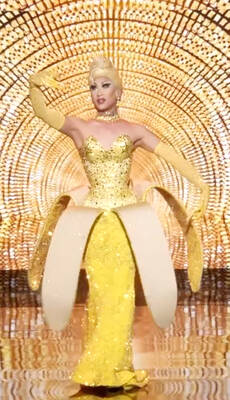
Taiwan’s first drag queen to compete on the internationally acclaimed RuPaul’s Drag Race, Nymphia Wind (妮妃雅), was on Friday crowned the “Next Drag Superstar.” Dressed in a sparkling banana dress, Nymphia Wind swept onto the stage for the final, and stole the show. “Taiwan this is for you,” she said right after show host RuPaul announced her as the winner. “To those who feel like they don’t belong, just remember to live fearlessly and to live their truth,” she said on stage. One of the frontrunners for the past 15 episodes, the 28-year-old breezed through to the final after weeks of showcasing her unique


 RSS
RSS