


The Ministry of Foreign Affairs (MOFA) yesterday asserted that the US does not oppose Taiwan's referendum plans, despite the concern expressed by Washington over the proposal.
In a background press conference on US President George W. Bush's meeting with Chinese Premier Wen Jiabao (溫家寶) in Washington, a high-ranking MOFA official who asked to remain anonymous said: "The US does not oppose Taiwan's holding referendums."
At his meeting with Wen earlier in the week, Bush said: "The comments and actions made by the leader of Taiwan indicate that he may be willing to make decisions unilaterally that change the status quo, which we oppose."
In efforts to quash grim media speculation on the future of Taiwan-US relations after the Bush-Wen meeting, the official clarified that Bush did not say the US opposes Taiwan's referendum plan in his reprimand of President Chen Shui-bian (
While Bush's remarks have widely been interpreted as targeting Chen's proposal to hold a referendum with next year's presidential election, the official said Bush was actually expressing concerns over some "comments and actions" Chen made in his presidential campaign.
The official said what the US was worried about was Chen's moves that might "change the status quo or lead to Taiwan's independence."
But the official, like White House spokesmen, would not specify which comments or actions by Chen had threatened the status quo.
Bush's warning to Taiwan at his meeting with Wen was within the ministry's expectations, the official said.
The ministry acknowledged that Taiwan's intense communications with the US on the referendum agenda over the past few months had failed to fill the gap in both sides' understanding of the issue.
The official did not explain exactly what had gone wrong with Taiwan's communication with the US.
The official declined to say why Taiwan had failed to take US concerns about the referendum issue into account, and he would not confirm reported visits by Bush envoys to caution Chen against moves that might alter the status quo.
The leaders of Taiwan and the US lack a formal communication channel because they do not have official diplomatic ties, the official noted.
Bush's open reprimand to Chen also aroused questions about why Chen had felt confident enough to tell a mass rally a few days ago that he had settled Taiwan-US relations enough to safely press ahead with his referendum proposal.
Commenting on the apparent chasm between Chen's appeasing words to his supporters and Bush's warning against him, the official said Chen's and Bush's remarks were made on different occasions.
"They were not in a dialogue," the official said.
The official said it was the ministry's belief that North Korea's nuclear program and the US-led war against terror were in part responsible for Bush's harsh tone on Taiwan in his meeting with Wen.
The Bush-Wen meeting was a crucial occasion to solve problems both China and the US are concerned about, the official said.
The official denied that Taiwan-US relations have suffered a serious setback after the Bush-Wen meeting and emphasized that "the mutual trust between Taiwan and the US has not been lost."
Analysts regarded Bush's comments as a severe setback in Taiwan-US relations, but the ministry said such speculation was untrue and biased. The official noted Bush also pledged to get involved if China uses force against Taiwan.
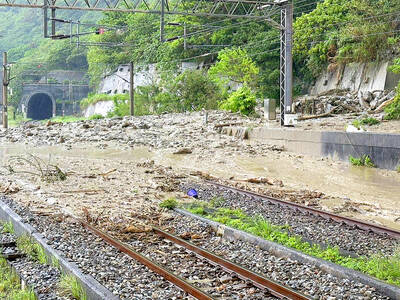
ROLLER-COASTER RIDE: More than five earthquakes ranging from magnitude 4.4 to 5.5 on the Richter scale shook eastern Taiwan in rapid succession yesterday afternoon Back-to-back weather fronts are forecast to hit Taiwan this week, resulting in rain across the nation in the coming days, the Central Weather Administration said yesterday, as it also warned residents in mountainous regions to be wary of landslides and rockfalls. As the first front approached, sporadic rainfall began in central and northern parts of Taiwan yesterday, the agency said, adding that rain is forecast to intensify in those regions today, while brief showers would also affect other parts of the nation. A second weather system is forecast to arrive on Thursday, bringing additional rain to the whole nation until Sunday, it
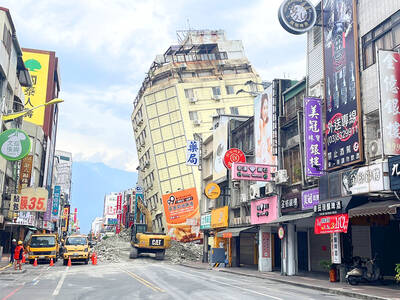
LANDSLIDES POSSIBLE: The agency advised the public to avoid visiting mountainous regions due to more expected aftershocks and rainfall from a series of weather fronts A series of earthquakes over the past few days were likely aftershocks of the April 3 earthquake in Hualien County, with further aftershocks to be expected for up to a year, the Central Weather Administration (CWA) said yesterday. Based on the nation’s experience after the quake on Sept. 21, 1999, more aftershocks are possible over the next six months to a year, the agency said. A total of 103 earthquakes of magnitude 4 on the local magnitude scale or higher hit Hualien County from 5:08pm on Monday to 10:27am yesterday, with 27 of them exceeding magnitude 5. They included two, of magnitude
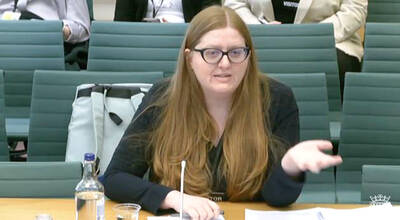
CONDITIONAL: The PRC imposes secret requirements that the funding it provides cannot be spent in states with diplomatic relations with Taiwan, Emma Reilly said China has been bribing UN officials to obtain “special benefits” and to block funding from countries that have diplomatic ties with Taiwan, a former UN employee told the British House of Commons on Tuesday. At a House of Commons Foreign Affairs Committee hearing into “international relations within the multilateral system,” former Office of the UN High Commissioner for Human Rights (OHCHR) employee Emma Reilly said in a written statement that “Beijing paid bribes to the two successive Presidents of the [UN] General Assembly” during the two-year negotiation of the Sustainable Development Goals. Another way China exercises influence within the UN Secretariat is
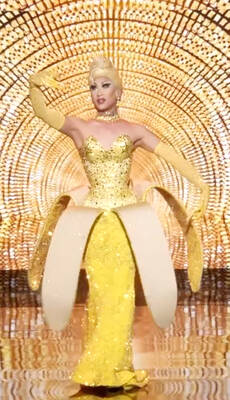
Taiwan’s first drag queen to compete on the internationally acclaimed RuPaul’s Drag Race, Nymphia Wind (妮妃雅), was on Friday crowned the “Next Drag Superstar.” Dressed in a sparkling banana dress, Nymphia Wind swept onto the stage for the final, and stole the show. “Taiwan this is for you,” she said right after show host RuPaul announced her as the winner. “To those who feel like they don’t belong, just remember to live fearlessly and to live their truth,” she said on stage. One of the frontrunners for the past 15 episodes, the 28-year-old breezed through to the final after weeks of showcasing her unique


 RSS
RSS