


A defiant President Chen Shui-bian (
"The realization of a national referendum, which is set to maintain peace and the status quo of the Taiwan Strait, is not only significant to Taiwan's democracy but also is very important to the entire Asia-Pacific region and the rest the world," Chen said.
Chen's remarks came on the heels of an unprecedented rebuke from US President George W. Bush concerning Chen's aims.
Bush, Tuesday, personally and publicly criticized the referendum plan, confirming in strong terms the heightened concern of his administration that the plan could badly affect US interests by destabilizing the situation in the Taiwan Strait.
Bush made his remarks in a brief press conference at the end of a 40-minute meeting with Chinese Premier Wen Jiabao (
Bush told reporters that he had just told Wen "we oppose any unilateral decision by either China or Taiwan to change the status quo.
"And the comments and actions made by the leader of Taiwan indicate that he may be willing to make decisions unilaterally to change the status quo, which we oppose."
And, while US spokesmen said the administration stuck to its policy that it "does not support Taiwan independence," Wen told the reporters that Bush reiterated to him US "opposition to Taiwan independence," a phrase Bush did not correct or object to.
"We very much appreciate the position adopted by President Bush toward the latest moves and developments in Taiwan, that is, the attempt to resort to referendums of various kinds as an excuse to pursue Taiwan independence," Wen told reporters.
No change on defense
But at the same time, a senior administration official disclosed that Bush also told Wen that if China uses force or coercion against Taiwan, then "we'll have to get involved."
Asked how that statement compared with Bush's pledge in April 2001 that he would do "whatever it took" to help in Taiwan's defense, the official, speaking on condition of anonymity, said: "In his comments to the Chinese, the president did make it very clear that he still sticks by what he said in the year 2001."
In a background briefing after the Bush-Wen meeting, the unnamed official said "the president's top goal is preserving the peace in the Taiwan Strait. We are in no way abandoning support for Taiwan's democracy or for the spread of freedom."
However, he said: "We're seeing developments on both sides of the Strait forcing us to drop some of the ambiguity that has been the policy in the past."
He said Bush told Wen "in no uncertain terms" that the US "would get involved if China tried to use coercion or force to unilaterally change the status of Taiwan." Bush was "very, very forceful on this issue," he said.
On the other hand, the official described Chen's moves as potentially dangerous. "We think anything that looks like a unilateral move toward independence on the part of Taiwan can start down a dangerous road," and is opposed by the Bush administration. "We don't welcome it. We urge caution," the official said.
No change intended
Chen, however denied that it was the intention of the referendum to change the status quo and continued to insist that its purpose was to bolster rather than disrupt stability in the Strait.
"Taiwan is an independent country," Chen said when receiving US Congressman Dan Burton at the Presidential Office yesterday morning. "As the head of state, my mission and obligation is to protect the country's sovereignty, safety, and we must defend Taiwan's current independence status quo from being changed."
"The purpose of the `defensive referendum' is to avoid war, to calm people's fears, and to maintain Taiwan's status quo" Chen said.
"We have no intention to change Taiwan's status quo and we will not allow it to be changed," Chen said.
"But the status quo we want to maintain is a peaceful and stable Taiwan rather than a situation filled with military threats and missile deployment," he stressed.
Chen also stressed that the referendum was important to Taiwan's democratic development, something which, from the outset, China has never been able to accept.
opposed to any democratic change
China has never supported Taiwan's democratic achievements, including the lifting of bans on organizing media and political parties, parliamentary reforms, and direct elections for the president, Chen said.
"China even regarded those developments as `provocative actions' and steps toward independence," the president said.
"Despite China's opposition, however, the people of Taiwan still continued to walk on their own path and successfully accomplished those democratic reforms," Chen said.
He stressed that China can resist being democratic or undertaking reforms, but it has no right to oppose or distort Taiwan's democratic reforms.
US officials, however, dismissed the contention that a referendum is a necessary part of democratic development, a reason Chen has given for holding one, and that by opposing the referendum the US is "thwarting democratic impulses" in Taiwan.
"It would be a big mistake to say that any particular referendum is the essence of democracy. Democracy is much more than that. Democracy is alive and well in Taiwan, and the US is strongly in support of it," said the unnamed US official who had described Chen's moves as "potentially dangerous."
Chen also appealed to other countries to examine their attitude toward China's military threat and recognize that Taiwan had to react to this threat and was doing so peacefully.
"The international community should neither just take China's military threat as a matter of course," Chen said.
"Nor should it regard the Taiwanese people's determination and efforts in strengthening their democracy as well as securing peace, and expressing concern about the missile threat, as actions of provocation," Chen said.
Chen stressed that Taiwan will not allow China or a few unelected leaders in Beijing to unilaterally determine the definition of democracy, provocation and peace
Despite Bush's tough statement, which took many observers in Washington by surprise, administration spokesmen struggled to maintain that US policy toward Taiwan has not changed.
Shortly after the Bush-Wen meeting, White House spokesman Scott McClellan told reporters that "our policy remains the same."
"The president made it clear that [his warning] applies to both Beijing's possible use of force and Taiwan itself, including referenda and constitutional reform that would change the status quo."
"It is our view," he went on, "that the recent statements and proposals coming out of Taiwan ... would imply a desire to change the status quo."
McClellan refused to discuss the possibility of any retaliatory action by Washington, such as sanctions or reduced arms sales, calling them "hypotheticals."
"I think we will continue to emphasize what we already have," he said
A source from the Presidential Office echoed this, but at the same time, said that Chen has "fully noted" Bush's serious concern.
They said that Bush was under pressure from his own National Security Council (NSC).
"We understand that the Bush administration's NSC seems to be less trustful of Taiwan," the source said. "However, President Bush's remark still showed that the US government has left space for more communication between the two sides."
The sources said that they had worked out a number of scenarios in connection with Wen's trip and little that was said surprised them.
The only two elements that did surprise them were Bush's saying he was "opposed" to the defensive referendum rather than using a weaker formula such as "does not support" and Bush's direct criticism of the "leader of Taiwan" instead of referring to the Taiwan government in general terms.
Deputy Secretary-General to the President Joseph Wu (吳釗燮) also said that Taiwan would like to show understanding that the US government must make a goodwill gesture to Wen, but Taiwan was also comforted by the fact that the Bush administration had shown no special favor toward China in the triangular US-Taiwan-China relationship.
"We can see that the US reaffirmed it will get `involved' if China takes military action against Taiwan," Wu said
"And the remark was not modified by any precondition such as an act of provocation by Taiwan," he said, adding " we can say that the US intended to make its stance clearer to both sides of Taiwan Strait," he said.
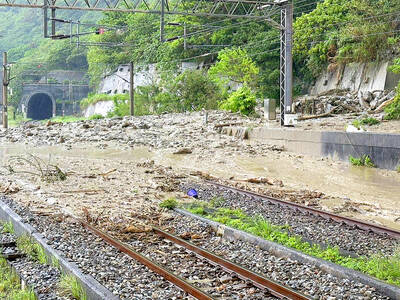
ROLLER-COASTER RIDE: More than five earthquakes ranging from magnitude 4.4 to 5.5 on the Richter scale shook eastern Taiwan in rapid succession yesterday afternoon Back-to-back weather fronts are forecast to hit Taiwan this week, resulting in rain across the nation in the coming days, the Central Weather Administration said yesterday, as it also warned residents in mountainous regions to be wary of landslides and rockfalls. As the first front approached, sporadic rainfall began in central and northern parts of Taiwan yesterday, the agency said, adding that rain is forecast to intensify in those regions today, while brief showers would also affect other parts of the nation. A second weather system is forecast to arrive on Thursday, bringing additional rain to the whole nation until Sunday, it
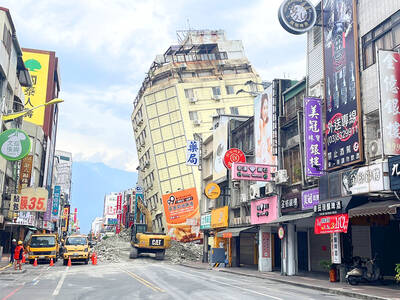
LANDSLIDES POSSIBLE: The agency advised the public to avoid visiting mountainous regions due to more expected aftershocks and rainfall from a series of weather fronts A series of earthquakes over the past few days were likely aftershocks of the April 3 earthquake in Hualien County, with further aftershocks to be expected for up to a year, the Central Weather Administration (CWA) said yesterday. Based on the nation’s experience after the quake on Sept. 21, 1999, more aftershocks are possible over the next six months to a year, the agency said. A total of 103 earthquakes of magnitude 4 on the local magnitude scale or higher hit Hualien County from 5:08pm on Monday to 10:27am yesterday, with 27 of them exceeding magnitude 5. They included two, of magnitude
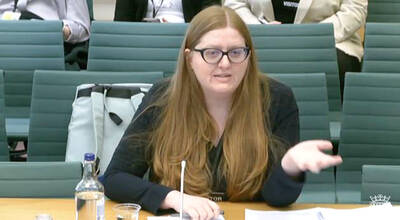
CONDITIONAL: The PRC imposes secret requirements that the funding it provides cannot be spent in states with diplomatic relations with Taiwan, Emma Reilly said China has been bribing UN officials to obtain “special benefits” and to block funding from countries that have diplomatic ties with Taiwan, a former UN employee told the British House of Commons on Tuesday. At a House of Commons Foreign Affairs Committee hearing into “international relations within the multilateral system,” former Office of the UN High Commissioner for Human Rights (OHCHR) employee Emma Reilly said in a written statement that “Beijing paid bribes to the two successive Presidents of the [UN] General Assembly” during the two-year negotiation of the Sustainable Development Goals. Another way China exercises influence within the UN Secretariat is

Taiwan’s first drag queen to compete on the internationally acclaimed RuPaul’s Drag Race, Nymphia Wind (妮妃雅), was on Friday crowned the “Next Drag Superstar.” Dressed in a sparkling banana dress, Nymphia Wind swept onto the stage for the final, and stole the show. “Taiwan this is for you,” she said right after show host RuPaul announced her as the winner. “To those who feel like they don’t belong, just remember to live fearlessly and to live their truth,” she said on stage. One of the frontrunners for the past 15 episodes, the 28-year-old breezed through to the final after weeks of showcasing her unique


 RSS
RSS