


The Democratic Progressive Party (DPP) said yesterday the issues raised in a "defensive referendum" could focus on asking China to dismantle its missiles pointed at Taiwan and deterring Beijing from imposing the "one country, two systems" formula on the nation.
DPP Deputy Secretary-General Lee Ying-yuan (李應元) said yesterday the two issues could be used to quell fears the administration is pushing for a referendum to change the country's sovereignty or to contradict Chen's "five noes" promise.

PHOTO: FANG PIN-CHAO, TAIPEI TIMES
Lee quoted DPP Legislator Trong Chai (蔡同榮), an advocate of using referendums to promote independence, as saying, "The holding of a defensive referendum should be related to the country's sovereignty. For example, the vote on the `one country, two systems' formula is a good idea for the voting topic."
Lee said after the party's weekly Central Standing Committee meeting yesterday that, "We hope the unified opinion of the 23 million Taiwanese people can force Beijing to dismantle the missiles targeted at Taiwan.
"It's like each Taiwanese writing a letter to Chinese President Hu Jintao (
Lee said Chen, also the party's chairman, explained in the committee meeting that there are four types of missiles deployed along China's southeast coast aimed at Taiwan.
DPP Legislator Gao Jyh-peng (
During the committee discussions, DPP legislative caucus whip Chen Chi-mai (
Director of the party's China Affairs Department Chen Chung-hsin (
Lee said many committee members believed a vote against China's missile deployment would be a good topic for the "defensive referendum."
Chen said the topics are open to discussion and encouraged more public debate on the issue before finalizing the agenda for the referendum, to be held on March 20 next year.
Lee said academics have suggested urging China to make a goodwill gesture on the missile issue before the Lunar New Year.
Lee added that the party has almost reached a consensus on the referendum issue and quelled dissenting views within the party on the proposal.
DPP Legislator Hung Chi-chang (洪奇昌), a member of the party's New Tide Faction, which was reported to have disagreed with Chen's plan for a "defensive referendum," stood behind the president.
"It's the president's right to initiate a referendum to ensure the completeness of the country's sovereignty should the country be under a foreign threat. I believe the president will propose the most appropriate topics [for the referendum] at the most appropriate time," Hung said.
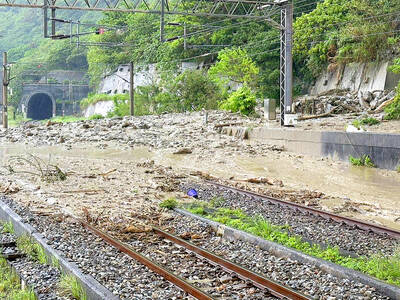
ROLLER-COASTER RIDE: More than five earthquakes ranging from magnitude 4.4 to 5.5 on the Richter scale shook eastern Taiwan in rapid succession yesterday afternoon Back-to-back weather fronts are forecast to hit Taiwan this week, resulting in rain across the nation in the coming days, the Central Weather Administration said yesterday, as it also warned residents in mountainous regions to be wary of landslides and rockfalls. As the first front approached, sporadic rainfall began in central and northern parts of Taiwan yesterday, the agency said, adding that rain is forecast to intensify in those regions today, while brief showers would also affect other parts of the nation. A second weather system is forecast to arrive on Thursday, bringing additional rain to the whole nation until Sunday, it
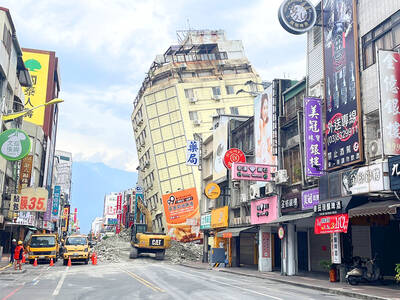
LANDSLIDES POSSIBLE: The agency advised the public to avoid visiting mountainous regions due to more expected aftershocks and rainfall from a series of weather fronts A series of earthquakes over the past few days were likely aftershocks of the April 3 earthquake in Hualien County, with further aftershocks to be expected for up to a year, the Central Weather Administration (CWA) said yesterday. Based on the nation’s experience after the quake on Sept. 21, 1999, more aftershocks are possible over the next six months to a year, the agency said. A total of 103 earthquakes of magnitude 4 on the local magnitude scale or higher hit Hualien County from 5:08pm on Monday to 10:27am yesterday, with 27 of them exceeding magnitude 5. They included two, of magnitude

CONDITIONAL: The PRC imposes secret requirements that the funding it provides cannot be spent in states with diplomatic relations with Taiwan, Emma Reilly said China has been bribing UN officials to obtain “special benefits” and to block funding from countries that have diplomatic ties with Taiwan, a former UN employee told the British House of Commons on Tuesday. At a House of Commons Foreign Affairs Committee hearing into “international relations within the multilateral system,” former Office of the UN High Commissioner for Human Rights (OHCHR) employee Emma Reilly said in a written statement that “Beijing paid bribes to the two successive Presidents of the [UN] General Assembly” during the two-year negotiation of the Sustainable Development Goals. Another way China exercises influence within the UN Secretariat is

Taiwan’s first drag queen to compete on the internationally acclaimed RuPaul’s Drag Race, Nymphia Wind (妮妃雅), was on Friday crowned the “Next Drag Superstar.” Dressed in a sparkling banana dress, Nymphia Wind swept onto the stage for the final, and stole the show. “Taiwan this is for you,” she said right after show host RuPaul announced her as the winner. “To those who feel like they don’t belong, just remember to live fearlessly and to live their truth,” she said on stage. One of the frontrunners for the past 15 episodes, the 28-year-old breezed through to the final after weeks of showcasing her unique


 RSS
RSS