


Japan's Prime Minister Junichiro Koizumi vowed yesterday to press on with reforms after his coalition secured a win in a weekend vote which left him with a weakened majority and saw a stronger opposition emerge.
Analysts said the results showed the voters' desire for a two-party system to challenge the long-ruling Liberal Democratic Party (LDP) and indicated that though Koizumi's reform agenda was safe for now, trouble lay ahead.
The incumbent three-party coalition led by Koizumi's LDP won 275 seats out of 480 in the lower house in Sunday's polls, compared to 287 in the last parliament, according to the final official result released late yesterday by the home affairs ministry's central election management committee.
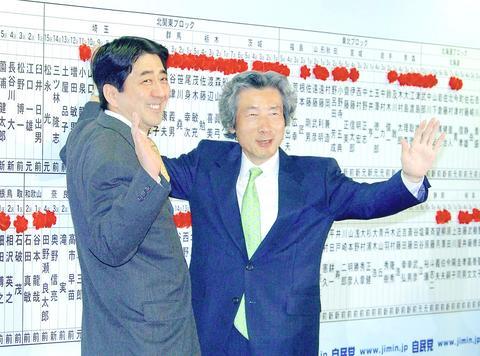
PHOTO: EPA
The LDP won 237 seats outright, down from 247.
After the vote, three independent candidates joined its ranks, giving it 240 seats, which were further boosted to 244 when the smallest coalition partner, the New Conservative Party, announced late yesterday it would merge with the LDP.
The post-election horse trading means the LDP has now achieved its target of winning an absolute majority and in theory is not dependent on its remaining coalition partner. The two parties together now control 278 seats.
"We have managed to secure a stable majority," Koizumi said at a news conference. "I believe such support from a great many people has laid the foundations for our system to carry on reforms. I want to nurture the bud of reform into a big tree.
"Basically we will go on with the present system," he said, when asked about possible changes to the Cabinet line-up and his Liberal Democratic Party's (LDP) executive.
Koizumi reshuffled his Cabinet to give it a more youthful, reformist profile in September when he was re-elected as LDP president for a three-year term.
The three-party coalition, also including the Buddhist-backed centrist Komeito and the LDP splinter New Conservative Party, was set to re-elect Koizumi as premier when a new parliament votes on the chief executive post.
The special session of parliament would be convened on Nov. 19, according to reports. The Cabinet would be officially named shortly afterwards.
As widely predicted, the largest opposition party, the Democratic Party of Japan (DPJ), won 177 seats, up from 137 before the election, raising the prospect of a genuine two-party system after half a century of near-unbroken LDP rule.
"The political landscape is about to suddenly turn into a two-party system," the Yomiuri Shimbun said in its editorial, although it warned the DPJ had to resolve internal policy divisions before being ready to take power.
The DPJ "has some way to go before it reaches this level," it said.
Other newspaper headlines yesterday suggested Koizumi's reform process could face a rocky ride as the effects of his charm and charisma wane.
"Winds blow against his structural reforms," read one headline. "Koizumi magic fading," said another.
Koizumi took power two-and-a-half years ago advocating drastic economic reforms and scored an easy win in upper-house elections in July 2001.
The deeply conservative LDP old guard, which is opposed to his policies, have kept the maverick politician in power as a vote-collecting machine for elections while effectively reducing his reform drive to empty rhetoric.
Also See Story: Japan to keep slogging along: analysts

‘NO SECURITY RISK’: The Railway Bureau reassured the public that the technicians’ activities were limited to technical guidance and did not involve sensitive systems The Railway Bureau yesterday said it had invited eight Chinese technicians to assist with an airport MRT construction project. The bureau issued the confirmation after an Internet user said Chinese nationals had entered the construction zone of Taiwan Taoyuan International Airport’s Terminal 3 project. They asked why “individuals from an enemy state” were allowed access to such a major national infrastructure project, which raised serious concerns over Taiwan’s industrial safety, sensitive systems and information security. The bureau’s Northern Region Engineering Branch Office said subcontractor Taiwan Handle Industrial Co (台灣手把工業) of the Taoyuan airport MRT’s “Contract No. CU05 Project A14 Station Civil, MEP &

A US uncrewed surface vessel (USV) encountered multiple Chinese warships during an autonomous transit of the Taiwan Strait, US defense company Seasats said in a statement on Wednesday. Seasats announced that a Lightfish USV had completed the first autonomous transit of the Taiwan Strait. Over five days, the USV traversed the entire length of the Strait while constantly monitoring surface vessel traffic, the company said. The Lightfish encountered multiple Chinese warships, one of which was a Chinese People’s Liberation Army Navy (PLAN) Type 056 corvette, it said. The Chinese vessels were operating “well within Taiwan’s exclusive economic zone without transmitting their identity via the
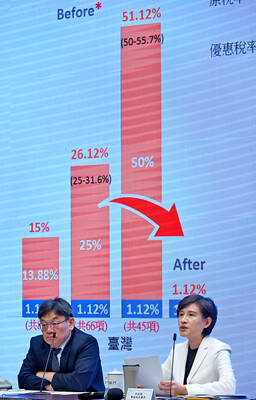
GREATER REACH? Auto parts and wood products would face tariffs of up to 15%, matching those targeting the EU, Japan and South Korea, Vice Premier said The US has announced that preferential tariff treatment for Taiwan’s non-semiconductor Section 232 goods would take effect retroactively from May 1, the Executive Yuan said yesterday. The US government yesterday posted a notice on the Federal Register’s public inspection Web site previewing tariff concessions for Taiwan under a memorandum of understanding (MOU) on Taiwan-US investment after two months of negotiations. The MOU signed on Jan. 15 stipulated three major preferential tariff arrangements: a 15 percent “reciprocal” tariff rate for Taiwan without stacking most-favored nation (MFN) rates; preferential Section 232 treatment for semiconductors and related products; and preferential Section 232 treatment for non-semiconductor

The National Chungshan Institute of Science and Technology yesterday showcased its locally developed variants of the Vision 60 robotic patrol dog, which it plans to deploy on the nation’s outlying territories in the South China Sea. The variants were produced under the Joint Lab project — created by the institute and domestic companies — and assembled with domestically produced motors, lenses and artificial intelligence (AI) systems alongside licensed tech from the US, Missile and Rocket Systems Research Division deputy director Jen Kuo-kang (任國光) told the media event at a military base in Taipei’s Dazhi (大直) area. Taiwan has built up its strengths


 RSS
RSS