


Japan's 2-0 victory over South Korea in the final game of the 2003 Asian Baseball Championship gave the host country the unshared title in this year's competition and Taiwan the second-place finish that it desperately sought for the right to represent Asia in the upcoming Olympic Games in Athens, Greece.
A loss by the Japanese would have sent South Korea in place of Taiwan because Taiwan, with the same 2-1 record as South Korea, would have lost the tiebreaker, having yielded more runs than South Korea.
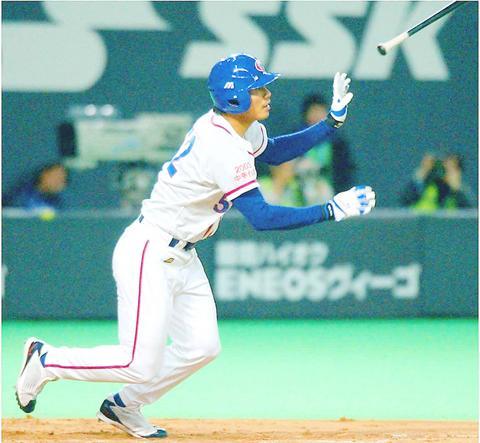
PHOTO: AP/KYODO NEWS
To get the second win in this year's four-team, three-game round-robin tournament, in Sapporo Japan, Taiwan barely slipped by China with a 3-1 victory earlier in the day, thanks to slugger Chen Chin-feng's (
Chen's hot bat continued to make opposing pitchers shiver as Chen went 3-for-4 for the second game in a row to help Taiwan bounce back from Thursday night's embarrassing 9-0 defeat by Japan.
Chen was one single shy of batting for the cycle as he ripped an offering from Chinese starter Wang Nan (
The 26-year-old Tainan native accounted for all of Taiwan's three runs as he knocked home two and scored the third from third base on Wang Nan's wild pitch in the bottom of the fourth. From the mound, Taiwan's starter Chang Chih-chia (
Chang took a shutout into the ninth before allowing a run on Chinese centerfielder Chang Hung-po's (
The game began with Taiwan taking a 1-0 lead in the bottom of the second on designated hitter Chen Chin-feng's solo shot to dead center, before the score read 2-0 in the fourth on a wild pitch that scored Chen again from third.
Taiwan put runners in scoring positions in the next three innings, but failed to cash in.
Outside the heavyweights in the order, who produced six of Taiwan's eight runs, the rest of the lineup was a meagerly 2-for-24 against Chinese pitching that yielded six runs to Japan and 13 to South Korea.
With China managing to stay within striking distance, Chen Chin-feng made sure his team would not be denied the victory by driving a pitch down the right-field line for a triple that scored fellow teammate Chang Tai-shan (張泰山) all the way from first for Taiwan's third and deciding run.
Despite the win, Taiwan's manager Hsu Sheng-ming (徐生明) expressed concern regarding his team's inability to put the game away earlier against a much weaker Chinese side. Hsu said he "would critically review the lack of offense overall as soon as the team returns home from Japan," according to Chinese-language media.
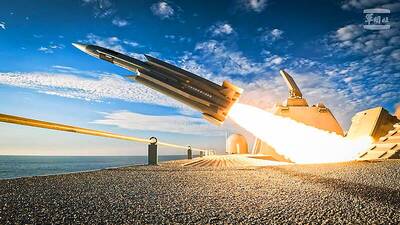
DETERRENCE: With 1,000 indigenous Hsiung Feng II and III missiles and 400 Harpoon missiles, the nation would boast the highest anti-ship missile density in the world With Taiwan wrapping up mass production of Hsiung Feng II and III missiles by December and an influx of Harpoon missiles from the US, Taiwan would have the highest density of anti-ship missiles in the world, a source said yesterday. Taiwan is to wrap up mass production of the indigenous anti-ship missiles by the end of year, as the Chungshan Institute of Science and Technology has been meeting production targets ahead of schedule, a defense official with knowledge of the matter said. Combined with the 400 Harpoon anti-ship missiles Taiwan expects to receive from the US by 2028, the nation would have
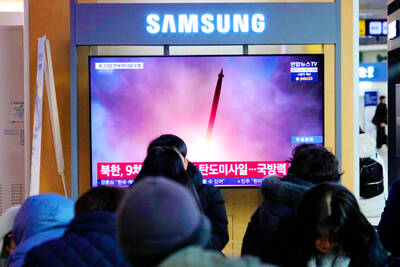
North Korea yesterday fired about 10 ballistic missiles to the sea toward Japan, the South Korean Joint Chiefs of Staff (JCS) said, days after Pyongyang warned of “terrible consequences” over ongoing South Korea-US military drills. Pyongyang recently dashed hopes of a diplomatic thaw with Seoul, Washington’s security ally, describing its latest peace efforts as a “clumsy, deceptive farce.” Seoul’s military detected “around 10 ballistic missiles launched from the Sunan area in North Korea toward the East Sea [Sea of Japan] at around 1:20pm,” JCS said in a statement, referring to South Korea’s name for the body of water. The missiles

‘UNWAVERING FRIENDSHIP’: A representative of a Japanese group that co-organized a memorial, said he hopes Japanese never forget Taiwan’s kindness President William Lai (賴清德) yesterday marked the 15th anniversary of the Tohoku earthquake and tsunami, urging continued cooperation between Taiwan and Japan on disaster prevention and humanitarian assistance. Lai wrote on social media that Taiwan and Japan have always helped each other in the aftermath of major disasters. The magnitude 9 earthquake struck northeastern Japan on March 11, 2011, triggering a massive tsunami that claimed more than 19,000 lives, according to data from Japanese authorities. Following the disaster, Taiwan donated more than US$240 million in aid, making it one of the largest contributors of financial assistance to Japan. In addition to cash donations and
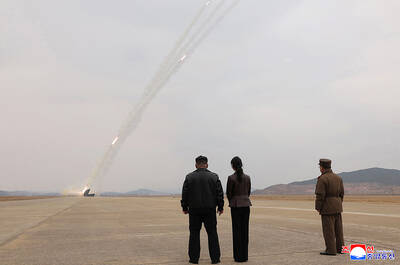
North Korea tested nuclear-capable rocket launchers, state media reported yesterday, a day after Seoul detected the launch of about 10 ballistic missiles. The test comes after South Korean and US forces launched their springtime military drills, due to run until Thursday. North Korean leader Kim Jong-un on Saturday oversaw the testing of the multiple rocket launcher system (MRLS), the Korean Central News Agency (KCNA) said. The test involved 12 600mm-caliber ultra-precision multiple rocket launchers and two artillery companies, it said. Kim said the drill gave Pyongyang’s enemies, within the 420km striking range, a sense of “uneasiness” and “a deep understanding


 RSS
RSS