


US President George W. Bush asked a skeptical UN General Assembly yesterday for help in Iraqi reconstruction and said it was time to set aside past differences over the US-led invasion.
"Now the nation of Iraq needs and deserves our aid -- and all nations of good will should step forward and provide that support," Bush said, six months after the US and Britain went to war without UN backing.
In a speech defending his effort in Iraq, holding out the possibility that weapons of mass destruction may yet be accounted for, Bush also resisted a speedy transfer of Iraqi sovereignty as urged by some key allies, saying he wanted an orderly process that should not be hurried.
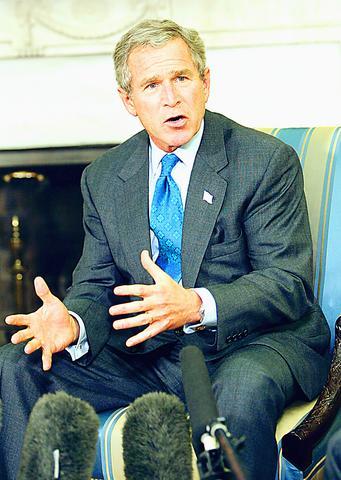
PHOTO: REUTERSN
"The primary goal of our coalition in Iraq is self government for the people of Iraq, reached by orderly and democratic means. This process must unfold according to the needs of Iraqis -- neither hurried nor delayed by the wishes of other parties," Bush said.
On the eve of debate, Bush, whose job approval ratings at home have been knocked in part by mounting US casualties in Iraq, rejected a suggestion things were not going well.
"I don't think they're going badly. I mean, obviously I think they're going badly for the soldiers who lost their lives, and I weep for that person and their family. But no, I think we're making good progress," he told Fox news.
Washington is working on a new UN resolution aimed at attracting wider support for postwar reconstruction and easing the strain on US troops. But critics of the Iraq invasion, notably France and Germany, are pressing for more concessions.
Bush said he hoped to use a meeting on the sidelines of the assembly with French President Jacques Chirac, who spearheaded opposition to the war on Iraq, to try to convince him "that America is a good nation, genuinely good."
US forces, which have suffered dozens of casualties since Bush declared major combat over on May 1, killed three people yesterday after clashes with guerrillas near the flashpoint town of Falluja, west of Baghdad, locals and hospital officials said.
A US military spokeswoman confirmed American troops killed at least one person in the early-morning incident just north of Falluja, adding that "unknown forces" had attacked them near the town, a focus of support for ousted leader Saddam Hussein.
Chirac has criticized a draft of the US resolution, circulated to the 15-member Security Council, for not turning over at least symbolic sovereignty to an Iraqi governing council, then transfer power gradually over six to nine months.
National security adviser, Condoleezza Rice, rejected Chirac's idea.
"The French plan which would somehow try to transfer sovereignty to unelected people just isn't workable," she told reporters on Monday.
Despite their criticisms, both France, and yesterday Germany, have said they are unlikely to veto a resolution in the Security Council.
The main problem, however, is whether a resolution would attract any troops or money if the US retains firm control over the civilian as well as the military structures.
Pakistani President Pervez Musharraf, to whom Washington is looking for a major contribution of peacekeepers, told The New York Times widespread domestic opposition would only change if "the United Nations, Muslim countries, Arab countries and Iraqis themselves are asking for Muslim troops."
South Korea said the deployment of troops would be costly and Turkish Foreign Minister Abdullah Gul said his country was not satisfied with US responses to Turkish Kurd rebels in northern Iraq and wanted assurances of action before it decides whether to send peacekeepers.
UN food agencies said several million Iraqis remained desperately hungry despite a better cereals crop and the lifting of sanctions.
Also See Stories:
Pre-emption confronted
Iraqis push to take power faster, Colin Powell says
US-appointed leaders in Iraq ban Arabic TV stations
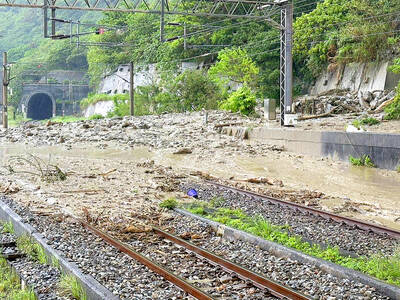
ROLLER-COASTER RIDE: More than five earthquakes ranging from magnitude 4.4 to 5.5 on the Richter scale shook eastern Taiwan in rapid succession yesterday afternoon Back-to-back weather fronts are forecast to hit Taiwan this week, resulting in rain across the nation in the coming days, the Central Weather Administration said yesterday, as it also warned residents in mountainous regions to be wary of landslides and rockfalls. As the first front approached, sporadic rainfall began in central and northern parts of Taiwan yesterday, the agency said, adding that rain is forecast to intensify in those regions today, while brief showers would also affect other parts of the nation. A second weather system is forecast to arrive on Thursday, bringing additional rain to the whole nation until Sunday, it
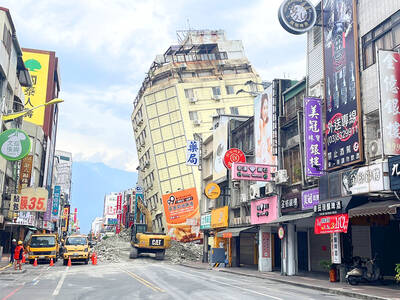
LANDSLIDES POSSIBLE: The agency advised the public to avoid visiting mountainous regions due to more expected aftershocks and rainfall from a series of weather fronts A series of earthquakes over the past few days were likely aftershocks of the April 3 earthquake in Hualien County, with further aftershocks to be expected for up to a year, the Central Weather Administration (CWA) said yesterday. Based on the nation’s experience after the quake on Sept. 21, 1999, more aftershocks are possible over the next six months to a year, the agency said. A total of 103 earthquakes of magnitude 4 on the local magnitude scale or higher hit Hualien County from 5:08pm on Monday to 10:27am yesterday, with 27 of them exceeding magnitude 5. They included two, of magnitude
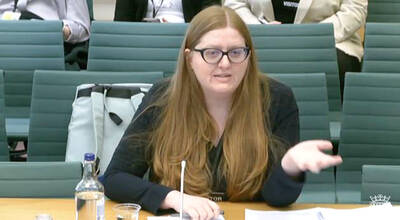
CONDITIONAL: The PRC imposes secret requirements that the funding it provides cannot be spent in states with diplomatic relations with Taiwan, Emma Reilly said China has been bribing UN officials to obtain “special benefits” and to block funding from countries that have diplomatic ties with Taiwan, a former UN employee told the British House of Commons on Tuesday. At a House of Commons Foreign Affairs Committee hearing into “international relations within the multilateral system,” former Office of the UN High Commissioner for Human Rights (OHCHR) employee Emma Reilly said in a written statement that “Beijing paid bribes to the two successive Presidents of the [UN] General Assembly” during the two-year negotiation of the Sustainable Development Goals. Another way China exercises influence within the UN Secretariat is

Taiwan’s first drag queen to compete on the internationally acclaimed RuPaul’s Drag Race, Nymphia Wind (妮妃雅), was on Friday crowned the “Next Drag Superstar.” Dressed in a sparkling banana dress, Nymphia Wind swept onto the stage for the final, and stole the show. “Taiwan this is for you,” she said right after show host RuPaul announced her as the winner. “To those who feel like they don’t belong, just remember to live fearlessly and to live their truth,” she said on stage. One of the frontrunners for the past 15 episodes, the 28-year-old breezed through to the final after weeks of showcasing her unique


 RSS
RSS