


China has not yet pressed the US for concessions on Taiwan in exchange for Beijing's cooperation in North Korea and other issues, and Washington would not grant any such demands, a senior US administration official says.
Much of the reason for that is that Beijing is as much concerned over the threat of nuclear weapons in North Korea as is Washington, so that it does not have the leverage to press the US on the issue, the official said in an exclusive interview with the Taipei Times and its sister publication, the Liberty Times.
There has been much speculation that Washington might be forced to make some concessions to Beijing over Taiwan with the improvement of Sino-US relations in recent years as Washington has sought Beijing's aid in the war on terrorism, favorable votes in the UN on America's Iraq policy, and the North Korean nuclear threat.
So far, the official said, that has not translated into any Chinese request or any US willingness to compromise Taiwan's position.
"I don't think there is any real risk that the Taiwanese position in US policy is going to be affected adversely by developments in US-PRC relations," the senior official said. "I don't see, in this administration, anyway, a risk of Taiwan's position eroding," especially with regard to the US commitment to substantial arms sales to Taiwan.
The official said that China has not yet demanded a quid pro quo for its support of US positions on terrorism and North Korea. "I don't say they will never say it, but I do say they have not said it so far," he said. "I don't think that we would deal with them on that basis."
One main reason the Bush administration would not accept any Chinese pressure to compromise on Taiwan is that a nuclear-weapons-free Korean peninsula "is just as much in their interests as it is in ours," he said.
"If North Korea has nuclear weapons, there's a risk that Japan, South Korea, and Taiwan would decide that they wanted to have nuclear weapons as well. And the possession of nuclear weapons by any other country in East Asia does pose a direct challenge to China's national security," the official said.
"So I don't think this is a case where they're doing us a favor on North Korea," he said.
On the offer made by former Chinese President Jiang Zemin to cut the number of Chinese ballistic missiles facing Taiwan in exchange for a reduction in US arms sales to Taiwan, the official said the matter seems to be dead for now.
"That's just not going to fly," he said. While China has not abandoned the idea as its official position, "they don't bring it up any more," after having been convinced the Bush administration would not accept it, the official said.
China seems more concerned over Washington's plan for a national missile defense system, especially the so-called "boost phase" which would place PAC-3 missile defense systems in East Asia to intercept North Korean or other missiles in the earliest moments after they lift off. The Chinese are concerned over how this would involve South Korea, Japan and Taiwan, the official said.
"And the Chinese are certainly aware that in Japan especially, the government has committed substantial resources to developing a missile defense system. And it bothers them particularly if Taiwan would proceed not just in the AEGIS system but in actual missile defense."
"We do get into that quite a bit," in talks with Chinese leaders, "and our position is very clear: If other countries want to participate in our missile defense, we're happy to have them," the official said.
Taiwan has shown an interest in acquiring from the US sophisticated destroyers equipped with the AEGIS radar and missile defense system.
The sale has been held up by Chinese opposition and also the enormous costs involved in purchasing the vessels.
Whether Japan would be ready to come to Taiwan's defense in case of a Chinese attack will take some time to determine, the US official feels. "That's something we still have to talk to Japan about," he said.
Japan's constitution puts great constraints on the use of its Self Defense Forces for anything but coastal and homeland defense, although there are pressures to lift the restrictions.
Theofficial did take comfort in the fact that Japan has agreed to take part in a multilateral military exercise that began this weekend in the Coral Sea, with ships from the US, Australia, France and Japan, the first time Tokyo has made such a commitment.
The decision reflects "the evolving Japanese thinking," the official said. "It's a significant decision for them, one that we wanted them to make." However, he noted, "it was not an easy decision for them, so you have to take this forward one step at a time."
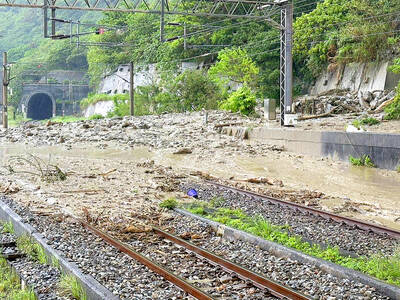
ROLLER-COASTER RIDE: More than five earthquakes ranging from magnitude 4.4 to 5.5 on the Richter scale shook eastern Taiwan in rapid succession yesterday afternoon Back-to-back weather fronts are forecast to hit Taiwan this week, resulting in rain across the nation in the coming days, the Central Weather Administration said yesterday, as it also warned residents in mountainous regions to be wary of landslides and rockfalls. As the first front approached, sporadic rainfall began in central and northern parts of Taiwan yesterday, the agency said, adding that rain is forecast to intensify in those regions today, while brief showers would also affect other parts of the nation. A second weather system is forecast to arrive on Thursday, bringing additional rain to the whole nation until Sunday, it
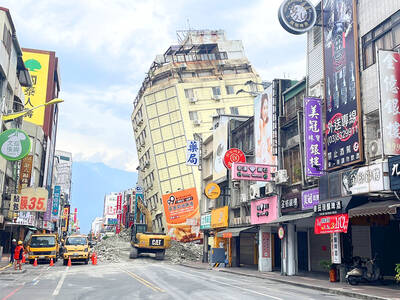
LANDSLIDES POSSIBLE: The agency advised the public to avoid visiting mountainous regions due to more expected aftershocks and rainfall from a series of weather fronts A series of earthquakes over the past few days were likely aftershocks of the April 3 earthquake in Hualien County, with further aftershocks to be expected for up to a year, the Central Weather Administration (CWA) said yesterday. Based on the nation’s experience after the quake on Sept. 21, 1999, more aftershocks are possible over the next six months to a year, the agency said. A total of 103 earthquakes of magnitude 4 on the local magnitude scale or higher hit Hualien County from 5:08pm on Monday to 10:27am yesterday, with 27 of them exceeding magnitude 5. They included two, of magnitude

CONDITIONAL: The PRC imposes secret requirements that the funding it provides cannot be spent in states with diplomatic relations with Taiwan, Emma Reilly said China has been bribing UN officials to obtain “special benefits” and to block funding from countries that have diplomatic ties with Taiwan, a former UN employee told the British House of Commons on Tuesday. At a House of Commons Foreign Affairs Committee hearing into “international relations within the multilateral system,” former Office of the UN High Commissioner for Human Rights (OHCHR) employee Emma Reilly said in a written statement that “Beijing paid bribes to the two successive Presidents of the [UN] General Assembly” during the two-year negotiation of the Sustainable Development Goals. Another way China exercises influence within the UN Secretariat is

Taiwan’s first drag queen to compete on the internationally acclaimed RuPaul’s Drag Race, Nymphia Wind (妮妃雅), was on Friday crowned the “Next Drag Superstar.” Dressed in a sparkling banana dress, Nymphia Wind swept onto the stage for the final, and stole the show. “Taiwan this is for you,” she said right after show host RuPaul announced her as the winner. “To those who feel like they don’t belong, just remember to live fearlessly and to live their truth,” she said on stage. One of the frontrunners for the past 15 episodes, the 28-year-old breezed through to the final after weeks of showcasing her unique


 RSS
RSS