


The Dalai Lama is willing to return to Tibet and end nearly half a century of exile in India if China allows him to go back to his homeland "without preconditions."
In an exclusive interview, Tibet's exiled spiritual leader said he was ready to return to the capital, Lhasa, which he fled in 1959, as soon as he got the "green light" from Beijing. He said China's government had stopped him visiting Tibet, most recently in 1984, and prevented him from traveling to sacred Buddhist sites inside China.
"I'm hopeful to visit Tibet, to see my old place with my own eyes, and try to cool down the situation," he added.
"You ask under what circumstances? China should give me the green light, without preconditions."
The Dalai Lama's offer follows a thaw between China and Tibet's exiled leadership, and came on the eve of his three-week trip to the US, which began Thursday. He is likely to discuss his possible return to Tibet with US President George W. Bush, whom he is to meet next week.
Speculation that the Dalai Lama is secretly preparing to make a deal with China has been growing since two of his envoys made a trip to Beijing last September. They visited China again in late May, in the first direct contact between both sides since 1993.
The visits, together with the release of several Tibetan political prisoners and government tours to Tibet for foreign journalists, including one last week, have prompted hopes of an end to Beijing's decades-long impasse with Tibet's exiled government.
The Dalai Lama said that negotiations with China had been "positive," and stressed that the only way of finding a solution to the Tibet problem was through dialogue.
But he said meaningful negotiations with China had not yet taken place, with Beijing unwilling to make any concessions.
"We have not yet started serious discussions," he said. "For the moment I believe it is very essential to develop confidence. This is the moment to try and build confidence and understanding."
In the meantime the situation in Tibet had not improved, he said. He also reiterated his demand for Tibet to be given a degree of self-rule, the so-called "middle way approach" he has pursued since the 1970s.
"Our position is not seeking independence for Tibet, but genuine autonomy, which the Chinese constitution mentions," he said.
The Dalai Lama fled from Tibet in 1959, after a failed uprising against China's occupation. Since then he has lived in Dharamsala, a hill station in northern India, where hundreds of Tibetan monks wearing maroon robes trek up and down the steep, potholed roads alongside foreign backpackers.
The Dalai Lama said there was "no point in guessing" why the Chinese had decided to talk to him now. But he said communist totalitarian systems had disappeared from most of the world over the past 15 years and that a "confused" China was in a state of flux while aggressively pursuing a Western capitalist model.
"I think the majority of communist party members don't have any genuine belief in communist ideology," he said. "They join the communist party simply for a job.
"In the 1950s when I was in China I found those party members were really dedicated. They were fully convinced of their ideology."
He added: "China is changing. Chinese intellectuals now begin to realize their policy regarding so-called minorities is not working. It's in China's own interest to be critical about the current policy. Therefore I'm very optimistic."
He also gave his strongest hint so far that he believes Tibetans will discover another Dalai Lama after his death and that he expects the Chinese to come up with a rival. He said his reincarnation, the 15th, would be born to a Tibetan family outside China.
"We are still carrying on a struggle," he said. "Under those circumstances my reincarnation will logically be outside in a free country because the very purpose of the reincarnation is to fulfil the task started by the previous life."
In 1995 the Chinese authorities whisked away a six-year-old boy whom the Dalai Lama had identified as the Panchen Lama -- the second most powerful figure in Tibetan Buddhism. He has not been seen since, though Chinese officials insist he is in good health. They tried to install another boy as Panchen Lama.
The Dalai Lama said the Chinese might appoint a successor to him, "a young lucky boy," but Tibetans would reject him. "They will not respect him. He will not have any influence," he said.
He admitted that his death would be a "serious setback" for Tibetans and that things would be "a little chaotic for a few months."
But he pointed out that since the election of Tibet's first prime minister in exile two years ago, he was in a state of "semi-retirement."
"When I die that's permanent retirement," he added jokingly.
Concern over what might happen after the Dalai Lama's death was prompted by rumors last year that he had stomach cancer. He said he did not have cancer but admitted he had been seriously ill with pains in his intestine. He was now in good health, he said.
Earlier this summer he admitted that being Dalai Lama meant that he had "missed out" on sex. He said that while sex was undoubtedly pleasurable, it brought complications in the long run.
"Of course for a short moment people ... are very happy. But generally speaking I think [sex brings] too many ups and downs."
The Dalai Lama said he had avoided sexual desire by embarking on serious study of Buddhist texts from the age of 15 or 16 and by not eating solid food after lunch. Pointing to his groin he said: "So my instrument is useless. It has no purpose, no meaning."
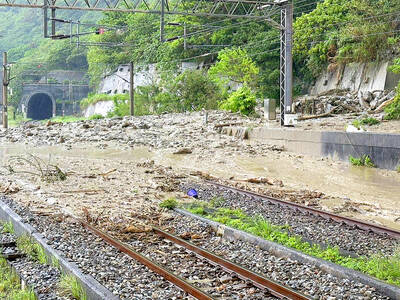
ROLLER-COASTER RIDE: More than five earthquakes ranging from magnitude 4.4 to 5.5 on the Richter scale shook eastern Taiwan in rapid succession yesterday afternoon Back-to-back weather fronts are forecast to hit Taiwan this week, resulting in rain across the nation in the coming days, the Central Weather Administration said yesterday, as it also warned residents in mountainous regions to be wary of landslides and rockfalls. As the first front approached, sporadic rainfall began in central and northern parts of Taiwan yesterday, the agency said, adding that rain is forecast to intensify in those regions today, while brief showers would also affect other parts of the nation. A second weather system is forecast to arrive on Thursday, bringing additional rain to the whole nation until Sunday, it
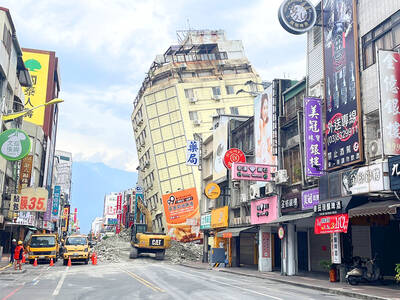
LANDSLIDES POSSIBLE: The agency advised the public to avoid visiting mountainous regions due to more expected aftershocks and rainfall from a series of weather fronts A series of earthquakes over the past few days were likely aftershocks of the April 3 earthquake in Hualien County, with further aftershocks to be expected for up to a year, the Central Weather Administration (CWA) said yesterday. Based on the nation’s experience after the quake on Sept. 21, 1999, more aftershocks are possible over the next six months to a year, the agency said. A total of 103 earthquakes of magnitude 4 on the local magnitude scale or higher hit Hualien County from 5:08pm on Monday to 10:27am yesterday, with 27 of them exceeding magnitude 5. They included two, of magnitude

CONDITIONAL: The PRC imposes secret requirements that the funding it provides cannot be spent in states with diplomatic relations with Taiwan, Emma Reilly said China has been bribing UN officials to obtain “special benefits” and to block funding from countries that have diplomatic ties with Taiwan, a former UN employee told the British House of Commons on Tuesday. At a House of Commons Foreign Affairs Committee hearing into “international relations within the multilateral system,” former Office of the UN High Commissioner for Human Rights (OHCHR) employee Emma Reilly said in a written statement that “Beijing paid bribes to the two successive Presidents of the [UN] General Assembly” during the two-year negotiation of the Sustainable Development Goals. Another way China exercises influence within the UN Secretariat is

Taiwan’s first drag queen to compete on the internationally acclaimed RuPaul’s Drag Race, Nymphia Wind (妮妃雅), was on Friday crowned the “Next Drag Superstar.” Dressed in a sparkling banana dress, Nymphia Wind swept onto the stage for the final, and stole the show. “Taiwan this is for you,” she said right after show host RuPaul announced her as the winner. “To those who feel like they don’t belong, just remember to live fearlessly and to live their truth,” she said on stage. One of the frontrunners for the past 15 episodes, the 28-year-old breezed through to the final after weeks of showcasing her unique


 RSS
RSS