

Palestinian leader Yasser Arafat yesterday was quoted as saying that the US-backed "road map" for Middle East peace is dead and that Israel is to blame.
The plan, launched June 4, calls on Israel and the Palestinian Authority to end nearly three years of violence and envisions the establishment of a Palestinian state by 2005.
PHOTO: AFP
The plan has been stalled for several weeks because of renewed fighting and a deadlock between Israel and the Palestinians on the dismantling of armed groups. Israel has accused Arafat of getting in the way of the road map and trying to undermine his prime minister, the US-backed Mahmoud Abbas, at every turn.
The CNN Web site yesterday quoted Arafat as saying the peace plan has no future.
"The road map is dead, but only because of Israeli military aggression in recent weeks," Arafat said.
The latest escalation was set off by a Hamas bus bombing in Jerusalem in mid-August in which 21 people died. Since then, 16 Palestinians -- 11 Palestinian militants and five bystanders -- have been killed in six Israeli helicopter strikes in the Gaza Strip. After the first of the strikes -- which killed Hamas leader Ismail Abu Shanab -- Hamas and other militant Palestinian groups announced that they were cancelling a seven week ceasefire with Israel.
Meanwhile, calling Arafat the biggest obstacle to peace, an Israeli defense minister said on Tuesday that Israel could seek to expel the Palestinian leader by the end of the year,
Defense Minister Shaul Mofaz, who has long supported expelling Arafat, issued the warning as Arafat and Abbas remained locked in a power struggle.
Abbas is increasingly unpopular at home and could be ousted, possibly in a parliament vote next week. Arafat and Abbas have clashed on control of security forces and key appointments, threatening a rift that could hinder peace efforts.
Palestinian Cabinet Minister Ghassan Khatib said Mofaz's threat of expelling Arafat only raised tensions, "but is consistent with the spirit of escalation of the Israeli leadership."
In an interview with Israel's Army Radio, Mofaz said Arafat was blocking progress on the road map.
"Arafat, of course, has become the most significant obstacle both to the leadership of [Abbas] and to the peace process," Mofaz said. "I think that he has to disappear from the stage of history, and not be included in the ranks of the Palestinian leadership."
The defense minister said Israel made a "historic mistake" when it decided not to exile him two years ago.
"With regard to the future, I think we will be compelled to deal with this issue within a relatively short period of time, very possibly even this year," he said.
Mofaz said if Israel decides to expel Arafat, the timing would have to be chosen carefully so as not to undermine Abbas, who Israel believes is serious about reaching a peace deal.

PATROL PARTNERS: The ‘Chiayi’ and the ‘Penghu’ departed for a two-day joint patrol of Palau’s exclusive economic zone, the CGA’s second diplomatic visit to the country The Coast Guard Administration (CGA) set a record for its southernmost deployment of a coast guard vessel as the vessels Chiayi and the Penghu reached Palau’s Pulo Anna Island on Saturday in a cooperative exercise between the two countries. The island, about 217 nautical miles (401km) southwest of Koror in the Palauan state of Sonsorol and 1,220 nautical miles from Taiwan’s southernmost point, Oluanpi (鵝鑾鼻), is the furthest south a CGA vessel has sailed. The two vessels are in Palau for the coast guard’s second diplomatic visit to the country. They docked at Malakal Harbor on Tuesday last week. The coast guard

The government is monitoring online rumors that a pneumonic plague outbreak has spread from Russia into China, and it might enhance quarantine measures, Premier Cho Jung-tai (卓榮泰) said yesterday. During a legislative meeting, Democratic Progressive Party Legislator Wang Ting-yu (王定宇) said that rumors had circulated that the disease had spread across several Chinese provinces. He asked Cho whether the government was prepared to prevent the disease spreading to Taiwan, given the volume of traffic between the two sides, and how concerned the government was about the alleged outbreak. The Ministry of Health and Welfare had implemented border quarantine measures after briefing the Executive

BATCH 1: The military has plans to assign the weapons to the army to defend Taiwan proper, as well as outlying islands and the navy for the Marine Corps, the official said Taiwan is to receive 500 Stinger missiles and 178 launchers from the US by the end of the year, the first batch under a planned two-stage acquisition totaling 2,621 missiles and 763 launchers, a defense official said yesterday on condition of anonymity. The portable missiles would play a vital role in the nation’s air defense capabilities, the source said. The army plans to deploy 2,235 missiles and 657 launchers to defend Taiwan proper and outlying islands, they said, citing military documents. The navy is allotted 295 missiles and 85 launchers to arm the Marine Corps and some surface vessels that lack air defense
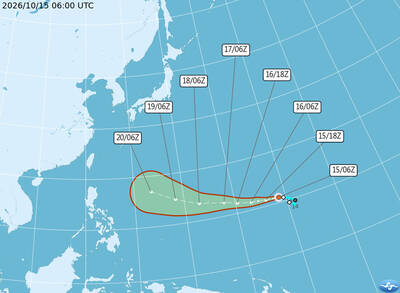
EAST OF GUAM: Tropical Storm Champi is forecast to strengthen into a typhoon, but its effect on Taiwan is uncertain due to the presence of a high-pressure system Tropical Storm Champi formed yesterday and has the potential to increase in strength, the Central Weather Administration (CWA) said yesterday. Forecasters are closely monitoring a Pacific high-pressure system that would dictate whether the storm turns north or moves toward Taiwan next week, the CWA said. The most likely scenario is that it turns northward after passing the Ryukyu Islands, CWA forecaster Cheng Chieh-jen (鄭傑仁) said. As of 8pm yesterday, Champi was east of Guam moving west-northwest at 20kph, CWA data showed. It had maximum sustained winds near the center of 72kph and gusts of up to 101kph, the data showed. If the Pacific high-pressure system


 RSS
RSS