


Grieving families cremated the victims of twin car bombs in India's financial capital Mumbai yesterday as India revived accusations that Pakistan was not doing enough to curb Muslim militants.
Deputy Prime Minister Lal Krishna Advani, touring the sites of Monday's bomb blasts, said Pakistan had been waging a "war of terrorism" against India for years.
But he stopped short of blaming Islamabad directly for Monday's blasts, which killed 50 people and wounded 148, saying he did not know who was responsible.
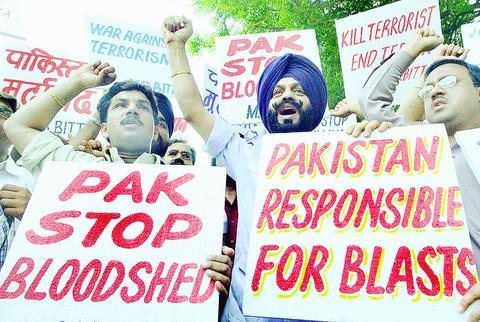
PHOTO: AFP
"Our neighbor's war of terrorism ... is against the whole of India," Advani told reporters.
Islamabad condemned Mon-day's bombings, which coincided with a thaw in relations between nuclear-armed India and Pakistan.
Advani said Pakistan should prove its sincerity by handing over suspects wanted by New Delhi for past bombings.
"Only then can we believe that they meant what they said yesterday when they condemned the attacks," he said.
Pakistan Information Minister Sheikh Rashid Ahmed said India was indulging in "non-serious talk."
"We are not involved in the war in India," he said. "We don't need it and it is India's own problem."
Police have blamed the outlawed Students Islamic Movement of India working together with the banned Pakistan-based Kashmiri separatist group Lashkar-e-Taiba for the bombings.
India stepped up security nationwide yesterday to head off any religious violence but police said there were no reports of clashes between Hindus and Muslims.
Among the victims were eight men from western Gujarat state, where at least 1,000 people, mostly Muslims, died last year in revenge killings following an attack on a train carrying Hindu pilgrims from the northern holy town of Ayodhya.
The eight Gujaratis, whose bodies were being taken back yesterday to their home town of Surendranagar, were on a pilgrimage to a Hindu festival and were in Mumbai on holiday.
"They were all excited about the trip because it was the first time they were going to a place like Mumbai," said Kalubhai Motibhai Manguda, a 41-year-old milk-seller in Surendranagar, and nephew of three brothers who died.
The eight men had been visiting the Gateway of India, a huge British colonial waterfront arch and Mumbai's most popular tourist attraction, when the second bomb exploded. The first exploded in a gold and jewelry market.
In Mumbai, police raided slums and picked up people for questioning about the bombs, which were planted in taxis.
No one has claimed responsibility for the bombings. Police were questioning the owner of one of the taxis used in the blasts about a couple who hired him on Sunday for a tour.
Many in the city, which attracts thousands of poor migrants seeking a better life, said they were afraid.
"Every moment, I feel there is danger in Mumbai. But still, I have to put my life on the line and go out to work today," said Sheikh Abdul Sheikh, a 32-year-old tailor.
Gulzar Hussain, 28-year-old owner of a shoe shop near the site of the first blast, had to dig his uncle's blood-soaked body from underneath a dead customer but was unable to save him.
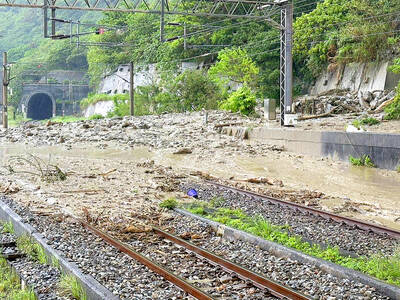
ROLLER-COASTER RIDE: More than five earthquakes ranging from magnitude 4.4 to 5.5 on the Richter scale shook eastern Taiwan in rapid succession yesterday afternoon Back-to-back weather fronts are forecast to hit Taiwan this week, resulting in rain across the nation in the coming days, the Central Weather Administration said yesterday, as it also warned residents in mountainous regions to be wary of landslides and rockfalls. As the first front approached, sporadic rainfall began in central and northern parts of Taiwan yesterday, the agency said, adding that rain is forecast to intensify in those regions today, while brief showers would also affect other parts of the nation. A second weather system is forecast to arrive on Thursday, bringing additional rain to the whole nation until Sunday, it
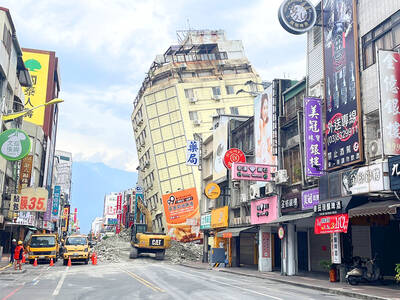
LANDSLIDES POSSIBLE: The agency advised the public to avoid visiting mountainous regions due to more expected aftershocks and rainfall from a series of weather fronts A series of earthquakes over the past few days were likely aftershocks of the April 3 earthquake in Hualien County, with further aftershocks to be expected for up to a year, the Central Weather Administration (CWA) said yesterday. Based on the nation’s experience after the quake on Sept. 21, 1999, more aftershocks are possible over the next six months to a year, the agency said. A total of 103 earthquakes of magnitude 4 on the local magnitude scale or higher hit Hualien County from 5:08pm on Monday to 10:27am yesterday, with 27 of them exceeding magnitude 5. They included two, of magnitude

CONDITIONAL: The PRC imposes secret requirements that the funding it provides cannot be spent in states with diplomatic relations with Taiwan, Emma Reilly said China has been bribing UN officials to obtain “special benefits” and to block funding from countries that have diplomatic ties with Taiwan, a former UN employee told the British House of Commons on Tuesday. At a House of Commons Foreign Affairs Committee hearing into “international relations within the multilateral system,” former Office of the UN High Commissioner for Human Rights (OHCHR) employee Emma Reilly said in a written statement that “Beijing paid bribes to the two successive Presidents of the [UN] General Assembly” during the two-year negotiation of the Sustainable Development Goals. Another way China exercises influence within the UN Secretariat is

Taiwan’s first drag queen to compete on the internationally acclaimed RuPaul’s Drag Race, Nymphia Wind (妮妃雅), was on Friday crowned the “Next Drag Superstar.” Dressed in a sparkling banana dress, Nymphia Wind swept onto the stage for the final, and stole the show. “Taiwan this is for you,” she said right after show host RuPaul announced her as the winner. “To those who feel like they don’t belong, just remember to live fearlessly and to live their truth,” she said on stage. One of the frontrunners for the past 15 episodes, the 28-year-old breezed through to the final after weeks of showcasing her unique


 RSS
RSS