


A Chinese survey vessel believed to be a spy ship has been found operating near Taiwan again, naval officials said yesterday.
The 2,894-tonne Xiangyanghong 14 oceanographic research ship, linked to China's National Bureau of Oceanography, was detected by the navy's radar systems at noon Wednesday in high seas near Green Island, off southeastern Taiwan, the officials said.
"The navy dispatched patrol vessels to monitor its movement and ordered related radar stations to keep close watch on the target," they said.
The same vessel intruded into Taiwan's territorial waters last November, prompting Taipei to lodge a protest with Beijing.
Its crew members claimed the ship was conducting an oceanographic survey when Taiwanese coast patrol boats tried to intercept it for inspection on Wednesday, local papers reported.
The Xiangyanghong 14 did not leave the navy's monitoring range until 2:30pm on Thursday.
Upon spotting the Xiangyanghong 14 the ROC Navy immediately dispatched two Perry-class frigates to the adjacent waters to monitor the Chinese vessel and informed the Coast Guard Administration (CGA) about the situation.
The CGA dispatched three coastal patrol vessels to shadow the research ship. Some four hours of playing cat and mouse ensued, with the Xiangyanghong 14 being chased to some 130km from Oluanpi before the CGA vessels ceased their pursuit.
During the pursuit, according to CGA officials, the Xiangyanghong 14 sent a message to the CGA vessels through an international telecommunications channel to ask the Taiwan patrol vessels to leave the area in order to avoid what it termed "accidents" from occurring.
Chinese maritime research vessels were discovered operating in waters very close to Taiwan's exclusive economic zone on more than 10 occasions last year, with some technically being incursions into Taiwan's territorial waters, the Ministry of National Defense (MND) said yesterday.
Since the research vessels were not military ones and were on international research missions, the navy was not in a position to interfere, MND officials said.
They added that the best Taiwan could do was to chase them away using the civilian CGA vessels despite knowing that the vessels were on espionage missions collecting security-related maritime intelligence.
Radar stations and reconnaissance vessels have been placed on higher alert to bolster the CGA's capacity to monitor and search for suspicious craft, the MND said.
The Xiangyanghong 14 is not armed but is equipped with various antennas. It operates in the Taiwan Strait all year round.
CGA officials said they suspect that the ship has repeatedly sailed close to Orchid Island not only to conduct oceanic research but also to intercept Taiwan's communications broadcasts

‘NO SECURITY RISK’: The Railway Bureau reassured the public that the technicians’ activities were limited to technical guidance and did not involve sensitive systems The Railway Bureau yesterday said it had invited eight Chinese technicians to assist with an airport MRT construction project. The bureau issued the confirmation after an Internet user said Chinese nationals had entered the construction zone of Taiwan Taoyuan International Airport’s Terminal 3 project. They asked why “individuals from an enemy state” were allowed access to such a major national infrastructure project, which raised serious concerns over Taiwan’s industrial safety, sensitive systems and information security. The bureau’s Northern Region Engineering Branch Office said subcontractor Taiwan Handle Industrial Co (台灣手把工業) of the Taoyuan airport MRT’s “Contract No. CU05 Project A14 Station Civil, MEP &

A US uncrewed surface vessel (USV) encountered multiple Chinese warships during an autonomous transit of the Taiwan Strait, US defense company Seasats said in a statement on Wednesday. Seasats announced that a Lightfish USV had completed the first autonomous transit of the Taiwan Strait. Over five days, the USV traversed the entire length of the Strait while constantly monitoring surface vessel traffic, the company said. The Lightfish encountered multiple Chinese warships, one of which was a Chinese People’s Liberation Army Navy (PLAN) Type 056 corvette, it said. The Chinese vessels were operating “well within Taiwan’s exclusive economic zone without transmitting their identity via the
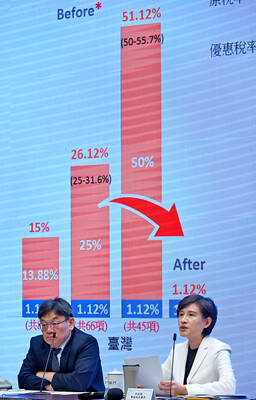
GREATER REACH? Auto parts and wood products would face tariffs of up to 15%, matching those targeting the EU, Japan and South Korea, Vice Premier said The US has announced that preferential tariff treatment for Taiwan’s non-semiconductor Section 232 goods would take effect retroactively from May 1, the Executive Yuan said yesterday. The US government yesterday posted a notice on the Federal Register’s public inspection Web site previewing tariff concessions for Taiwan under a memorandum of understanding (MOU) on Taiwan-US investment after two months of negotiations. The MOU signed on Jan. 15 stipulated three major preferential tariff arrangements: a 15 percent “reciprocal” tariff rate for Taiwan without stacking most-favored nation (MFN) rates; preferential Section 232 treatment for semiconductors and related products; and preferential Section 232 treatment for non-semiconductor

The National Chungshan Institute of Science and Technology yesterday showcased its locally developed variants of the Vision 60 robotic patrol dog, which it plans to deploy on the nation’s outlying territories in the South China Sea. The variants were produced under the Joint Lab project — created by the institute and domestic companies — and assembled with domestically produced motors, lenses and artificial intelligence (AI) systems alongside licensed tech from the US, Missile and Rocket Systems Research Division deputy director Jen Kuo-kang (任國光) told the media event at a military base in Taipei’s Dazhi (大直) area. Taiwan has built up its strengths


 RSS
RSS