


President Chen Shui-bian (
The president made the remarks when he presented rehabilitation certificates to each of the victims or the representatives of the victims of the 228 Incident in a ceremony held at the Presidential Office. The certificates were co-signed by Chen and Vice President Annette Lu (
"The 228 Incident was Taiwan's biggest historical wound since World War II, " the president said. "The people of Taiwan wanted social justice and democratic reforms, but were relentlessly suppressed by the KMT government, resulting in heavy casualties among the Taiwanese elite and ordinary civilians."
The KMT government, trying to cover its actions, labeled the incident a "mutiny," and the victims "mobsters," he added.
The president said that a rehabilitation certificate will not bring back past lives, but he was convinced that the incident was brought into the public consciousness only after the efforts of so many democratic forerunners.
After "scores of years of declassifying files and the investigation of oral historians, " the president said the 228 Incident is no longer just a "violent disturbance," or described as "Communist China orchestrating mobsters," but was "a protest against social injustice, a demand for democracy, and the advocacy of Taiwanese people ruling Taiwan," which he said has become the "228 spirit" and an "asset of Taiwan's historical culture."
He stressed that to "right the wrongs, pursue historical truth and social justice is the root of a nation based on human rights, and the rehabilitation of names of the 228 Incident is the upholding of human rights, and a milestone for Taiwan."
He extended his apologies again to the victims and their relatives for their sufferings over the years, hoping that every one in Taiwan would "learn from the incident, and work toward making Taiwan a just, peaceful country with dignity."
Speaking at the same occasion, Vice President Lu said that there should not be only concerts and flowers in memory of the incident each year, but that all generations should "learn the historical truth."
The 228 Memorial Foundation has agreed to do more to let the nation learn about the incident, she said.
The 228 Incident is so called after a rebellion against the KMT's venal and brutal rule which broke out on Feb. 27, 1947.

An Emirates flight from Dubai arrived at Taiwan Taoyuan International Airport yesterday afternoon, the first service of the airline since the US and Israel launched strikes against Iran on Saturday. Flight EK366 took off from the United Arab Emirates (UAE) at 3:51am yesterday and landed at 4:02pm before taxiing to the airport’s D6 gate at Terminal 2 at 4:08pm, data from the airport and FlightAware, a global flight tracking site, showed. Of the 501 passengers on the flight, 275 were Taiwanese, including 96 group tour travelers, the data showed. Tourism Administration Deputy Director-General Huang He-ting (黃荷婷) greeted Taiwanese passengers at the airport and

POSSIBILITIES EMERGE: With Taiwan’s victory and Japan’s narrow win over Australia, Taiwan now have a chance to advance if South Korea also beat the Aussies Taiwan has high hopes that the national baseball team would advance to the World Baseball Classic (WBC) quarter-finals after clinching a crucial 5-4 victory over South Korea in a nail-biting extra-inning game at the Tokyo Dome yesterday. Boosted by three home runs — two solo shots by Yu Chang (張育成) and Cheng Tsung-che (鄭宗哲) and a two-run homer by Stuart Fairchild — the triumph gave Taiwan a much-needed second victory in the five-team Pool C, where only the top two finishers would advance to the knockout stage in Miami, Florida. Entering extra innings with the game tied at four apiece, Taiwan scored

MISSION OF PEACE: The foreign minister urged Beijing to respect Taiwan’s existence as an independent nation, and work together to ensure peace and stability in the region Minister of Foreign Affairs Lin Chia-lung (林佳龍) yesterday rejected Chinese Minister of Foreign Affairs Wang Yi’s (王毅) comments about Taiwan, criticizing China as a “troublemaker” in the international community and a disruptor of cross-strait peace. Speaking at a news conference on the sidelines of the Chinese National People’s Congress, Wang said that Taiwan has always been a territory of China and that it would be impossible for it to become its own country. The “return” of Taiwan to China was the natural outcome of the Chinese people’s resistance against Japan in World War II, and that any pursuit of independence was “doomed
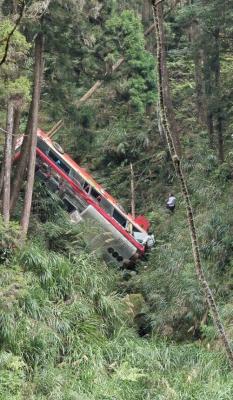
One person was killed and another seven injured today when a tourist shuttle bus plunged 30m to 40m down a ravine in Nantou County, the Tourism Administration said. The bus is suspected to have suddenly accelerated out of control near the flower center of the Sun-Link-Sea Forest Recreation Area, a popular attraction during cherry blossom season. Of the eight onboard, a 66-year-old man was killed, four were seriously injured and three sustained minor injuries, including the driver. The Nantou County Police Department said it received a report of the incident at 12:15pm and dispatched seven teams to assist. All surviving passengers have been transferred


 RSS
RSS