


The search for former Iraqi president Saddam Hussein gained fresh impetus yesterday after US soldiers killed his two sons Uday and Qusay in a fierce six-hour battle with machineguns and rockets at a villa in northern Iraq.
Celebratory shots rang out in Baghdad, but sceptical Iraqis said they wanted proof of the deaths.
Lieutenant-General Ricardo Sanchez, commander of ground forces in Iraq, said he would provide evidence to show beyond doubt that the two men had been killed when 200 soldiers backed up by helicopters attacked the villa in Mosul on Tuesday.
He told a news conference late on Tuesday that the deaths of Uday and Qusay -- tracked down after a tip-off from a walk-in informant who stands to gain at least some of the two US$15 million rewards for information on their whereabouts -- showed that Saddam himself could not hide forever.
"It confirms that we will succeed in our hunt for former regime members, and in particular Saddam Hussein, wherever they are and however long it takes," he said.
Sanchez said the killings of Uday, 39, and Qusay, two years younger, would also deal a blow to guerrillas who have staged a wave of attacks and ambushes on US forces in Iraq, claiming the lives of 39 American soldiers since President George W. Bush declared major combat over on May 1.
Paul Bremer, the US administrator of Iraq, said there was a risk of revenge attacks by Saddam loyalists.
"We could see attacks in the next few days as revenge. But you have to remember that a lot of the attacks that are taking place are being based on the idea that somehow the Saddams are coming back, that he and his sons are coming back," he said.
"Well, they're not coming back. But now two of them are dead. It won't be long before we get the father," he said.
The US has offered US$25 million for information leading to the capture or killing of Saddam.
"I think we now have a possibility of somebody coming with the big one, somebody who really wants to get the US$25 million reward," said Bremer, on a visit to the US. "It will move the day a bit closer when we get our hands on the father."
Many Iraqis still doubted Saddam's sons were dead.
"I don't believe they are dead because Saddam would never let his sons travel together," said Nasheet Chalabi, who owns a grocery shop in Mosul.
US officials have blamed die-hard Saddam loyalists for the guerrilla insurgency against American forces.
But other groups have also claimed responsibility for the attacks, distancing themselves from Saddam's secular Iraqi nationalism and embracing the Islamist, anti-American slogans of Osama bin Laden's al-Qaeda network.
A leading pro-US Iraqi politician said Qusay was behind many of the attacks on US troops. "He was in charge of the network that was causing a great deal of the trouble," Ahmad Chalabi, head of the Iraqi National Congress, told reporters.
"This is very important. This will contribute considerably to reducing attacks on coalition soldiers," he said in New York. "Both of those characters are hated figures in Iraq."
But Wamidh Nazmi, a political science professor at Baghdad University, said the killings would not end guerrilla attacks.
"I do not think that Saddam and his two sons are a very important part of the resistance ... and if they have any role it is a minimal one," he said. "So I don't think the deaths of the sons ... will affect the resistance, nor even the death of Saddam himself."
Uday and Qusay were not noticeably close in life, but they went down fighting side by side in the violent tradition of their clan. Barricading themselves into the villa, they resisted US troops for several sweltering hours.
Two other bodies removed from the villa were a grandson of Saddam and an aide of Uday.
Also see stories:
Saddam's sons: chips off the old block
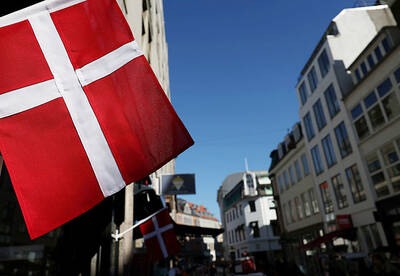
‘UNFRIENDLY’: Changing the nationality listing of Taiwanese residents to ‘China’ goes against EU foreign policy as well as democratic and human rights principles, MOFA said Taiwan yesterday called on Denmark to correct its designation of the nationality of Taiwanese residents as “China” or face retaliatory measures. The Danish government in 2024 changed the nationality of Taiwanese citizens on their residence permits from “Taiwan” to “China.” The decision goes against EU foreign policy and contravenes democratic and human rights principles, Ministry of Foreign Affairs (MOFA) spokesman Hsiao Kuang-wei (蕭光偉) said. Denmark should present a solution acceptable to Taiwan as soon as possible and correct the erroneous designation to preserve the longstanding friendship between the two nations, Hsiao said. The issue could damage Denmark’s image and business reputation in Taiwan,

The nation’s fastest supercomputer, Nano 4 (晶創26), is scheduled to be launched in the third quarter, and would be used to train large language models in finance and national defense sectors, the National Center for High-Performance Computing (NCHC) said. The supercomputer, which would operate at about 86.05 petaflops, is being tested at a new cloud computing center in the Southern Taiwan Science Park in Tainan. The exterior of the server cabinet features chip circuitry patterns overlaid with a map of Taiwan, highlighting the nation’s central position in the semiconductor industry. The center also houses Taiwania 2, Taiwania 3, Forerunner 1 and
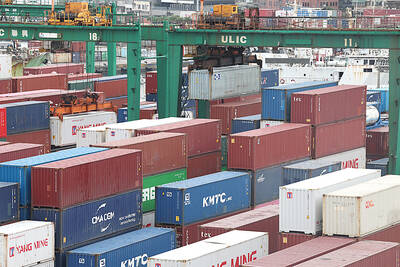
Taiwan climbed to its highest position in global export rankings in more than three decades last year, buoyed by demand linked to artificial intelligence (AI) that lifted shipments of semiconductors and technology products, Ministry of Finance data released yesterday showed. Taiwan accounted for 2.4 percent of global exports last year, or about US$640 billion, ranking 12th worldwide, the data showed. That was up four places from a year earlier and marked the nation’s best ranking since 1994, the ministry said. Taiwan’s share of global exports rose by 0.5 percentage points from the previous year, the largest increase among major economies, reflecting the nation’s
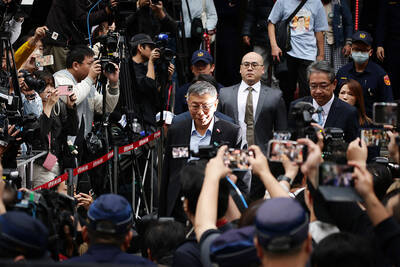
FIRST TRIAL: Ko’s lawyers sought reduced bail and other concessions, as did other defendants, but the bail judge denied their requests, citing the severity of the sentences Former Taipei mayor Ko Wen-je (柯文哲) was yesterday sentenced to 17 years in prison and had his civil rights suspended for six years over corruption, embezzlement and other charges. Taipei prosecutors in December last year asked the Taipei District Court for a combined 28-year, six-month sentence for the four cases against Ko, who founded the Taiwan People’s Party (TPP). The cases were linked to the Core Pacific City (京華城購物中心) redevelopment project and the mismanagement of political donations. Other defendants convicted on separate charges included Chinese Nationalist Party (KMT) Taipei City Councilor Angela Ying (應曉薇), who was handed a 15-year, six-month sentence; Core Pacific


 RSS
RSS