


Iraq's daily barrage of attacks killed two more American soldiers and an Iraqi employee of a UN-affiliated relief agency, while thousands of followers of a hardline Shiite Muslim cleric staged an anti-American protest in the holy city of Najaf.
Also, the top commander of American and international troops in Iraq said Sunday he is establishing an Iraqi "civil defense force," or armed militia, of about 6,800 men to help American forces combat the violence and sabotage that he and others believe is being spearheaded by remnants of Saddam Hussein's regime.
General John Abizaid, the commander of US Central Command, said he will establish eight battalions of armed Iraqi militiamen, each with about 850 men. They will be trained by conventional US forces -- a job usually handled by American special operations forces -- and are expected to be ready to begin operating within 45 days, he said.
The two US soldiers died when rocket-propelled grenades and small-arms fire struck their convoy early Sunday near Tal Afar, a town west of the northern city of Mosul, said military spokesman Corporal Todd Pruden. Another soldier was injured. All the victims were from the 101st Airborne Division.
The deaths brought to 151 the number of US troops killed in action since the March 20 start of war -- four more than during the 1991 Gulf War. Also Sunday, a US soldier was killed and two others injured when their vehicle crashed and flipped over near Baghdad International Airport, according to a statement from US Central Command in Tampa, Florida.
The area of the convoy attack near Tal Afar, 385km northwest of Baghdad, had been relatively peaceful in recent weeks, and the ambush was a worrying development for American forces trying to bring stability to Iraq.
Most recent violence has occurred in an area north and west of Baghdad called the Sunni triangle, where support for Saddam remains. Tal Afar lies outside that region.
On Sunday, the top US official in Iraq said he believes Saddam is still alive and in the country, though not orchestrating attacks on American troops.
Paul Bremer, speaking to NBC's Meet the Press, said there was no evidence of central control in the assaults, calling them "highly professional but very small, sort of squad-level attacks, five or six people at a time attacking us."
Still, he said, getting Saddam would help the situation.
"The sooner we can either kill him or capture him, the better, because the fact that his fate is unknown certainly gives his supporters the chance to go around and try to rally support for him," said Bremer.
In another troubling sign, a two-car convoy carrying members of the International Organization for Migration were ambushed near the southern city of Hilla when a pickup truck pulled up alongside one car and opened fire.
The car collided with a bus. Personnel in a World Health Organization convoy traveling behind the IOM vehicles treated three injured and took the Iraqi driver to a hospital, where he died, said Omer Mekki, the WHO deputy director in Iraq.
Both convoys were clearly marked as UN vehicles.
"We're a bit shaken. Everybody is a bit shocked," said Mekki. "But when we were recruited and we came to Iraq, we knew there were risks. An incident like this is not unexpected."
Ahmed Fawzi, spokesman for the special representative of UN Secretary-General Kofi Annan, denounced the attack. "The United Nations is in Iraq to help the Iraqi people. We are not taking sides," he said in Baghdad.
"We have no way of knowing whether this was targeted at the United Nations. This is a dangerous situation. Only the restoration of law and order can put an end to these attacks," he said.
The UN World Food Program was targeted in a July 6 grenade attack in Mosul, and four days later, the agency issued a release citing concern over the security situation in Iraq.
UN special representative Sergio Vieira de Mello left Iraq on Sunday. He is to report to the UN Security council on Tuesday.
Meanwhile, in Najaf, thousands of followers of Shiite Muslim cleric Muqtada al-Sadr set out from the Imam Ali shrine on a 9.5km march to US headquarters there, shouting slogans against the new, US-sanctioned Iraqi Governing Council and the Americans.
"Long live al-Sadr. America and the Council are infidels," chanted the crowds. "Muqtada, go ahead. We are your soldiers of liberation."
US troops prevented the demonstrators from entering the headquarters and soldiers barricaded the building with Humvees. The crowd dispersed after clerics read out an appeal by al-Sadr to go home.
Earlier, al-Sadr said in a statement read inside the shrine that he wanted coalition forces to leave Najaf and allow Iraqis to handle security for themselves. In his Friday sermon, the cleric said he was recruiting a private army but fell short of calling for armed struggle against the US occupation.
A coalition official dismissed the threat, but said no private armies will be tolerated.
"The only army in Iraq will be the new Iraqi army, which is being formed," the official said, speaking on condition of anonymity. "Anyone found with an unlicensed weapon will be arrested."
The US-led coalition has begun building what it hopes will eventually be a 40,000-strong military force.
On the first day of recruiting Saturday, the coalition processed 5,000 applications at centers in Mosul, Baghdad and the southern city of Basra, the official said.
Al-Sadr, thought to be 30 years old, is not considered a high-ranking Shiite cleric.
Most of his support is by virtue of his being the son of Imam Mohammed Sadiq al-Sadr, a top Shiite religious leader assassinated by Saddam's agents in 1999.
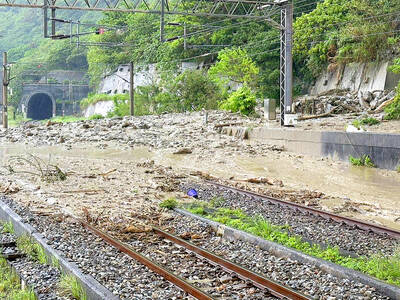
ROLLER-COASTER RIDE: More than five earthquakes ranging from magnitude 4.4 to 5.5 on the Richter scale shook eastern Taiwan in rapid succession yesterday afternoon Back-to-back weather fronts are forecast to hit Taiwan this week, resulting in rain across the nation in the coming days, the Central Weather Administration said yesterday, as it also warned residents in mountainous regions to be wary of landslides and rockfalls. As the first front approached, sporadic rainfall began in central and northern parts of Taiwan yesterday, the agency said, adding that rain is forecast to intensify in those regions today, while brief showers would also affect other parts of the nation. A second weather system is forecast to arrive on Thursday, bringing additional rain to the whole nation until Sunday, it
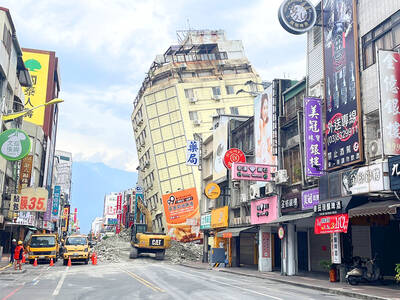
LANDSLIDES POSSIBLE: The agency advised the public to avoid visiting mountainous regions due to more expected aftershocks and rainfall from a series of weather fronts A series of earthquakes over the past few days were likely aftershocks of the April 3 earthquake in Hualien County, with further aftershocks to be expected for up to a year, the Central Weather Administration (CWA) said yesterday. Based on the nation’s experience after the quake on Sept. 21, 1999, more aftershocks are possible over the next six months to a year, the agency said. A total of 103 earthquakes of magnitude 4 on the local magnitude scale or higher hit Hualien County from 5:08pm on Monday to 10:27am yesterday, with 27 of them exceeding magnitude 5. They included two, of magnitude

CONDITIONAL: The PRC imposes secret requirements that the funding it provides cannot be spent in states with diplomatic relations with Taiwan, Emma Reilly said China has been bribing UN officials to obtain “special benefits” and to block funding from countries that have diplomatic ties with Taiwan, a former UN employee told the British House of Commons on Tuesday. At a House of Commons Foreign Affairs Committee hearing into “international relations within the multilateral system,” former Office of the UN High Commissioner for Human Rights (OHCHR) employee Emma Reilly said in a written statement that “Beijing paid bribes to the two successive Presidents of the [UN] General Assembly” during the two-year negotiation of the Sustainable Development Goals. Another way China exercises influence within the UN Secretariat is

Taiwan’s first drag queen to compete on the internationally acclaimed RuPaul’s Drag Race, Nymphia Wind (妮妃雅), was on Friday crowned the “Next Drag Superstar.” Dressed in a sparkling banana dress, Nymphia Wind swept onto the stage for the final, and stole the show. “Taiwan this is for you,” she said right after show host RuPaul announced her as the winner. “To those who feel like they don’t belong, just remember to live fearlessly and to live their truth,” she said on stage. One of the frontrunners for the past 15 episodes, the 28-year-old breezed through to the final after weeks of showcasing her unique


 RSS
RSS