


Senior figures in the British intelligence community and across Whitehall briefed the former international development secretary Clare Short that British Prime Minister Tony Blair had made a secret agreement last summer with US President George W. Bush to invade Iraq in February or March, she claimed yesterday.
In damning evidence to the House of Commons foreign affairs select committee, Short refused to identify the three figures, but she cited their authority for making her claim that Blair had actively deceived the Cabinet and the country in persuading them of the need to go to war.
Short told the first day of the committee's inquiry into the events leading up to the Iraq conflict that Blair had "used a series of half-truths, exaggerations, reassurances that were not the case to get us into conflict by the spring."
She claimed Blair told Bush that "we will be with you" without laying down conditions to temper US ambitions.
She also claimed that the intelligence and diplomatic community had privately opposed the war. This is the first time she has alleged that intelligence figures had serious doubts about the need for early military action.
Justifying her charge of deception, she said: "Three extremely senior people in the Whitehall system said to me very clearly and specifically that the target date was mid-February."
She went on: "I believe that the prime minister must have concluded that it was honorable and desirable to back the US in going for military action in Iraq and therefore it was honorable for him to persuade us through various ruses and ways to get us there -- so for him I think it was an honorable deception."
No. 10 last night denied Short's charge and said Blair had worked as hard as possible to secure support for a second UN resolution that may have persuaded former Iraqi president Saddam Hussein to cooperate.
In the same evidence session Cook exonerated Blair of the charge of deliberately misleading the country, but asserted that intelligence material was chosen selectively to fit a predetermined policy.
He said his own personal briefing by the Secret Intelligence Service (MI6) confirmed him in his belief that Iraq did not have weaponized chemicals, let alone weapons capable of being fired within 45 minutes, a claim made in the main intelligence document published last September.
"I think it would be fair to say there was a selection of evidence to support a conclusion," he said. "I fear we got into a position in which the intelligence was not being used to inform and shape policy, but to shape policy that was already settled."
He asserted that No 10 had "a burning fixation" with weapons of mass destruction that led Blair to reject Cook's view that the policy of containment was working.
Both former ministers confirmed a previous Guardian story that Cabinet ministers had been given private intelligence briefings by SIS, but insisted the briefings did not indicate that the world had to act immediately to stem an imminent Iraqi threat. At best, Short said, Iraq had scientists working to try to develop biological and chemical weapons, but it was wrong to suggest that meant there were "weaponized" materials.
Short also claimed there was a shocking collapse in proper government procedure, with a small unelected entourage in Downing Street making the decisions without minutes, proper options papers or any written material. She said the Cabinet was never shown military options papers.
She also gave the impression that the Foreign Secretary Jack Straw was a cipher who "went along" with the decisions, while the real decision-making was "sucked out" of the Foreign Office.
The vehemence of the attack by the two ex-ministers and their damning analysis of the intelligence failure over Iraq raises fresh questions for Straw when he gives evidence before the committee next week.
He will defend the use of intelligence material in both public and private evidence sessions.
Also see story:
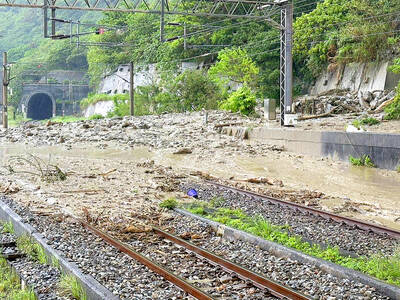
ROLLER-COASTER RIDE: More than five earthquakes ranging from magnitude 4.4 to 5.5 on the Richter scale shook eastern Taiwan in rapid succession yesterday afternoon Back-to-back weather fronts are forecast to hit Taiwan this week, resulting in rain across the nation in the coming days, the Central Weather Administration said yesterday, as it also warned residents in mountainous regions to be wary of landslides and rockfalls. As the first front approached, sporadic rainfall began in central and northern parts of Taiwan yesterday, the agency said, adding that rain is forecast to intensify in those regions today, while brief showers would also affect other parts of the nation. A second weather system is forecast to arrive on Thursday, bringing additional rain to the whole nation until Sunday, it
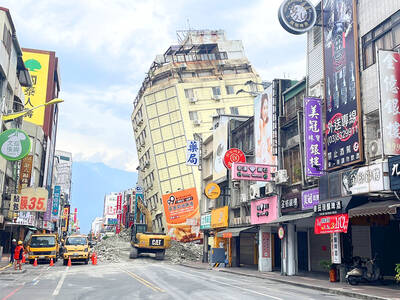
LANDSLIDES POSSIBLE: The agency advised the public to avoid visiting mountainous regions due to more expected aftershocks and rainfall from a series of weather fronts A series of earthquakes over the past few days were likely aftershocks of the April 3 earthquake in Hualien County, with further aftershocks to be expected for up to a year, the Central Weather Administration (CWA) said yesterday. Based on the nation’s experience after the quake on Sept. 21, 1999, more aftershocks are possible over the next six months to a year, the agency said. A total of 103 earthquakes of magnitude 4 on the local magnitude scale or higher hit Hualien County from 5:08pm on Monday to 10:27am yesterday, with 27 of them exceeding magnitude 5. They included two, of magnitude
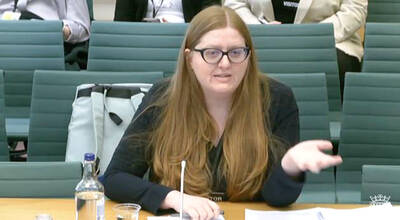
CONDITIONAL: The PRC imposes secret requirements that the funding it provides cannot be spent in states with diplomatic relations with Taiwan, Emma Reilly said China has been bribing UN officials to obtain “special benefits” and to block funding from countries that have diplomatic ties with Taiwan, a former UN employee told the British House of Commons on Tuesday. At a House of Commons Foreign Affairs Committee hearing into “international relations within the multilateral system,” former Office of the UN High Commissioner for Human Rights (OHCHR) employee Emma Reilly said in a written statement that “Beijing paid bribes to the two successive Presidents of the [UN] General Assembly” during the two-year negotiation of the Sustainable Development Goals. Another way China exercises influence within the UN Secretariat is

Taiwan’s first drag queen to compete on the internationally acclaimed RuPaul’s Drag Race, Nymphia Wind (妮妃雅), was on Friday crowned the “Next Drag Superstar.” Dressed in a sparkling banana dress, Nymphia Wind swept onto the stage for the final, and stole the show. “Taiwan this is for you,” she said right after show host RuPaul announced her as the winner. “To those who feel like they don’t belong, just remember to live fearlessly and to live their truth,” she said on stage. One of the frontrunners for the past 15 episodes, the 28-year-old breezed through to the final after weeks of showcasing her unique


 RSS
RSS