


Journalists at the UN are planning a briefing on self-determination for Taiwan today at the organization's headquarters in New York, less than a month after China blocked their attempts to hold a briefing on Taiwan's response to the SARS epidemic.
On May 23, UN Secretary General Kofi Annan barred Andrew Hsia (
The UN acted in response to objections from the Chinese delegation, sparking a street protest the next day by the journalists' organization, led by association president Anthony Jenkins.
Jenkins later wrote letters to Annan and Chinese Ambassador Wang Yingfan (
The association has invited Chen Lung-chu (
Wang turned down an invitation to take part.
The reaction of the Chinese delegation and the UN bureaucracy to this week's planned press conference was not clear Monday.
Meanwhile, 10 pro-independence Taiwanese-American organizations have written to Jenkins praising his efforts to bring Taiwanese issues before the world community and condemning Chinese actions to stymie those efforts.
"We wish to express our appreciation for your courageous actions," the group wrote in a letter to Jenkins on Monday. "We are grateful that the UNCA has tried its best to give the Taiwanese people a voice in the ongoing SARS crisis, and that it has fought for the right of the island's political leaders to disseminate and receive the information they so desperately need to combat the disease."
Citing the 1951 San Francisco Peace Treaty, which formally ended World War II, the Taiwanese-American groups called the treaty "the legal basis for the right of self-determination for the people of Taiwan."
"Despite the incessant threats from Chinese quarters, Taiwan is nevertheless gradually moving from a state of de facto to de jure independence," the groups said.
This week's conference, "The Applicability of International Law on Self-determination and Decolonization for Taiwan," is scheduled to be held in the UNCA meeting room in the UN building.
The Taiwanese groups said that a discussion of Taiwan's self-determination "is long overdue and will hopefully serve to dispel the various myths surrounding Taiwan's place in the international community."
Wu Ming-chi, the president of a Taiwan lobbying group in Washington, the Formosan Association for Public Affairs, voiced support for the planned UNCA conference.
"The United Nations must hold itself accountable to the ideals it stands for, Article 19 of the United Nations' Universal Declaration of Human Rights guarantees freedom of the press. This guarantee cannot be subject to narrow political considerations or to pressure from the PRC government," he said.
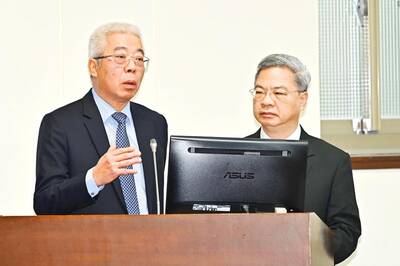
Taiwan has arranged for about 8 million barrels of crude oil, or about one-third of its monthly needs, to be shipped from the Red Sea this month to bypass the Strait of Hormuz and ease domestic supply pressures, CPC Corp, Taiwan (CPC, 台灣中油) said yesterday. The state-run oil company has worked with Middle Eastern suppliers to secure routes other than the Strait of Hormuz, through which about 20 percent of the world’s oil and liquefied natural gas typically passes, CPC chairman Fang Jeng-zen (方振仁) said at a meeting of the legislature’s Economics Committee in Taipei. Suppliers in Saudi Arabia have indicated they
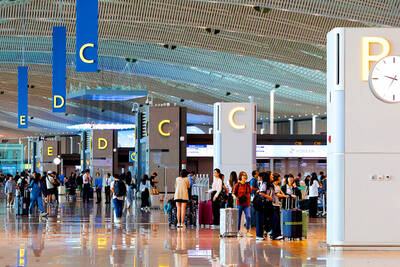
South Korea has adjusted its electronic arrival card system to no longer list Taiwan as a part of China, a move that the Ministry of Foreign Affairs said would help facilitate exchanges between the two sides. South Korea previously listed “Taiwan” as “Taiwan (China)” in the drop-down menus of its online arrival card system, where people had to fill out where they came from and their next destination. The ministry had requested South Korea make a revision and said it would change South Korea’s name on Taiwan’s online immigration system from “Republic of Korea” to “Korea (South),” should the issue not be
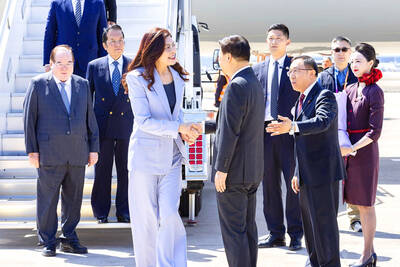
CCP ‘PAWN’? Beijing could use the KMT chairwoman’s visit to signal to the world that many people in Taiwan support the ‘one China’ principle, an academic said Chinese Nationalist Party (KMT) Chairwoman Cheng Li-wun (鄭麗文) yesterday arrived in China for a “peace” mission and potential meeting with Chinese President Xi Jinping (習近平), while a Taiwanese minister detailed the number of Chinese warships currently deployed around the nation. Cheng is visiting at a time of increased Chinese military pressure on Taiwan, as the opposition-dominated Legislative Yuan stalls a government plan for US$40 billion in extra defense spending. Speaking to reporters before going to the airport, Cheng said she was going on a “historic journey for peace,” but added that some people felt uneasy about her trip. “If you truly love Taiwan,

Tainan, Taipei and New Taipei City recorded the highest fines nationwide for illegal accommodations in the first quarter of this year, with fines issued in the three cities each exceeding NT$7 million (US$220,639), Tourism Administration data showed. Among them, Taipei had the highest number of illegal short-term rental units, with 410. There were 3,280 legally registered hotels nationwide in the first quarter, down by 14 properties, or 0.43 percent, from a year earlier, likely indicating operators exiting the market, the agency said. However, the number of unregistered properties rose to 1,174, including 314 illegal hotels and 860 illegal short-term rental


 RSS
RSS