


The retired US general appointed as Iraq's postwar administrator arrived in Baghdad yesterday, while two more top members of Saddam Hussein's regime -- including his son-in-law -- were reported captured.
Landing at Baghdad's airport in his first postwar visit to the capital, retired Lieutenant General Jay Garner, 64, said his priority was to restore basic services such as water and electricity as soon as possible -- a task he said would take intense work.
With Baghdad slowly returning to normal after days of looting and arson, Marines pulled back Sunday and left the US Army in control of the capital, where coalition-run radio announced an 11 pm to 6 am curfew.
Tensions appeared to ease between the US and Syria, with US President George W. Bush saying Syria appears to be heeding warnings against sheltering escaped members of Saddam's regime.
Israel, too, began letting down its guard. Authorities declared that the Iraqi missile threat against their citizens was over and prepared for the departure of 700 US soldiers manning Patriot missile installations there.
US Central Command said forces had captured Abd al-Khaliq Abd al-Ghafar, Saddam's scientific research minister, on Saturday -- a development that could shed light on Iraq's nuclear program. Abd al-Ghafar was the four of hearts in the US military's most-wanted deck of cards.
Also, Saddam's son-in-law and one of Saddam's bodyguards, both hiding in Syria, were persuaded to leave that country and surrendered to members of the opposition Iraqi National Congress in Baghdad, according to a spokesman for the group, Haider Ahmed.
Jamal Mustafa Abdallah Sultan al-Tikriti is married to Saddam's youngest daughter, Hala, and was deputy head of Iraq's tribal affairs office. He was the nine of clubs in the deck of cards issued to US military to help them recognize regime members.
He was being questioned by the opposition group and will be turned over to US officials, Ahmed said. Central Command had no information on the reported surrender.
Seven of the 55 most-wanted members of Saddam's regime are now in custody, though none from the very top of the list. An eighth figure, Ali Hassan al-Majid -- nicknamed "Chemical Ali" for his use of poison gas against the Kurds -- is believed to have been killed in an airstrike.
As for Saddam himself, Ahmad Chalabi, leader of the Iraqi National Congress exile group, said yesterday that Saddam is alive in Iraq and is moving from place to place.
"We are aware of his movements and we are aware of the areas that he has been to, and we learn of this within 12 to 24 hours," he said. "We will work to develop more information about his whereabouts."
The New York Times reported yesterday that a US military team said a scientist who claimed to have worked in Iraq's chemical weapons program for more than a decade told them Iraq destroyed chemical weapons and biological warfare equipment days before the war began.
Members of the Mobile Exploitation Team Alpha, or MET Alpha, said the scientist led Americans to material that proved to be precursors for a toxic agent banned by chemical weapons treaties, the Times said. MET Alpha did not identify the scientist.
The White House had no immediate comment, and US Central Command in Qatar could not confirm the report.
In Baghdad, the US military opened a warehouse to UN aid shipments and stockpiled flour on Sunday, trying for head off potential food shortages. Workers labored to restore basic services like power and water. A convoy of food arrived over the weekend for the malnourished animals of Baghdad Zoo.
US forces, together with returning Iraqi police, are trying to restore order until the interim authority led by Garner can take over.
Garner heads the Office of Reconstruction and Humanitarian Assistance, set up by the US administration to help rebuild Iraq and eventually turn authority over to the Iraqis. His initial team of about 19 civilian administrators is to grow to about 450 over the next week.
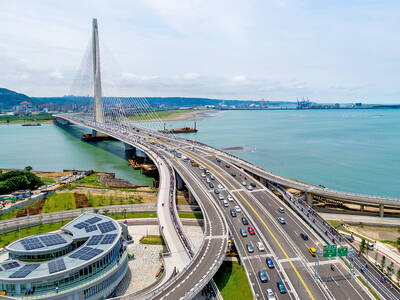
The Ministry of Transportation and Communications yesterday inaugurated the Danjiang Bridge across the Tamsui River in New Taipei City, saying that the structure would be an architectural icon and traffic artery for Taiwan. Feted as a major engineering achievement, the Danjiang Bridge is 920m long, 211m tall at the top of its pylon, and is the longest single-pylon asymmetric cable-stayed bridge in the world, the government’s Web site for the structure said. It was designed by late Iraqi-British architect Zaha Hadid. The structure, with a maximum deck of 70m, accommodates road and light rail traffic, and affords a 200m navigation channel for boats,
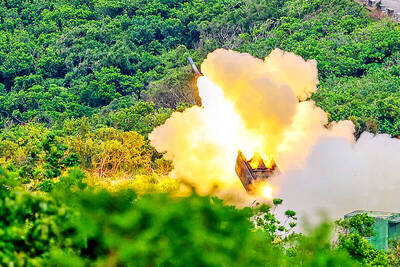
PRECISION STRIKES: The most significant reason to deploy HIMARS to outlying islands is to establish a ‘dead zone’ that the PLA would not dare enter, a source said A High Mobility Artillery Rocket System (HIMARS) would be deployed to Penghu County and Dongyin Island (東引) in Lienchiang County (Matsu) to force the Chinese military to retreat at least 100km from the coastline, a military source said yesterday. Taiwan has been procuring HIMARS and Army Tactical Missile Systems (ATACMS) from the US in batches. Once all batches have been delivered, Taiwan would possess 111 HIMARS units and 504 ATACMS, which have a range of 300km. Considering that “offense is the best defense,” the military plans to forward-deploy the systems to outlying islands such as Penghu and Dongyin so that

Taiwan Semiconductor Manufacturing Co (TSMC, 台積電), the world’s largest foundry service provider, yesterday said that global semiconductor revenue is projected to hit US$1.5 trillion in 2030, after the figure exceeds US$1 trillion this year, as artificial intelligence (AI) demand boosts consumption of token and compute power. “We are still at the beginning of the AI revolution, but we already see a significant impact across the whole semiconductor ecosystem,” TSMC deputy cochief operating officer Kevin Zhang (張曉強) said at the company’s annual technology symposium in Hsinchu City. “It is fair to say that in the past decade, smartphones and other mobile devices were
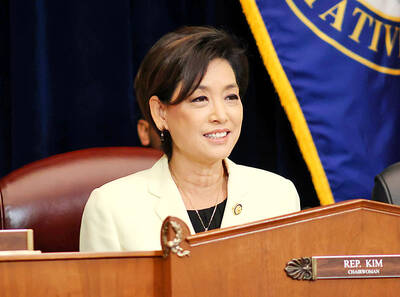
‘CLEAR MESSAGE’: The bill would set up an interagency ‘tiger team’ to review sanctions tools and other economic options to help deter any Chinese aggression toward Taiwan US Representative Young Kim has introduced a bill to deter Chinese aggression against Taiwan, calling for an interagency “tiger team” to preplan coordinated sanctions and economic measures in response to possible Chinese military or political action against Taiwan. “[Chinese President] Xi Jinping [習近平] has directed the People’s Liberation Army to be ready to invade Taiwan by 2027. China has a plan. America should have one too,” Kim said in a news release on Thursday last week. She introduced the “Deter PRC [People’s Republic of China] aggression against Taiwan act” to “ensure the US has a coordinated sanctions strategy ready should


 RSS
RSS