


Two people in China's remote northern region of Inner Mongolia have died from severe acute respiratory syndrome (SARS), the Xinhua news agency said yesterday, reinforcing fears about the disease's spread though the world's most populous country.
Ten cases of SARS were reported in the regional capital of Hohhot, Xinhua said. The disease has infected more than 3,000 people and killed more than 110 across the globe since it first appeared in the southern Chinese province of Guangdong in November.
Chinese and World Health Organization (WHO) officials were not immediately available for comment.
The WHO's Web site (www.int/en/) for the first time showed Japan among countries with reported probable cases of SARS.
The Japanese government said it had dropped its policy of reporting only confirmed cases, Kyodo news agency said.
The government also urged Japanese travelers to be careful on trips to Beijing.
Hong Kong and Chinese health experts said they had confirmed that the virus in China was the same as the one in Hong Kong, debunking the assertion of some Chinese doctors that SARS came from a common microbe, chlamydia pneumoniae, a cause of pneumonia as well as sexually transmitted infections.
Like Hong Kong SARS sufferers, patients in China showed evidence of a new strain of coronavirus, best known as a cause of the common cold, the University of Hong Kong said.
WHO officials said on Friday the epidemic was being contained elsewhere in the world but that they were worried about China.
Nearly a month after the WHO launched its first ever global alert because of the mystery disease that has created panic in much of Asia, the worst-hit region, the WHO nevertheless said there were signs that SARS may have peaked.
Even in Hong Kong, which has the highest incidence after China, there were signs that local health authorities were beginning to win the battle, the WHO said.
But yesterday Hong Kong reported yet another 49 cases and three more deaths.
"I think we are fighting a losing battle," said Peter Hung, a 33-year-old Hong Kong security guard. "The number of cases has shot up again and you can see the pattern that more and more people who have been infected are from the wider community.
"I think the chances of me getting it are about 50/50," Hung said through his heavy duty face mask.
Singapore warned its residents yesterday that SARS would not go away overnight but said it was learning to live with the illness after reporting 39 new cases in a week.
But as the government moved to calm jangled nerves, an outbreak of the virus at the nation's biggest hospital showed little sign of abating.
The government said late on Friday that six more people had been infected by SARS while either visiting or working at Singapore General Hospital, bringing the number of confirmed cases at the sprawling complex to 25 in a week.
Singapore has the world's fourth-highest number of cases.
The rash of new infections has been traced to an elderly Chinese man whose multiple ailments -- including chronic kidney disease and diabetes -- masked symptoms of SARS as he unwittingly coughed or sneezed it on to doctors, nurses, patients and guests.
Authorities believe SARS is caused by a type of coronavirus, a relative of the common-cold virus, which could be expected to spread like other cold and flu viruses through infected droplets.
The elderly man, dubbed a "super spreader," may have infected as many as 52 people, the government said.
Nurses and air-force paramedics at the main airport, armed with the power to quarantine, are now taking the temperature of all travelers from Hong Kong and China's Guangdong Province, the two areas hit hardest by SARS.
Sick-looking people from SARS-hit regions are already quizzed on their health while stepping into Singapore, and two women who had arrived from Hong Kong and China on Thursday are now quarantined as suspected SARS cases.
Also see stories:
Kids escape brunt of killer SARS
Top health official says nation worthy of WHO entry
New resolution may pave way for WHO entry, officials say
Let's deal with the facts, halt WHO bid
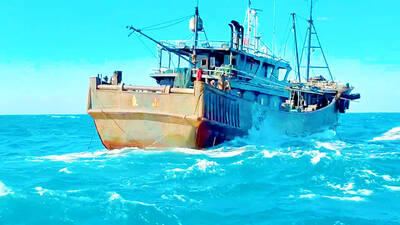
MAKING WAVES: China’s maritime militia could become a nontraditional threat in war, clogging up shipping lanes to prevent US or Japanese intervention, a report said About 1,900 Chinese ships flying flags of convenience and fishing vessels that participated in China’s military exercises around Taiwan last month and in January last year have been listed for monitoring, Coast Guard Administration (CGA) Deputy Director-General Hsieh Ching-chin (謝慶欽) said yesterday. Following amendments to the Commercial Port Act (商港法) and the Law of Ships (船舶法) last month, the CGA can designate possible berthing areas or deny ports of call for vessels suspected of loitering around areas where undersea cables can be accessed, Oceans Affairs Council Minister Kuan Bi-ling (管碧玲) said. The list of suspected ships, originally 300, had risen to about
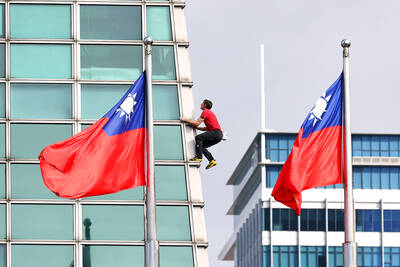
DAREDEVIL: Honnold said it had always been a dream of his to climb Taipei 101, while a Netflix producer said the skyscraper was ‘a real icon of this country’ US climber Alex Honnold yesterday took on Taiwan’s tallest building, becoming the first person to scale Taipei 101 without a rope, harness or safety net. Hundreds of spectators gathered at the base of the 101-story skyscraper to watch Honnold, 40, embark on his daredevil feat, which was also broadcast live on Netflix. Dressed in a red T-shirt and yellow custom-made climbing shoes, Honnold swiftly moved up the southeast face of the glass and steel building. At one point, he stepped onto a platform midway up to wave down at fans and onlookers who were taking photos. People watching from inside

Japan’s strategic alliance with the US would collapse if Tokyo were to turn away from a conflict in Taiwan, Japanese Prime Minister Sanae Takaichi said yesterday, but distanced herself from previous comments that suggested a possible military response in such an event. Takaichi expressed her latest views on a nationally broadcast TV program late on Monday, where an opposition party leader criticized her for igniting tensions with China with the earlier remarks. Ties between Japan and China have sunk to the worst level in years after Takaichi said in November that a hypothetical Chinese attack on Taiwan could bring about a Japanese
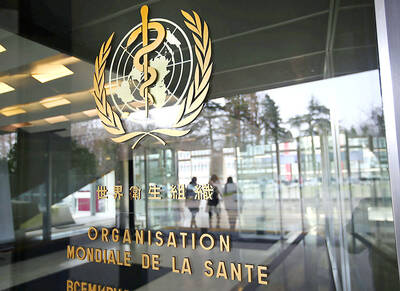
The WHO ignored early COVID-19 warnings from Taiwan, US Deputy Secretary of Health and Human Services Jim O’Neill said on Friday, as part of justification for Washington withdrawing from the global health body. US Secretary of State Marco Rubio on Thursday said that the US was pulling out of the UN agency, as it failed to fulfill its responsibilities during the COVID-19 pandemic. The WHO “ignored early COVID warnings from Taiwan in 2019 by pretending Taiwan did not exist, O’Neill wrote on X on Friday, Taiwan time. “It ignored rigorous science and promoted lockdowns.” The US will “continue international coordination on infectious


 RSS
RSS