


US troops mounted an air and tank assault on Baghdad to repel an Iraqi counterattack yesterday, a day after targeting Iraqi President Saddam Hussein and his two sons with bunker-busting bombs.
In Belfast, Northern Ireland, US President George W. Bush said it was unclear whether Saddam was still alive. "I don't know whether he survived," he said at a joint news conference with British Prime Minister Tony Blair. "The only thing I know is that he's losing power."
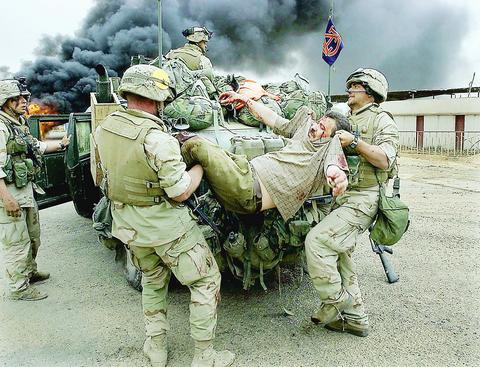
PHOTO: AP
The two leaders -- holding their third meeting in three weeks -- were looking ahead to the postwar period in Iraq while seeking to minimize splits on who should govern and rebuild the country.
"There will be a vital role for the UN in the reconstruction of Iraq," Blair said. "But the key is that Iraq in the end will be run by the Iraqi people."
Iraqi forces staged an assault on US forces in the capital shortly after dawn, sending buses and trucks full of fighters over the Tigris River, which divides the city. Tanks with the US Army's 3rd Infantry Division took up positions on a bridge. At least 50 Iraqi fighters were killed, and two US soldiers were reported wounded, one seriously, by snipers on rooftops.
A US A-10 "Warthog" warplane went down near Baghdad early yesterday, US Central Command said. The pilot ejected safely from the aircraft and was recovered by coalition ground forces near the airport.
During Monday's assault on Baghdad, a B-1B bomber carried out a massive strike on what the coalition described as a "leadership target," in an upscale neighborhood where senior Iraqi officials, possibly including Saddam and his two sons, were believed to be meeting. US officials, speaking on condition of anonymity, said US intelligence learned of the high-level meeting Monday morning.
It was not clear if any leader was killed; the strike left a smoking crater of dirt and concrete and destroyed three nearby houses. Iraqi rescue workers pulled two bodies from the rubble, but said the toll could be as high as 14.
As US and British troops advanced in Iraq, their political leaders were meeting in Belfast. It was the second summit for Bush and Blair since the fighting began.
"The hostilities phase is coming to a conclusion," US Secretary of State Colin Powell told reporters. Without elaboration, he said the US government is sending a team this week to Iraq to begin laying the groundwork for an interim authority.
As airstrikes continued yesterday, Arab satellite network al-Jazeera reported its Baghdad office was bombed, killing one staffer. While the network's cameras rolled, a second bomb fell in the same neighborhood on the Tigris, where a number of TV channels have offices. Abu Dhabi TV said its office had also been hit.
Later, the Palestine Hotel, home base for many journalists, was struck by what was believed to be tank fire. Reuters said a cameraman was killed in the blast and three of its staff were injured -- a reporter, a photographer and a technician. A Spanish cameraman working for Telecinco was also killed. All had to be rushed to hospital.
In southeastern Baghdad, the 3rd Battalion, 7th Marines, took over a prison overnight, where they found US Army uniforms and chemical weapons suits, possibly from captured US soldiers. Shortly after dawn, the Marines were attacked by Iraqis firing rocket-propelled grenades and AK-47s; Marine snipers shot more than a dozen of them.
Other Marines were sent to guard a nuclear plant yesterday. Near the airport, Army's 101st Airborne Division troops killed two Iraqis in a gunbattle at a former Republican Guard headquarters.
Members of the 2nd Brigade of the 3rd Infantry Division hunkered down for their first night in Baghdad at the sprawling, blue-and-gold-domed New Presidential Palace, where Saddam once slept. At least a dozen Iraqis were being held in a hastily erected holding pen on the grounds.
In the north, US jets continued to hammer Iraqi positions yesterday near the Baghdad-controlled cities of Kirkuk and Khaneqin. In the south, British forces claimed control over Basra on Monday, after battling militants there for two weeks.
Central Command said yesterday that nearly 85,000 US servicemen and British troops took part in Monday's attacks in southeast Baghdad and Basra. They seized five weapons caches consisting of more than 10 tonnes of ordnance, including a number of missiles, and destroyed, damaged or captured two dozen tanks, along with many other military vehicles, a statement said.
The coalition has taken more than 3,500 prisoners of war since the conflict began, Central Command said.
Defense officials said samples of a suspicious material found in Iraq are being tested for the presence of chemical weapons. Soldiers with the Army's 101st Airborne Division found the substance in metal drums in a compound near the city of Hindiyah, about 140km south of Baghdad. It was possible the substance was a pesticide, since it was found at an agricultural site, a local commander said.
At the UN, a group of 22 Arab countries decided late Monday to push for a General Assembly resolution calling for a ceasefire in Iraq. They are certain to face US opposition.
The group will seek a "very mild" resolution, said Yemen's UN Ambassador Abdullah Alsaidi. "It will ask for a ceasefire, respect for Iraqi sovereignty, territorial integrity. It will ask for the unity of Iraq."
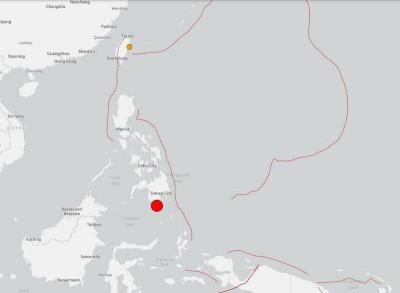
A magnitude 7.8 earthquake struck off the southern coast of Mindanao in the Philippines at 7:38am today, prompting the US Tsunami Warning System to issue an alert for neighboring countries, including Taiwan. The system issued a purple alert indicating a "tsunami threat." The potential threat zone includes Taiwan, the Philippines, Papua New Guinea, Yap and Palau. Philippine authorities were assessing the damage from the quake, with the office of civil defense seeking to verifying initial reports that 15 people had been killed and 129 injured in the region, mostly from falling debris. Arlene Hollero, disaster chief of Maasim town in the Philippines' Sarangani Province,

‘GRAY ZONE’ PRESSURE: Beijing’s activities are intended to create the deceitful impression that China has jurisdiction over the area around Taiwan, the CGA said Taiwan’s rights over its territorial waters and exclusive economic zone must not be violated by any country, the Mainland Affairs Council said yesterday, adding that it will not accept any unprovoked actions. The council issued the remarks in response to the China Coast Guard conducting maritime enforcement drills near eastern Taiwan and claiming to fully exercise China’s maritime administrative law enforcement authority. The Coast Guard Administration (CGA) has been closely monitoring the situation and is taking concrete steps to defend the nation’s sovereignty and secure its waters, the council said. China has no sovereign rights over the waters off eastern
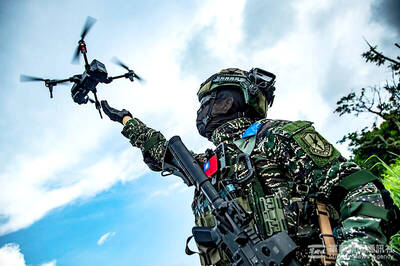
RESILIENCE: Taiwan plays a key role in semiconductors, energy, information infrastructure and advanced manufacturing, AIT Director Raymond Greene said Taiwan’s continued investment in deterrence and resilience remains vital, especially in uncrewed systems and other emerging technologies, American Institute in Taiwan (AIT) Director Raymond Greene said yesterday. Greene made the remarks at the annual National Strategic Summit on Supply Chain Resilience held by the Research Institute for Democracy, Society and Emerging Technology (DSET), a government-backed think tank. As Taiwan last year became the US’ fourth-largest trading partner and supply chain security is becoming more important, cooperation in emerging technologies continues to deepen between the two countries, he said. The US is committed to accelerating innovation, building key infrastructure, strengthening cooperation

RIGHT DIRECTION: Taiwan’s efforts to prevent forced labor include a proposal to ‘fully prohibit’ employers from withholding workers’ documents, an official said Taiwan is to establish a mechanism to restrict imports of goods linked to forced labor, the Executive Yuan said yesterday, after the US proposed imposing additional tariffs on Taiwanese goods over labor concerns. “The Ministry of Labor and the Ministry of Economic Affairs are to establish an interministerial review procedure,” Executive Yuan spokesperson Michelle Lee (李慧芝) said at a news briefing in Taipei. “The government is to use the Foreign Trade Act [貿易法] as the legal basis to restrict imports of goods produced with forced labor” and bring its supply chain governance more in line with international standards on human rights, resilience


 RSS
RSS