


Seventeen people were killed and 156 injured when a mountain train derailed on a bridge in Alishan yesterday.
Most of the injured suffered fractures or breathing difficulties. Four of the dead were children.
Yesterday's accident was the worst of the 10 that have taken place on the Alishan railway since 1962, according to the Taiwan Forestry Bureau which is responsible for the railway's operation.
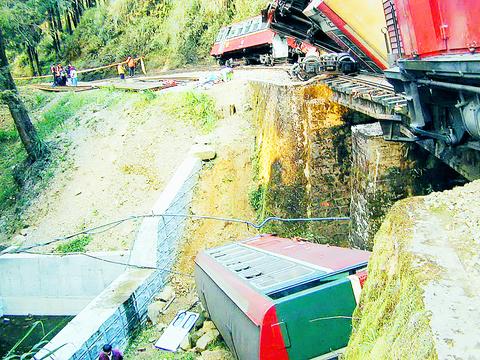
PHOTO: YANG KUO-TANG, TAIPEI TIMES
The accident took place at 2:07pm, shortly after the train, carryings around 200 people, departed from Alishan Railway Station.
The train was composed of four carriages, of which three derailed with one tumbling 6m into a chasm by the side of the track.
"The cars suddenly left the rails and fell over," one female passenger -- her face and hands streaked with blood -- told FTV cable news from a hospital bed.
"The car was filled with people. Some were standing," said the woman, who wasn't identified. "I looked at my daughter and saw her internal organs. I don't know where my daughter is now."
Witnesses said the tragedy might have occurred because the train was traveling too fast.
Police have detained the train driver, who said that the brakes on the train failed, a claim backed up by initial investigations into the causes of the crash.
The ruggedness of the mountain terrain and limited road access to the area made rescue operations very difficult, rescuers said.
Helicopters were dispatched to help evacuate injured passengers.
The derailment tragedy was nearly compounded when one helicopter, packed with injured travelers, was forced to make an emergency landing after catching its tail on a tree as it was taking off.
Fortunately, all 15 people on the helicopter, five crew and 10 injured travelers, were safe after the emergency landing.
All passengers on the train were evacuated by 4:39pm. The injured were sent to local hospitals.
The Council of Agriculture said yesterday that the families of those who died may claim at least NT$4.1 million in compensation from the railway system's travel insurance.
The Alishan train service has been completely suspended since the accident. There is as yet no indication of when it might restart
President Chen Shui-bian (陳水扁) cancelled his schedule, which involved watching a baseball game in Taipei, because of the tragedy. Chen, still managing to preside over the game's opening ceremony, apologized for his unexpected departure.
Premier Yu Shyi-kun asked government agencies to offer any help they could to the rescue operations
Minister of National Defense Tang Yao-ming (湯曜明) dispatched soldiers to join the rescue operations immediately after being informed of the accident.
Soldiers bringing medical kits and warm clothing arrived at the scene at 3:30pm. Two helicopters were deployed to help transport the injured.

The National Chungshan Institute of Science and Technology yesterday showcased its locally developed variants of the Vision 60 robotic patrol dog, which it plans to deploy on the nation’s outlying territories in the South China Sea. The variants were produced under the Joint Lab project — created by the institute and domestic companies — and assembled with domestically produced motors, lenses and artificial intelligence (AI) systems alongside licensed tech from the US, Missile and Rocket Systems Research Division deputy director Jen Kuo-kang (任國光) told the media event at a military base in Taipei’s Dazhi (大直) area. Taiwan has built up its strengths

RIGHT DIRECTION: Taiwan’s efforts to prevent forced labor include a proposal to ‘fully prohibit’ employers from withholding workers’ documents, an official said Taiwan is to establish a mechanism to restrict imports of goods linked to forced labor, the Executive Yuan said yesterday, after the US proposed imposing additional tariffs on Taiwanese goods over labor concerns. “The Ministry of Labor and the Ministry of Economic Affairs are to establish an interministerial review procedure,” Executive Yuan spokesperson Michelle Lee (李慧芝) said at a news briefing in Taipei. “The government is to use the Foreign Trade Act [貿易法] as the legal basis to restrict imports of goods produced with forced labor” and bring its supply chain governance more in line with international standards on human rights, resilience

NOT IMMEDIATE: Taiwan has a chance to appeal the proposed 10 percent tariff before it starts, while other countries face a 12.5 percent tariff from the trade office Taiwan is among 60 economies determined by the US to have failed to impose or enforce a ban on the importation of goods produced with forced labor, according to a notice released on Tuesday by the Office of the US Trade Representative (USTR), which proposed imposing an additional 10 percent or more tariff on them. The USTR in a statement said that following an investigation, it had determined under Section 301 of the Trade Act of 1974 that the failure of the 60 economies to impose and effectively enforce a prohibition on the importation of goods produced with forced labor is

TIT-FOR-TAT: The US allegedly revoked the visa of a Chinese national working at Xinhua News Agency in the US in response to Beijing’s expulsion of Vivian Wang The Presidential Office yesterday condemned China for expelling a New York Times correspondent from Beijing following the newspaper’s interview with President William Lai (賴清德), saying the move highlighted Beijing’s suppression of press freedom and its threat to international news media. Taiwan has noted a series of recent incidents in which Beijing used similar tactics to “threaten and pressure international media outlets and journalists,” Presidential Office spokeswoman Karen Kuo (郭雅慧) said in a statement. “This concerns not only press freedom and freedom of expression, but also the safety of journalists, and Taiwan and relevant partners are paying close attention to the situation,” she


 RSS
RSS