


Taipei Chief Prosecutor Lin Jinn-tsun (
"There will be a second indictment of suspects, including the China Development Financial Holding Corp Chairman Liu Tai-ying (
Those indicted are Zanadau Development Corp majority shareholder Su Hui-chen (
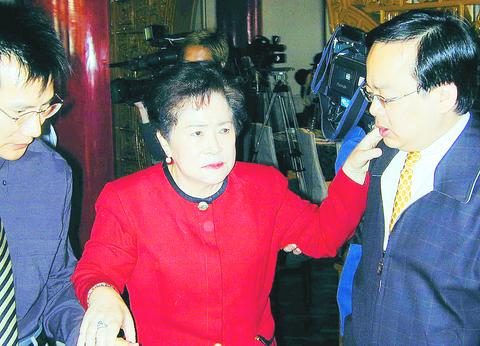
PHOTO: HUNG CHENG-HUNG, TAIPEI TIMES
The seven suspects whose charges will be suspended for two years, are Kaohsiung Fifth Credit Cooperative Credit Investigative Section Chief Hung Chen-hsiung (
All seven have been charged with breach of trust. If they do not break the law within the next two years, however, the charges against them will be automatically dropped.
"The seven suspects' charges were suspended because prosecutors believe they simply accepted orders rather than deliberately committed a crime by receiving bribes of their own volition," Chen Hung-ta said.
Su was charged with violations of the Securities Exchange Law (
Lee Ming-che was charged with corruption, forgery and breach of trust. Prosecutors demanded a 12-year sentence for him, alleging he was the broker behind the scandal.
Hsieh was charged with corruption and faces a possible 14-year sentence for allegedly using Taiwan Fertilizer's money to buy Zanadau stocks and receiving bribes from Su.
Yu Chen was charged with violation of the Securities Exchange Law and breach of trust for allegedly manipulating Zanadau's stocks as the company's president in 1998.
Yu Chen's resignation as a senior adviser to the president was immediately approved by President Chen Shui-bian (
Wong was charged with corruption and faces a possible nine-year sentence for allegedly receiving NT$25 million via Hsieh, as a bribe from Su.
Lin was charged with corruption with a recommended seven-year sentence for helping Su to receive a license for the construction of Zanadau's 11.66 hectare Tahu Commercial Zone (大湖工商綜合區) in Kaohsiung County, when the company did not meet eligibility criteria for such a license.
Lee Ming-se was charged with breach of trust with a suggested four-year sentence. Charges against the rest of the bank's employees were suspended.
They all allegedly helped Su gain financing from the bank, although Su had a poor credit history and was not qualified for the mortgage.
Chinese-language media have reported that prosecutors hurried to wrap up the first indictment yesterday because their deadline for indicting or relasing two of the major suspects -- Hsieh and Lee Ming-che -- falls tomorrow.
Hsieh and Lee have been detained since Oct. 17 last year. Under the Code of Criminal Procedure (刑事訴訟法), a detention request is valid for two months if approved by judges connected to the case.
Prosecutors may request another two months, making the total length of the detention four months, if necessary.

A signaling system malfunction disrupted high-speed rail (HSR) services beginning at 8am today, with trains temporarily reduced to three northbound and three southbound trains per hour as authorities conduct inspections. The malfunction occurred on a section of track in Miaoli County during pre-operation checks early this morning, forcing northbound and southbound trains to use a single track, the HSR operator said. The regular schedule has been replaced with three hourly trains offering only nonreserved seating in each direction, stopping at every station, it said, adding that business class cars would still have reserved seating. Departures from terminal stations are scheduled at the top
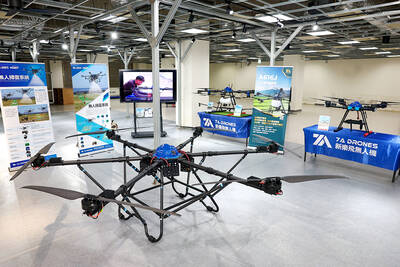
DRONE CENTRAL: Taiwan aims to become Asia’s democratic hub for drones, with most exports focused on high-quality military-grade models, an official said Taiwan’s drone industry is expected to expand significantly by 2030, producing 100,000 units per month and exporting half of them, the Ministry of Economic Affairs said yesterday. Current drone production capacity is about 15,000 units per month, but the industry can quickly scale up as demand increases, Industrial Development Administration Director-General Chiou Chyou-huey (邱求慧) told a news conference in Taipei. Taiwan’s drone output grew 2.5-fold last year to NT$12.9 billion (US$408.3 million) under a government program to develop the uncrewed vehicle sector, he said. The Executive Yuan in October last year approved plans to invest NT$44.2 billion into domestic production of uncrewed aerial

VERBOSE VESSELS: A CGA cutter and a China Coast Guard exchanged verbal barbs for more than a day in Taiwanese-controlled waters before the Chinese vessel left The Taiwanese and Chinese coast guards had a standoff near the strategically located Pratas Islands (Dongsha Islands, 東沙群島) in the north of the South China Sea, the Coast Guard Administration (CGA) said yesterday. The two sides engaged in intense radio exchanges over sovereignty claims during the 33-hour standoff. China Coast Guard vessel 3501 eventually left the restricted waters, 26.6 nautical miles (49.2km) west of the Pratas Islands, at 5pm yesterday, the CGA said. Lying approximately between southern Taiwan and Hong Kong, the Taiwan-controlled Pratas are seen by some security experts as vulnerable to Chinese attack due to their distance — more than
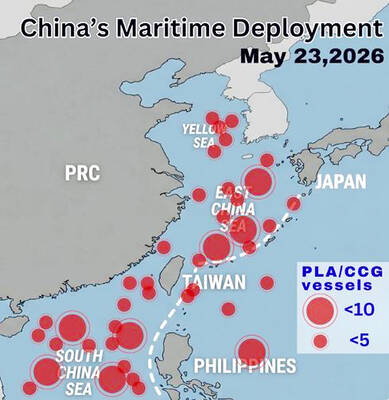
WARNING: China should stop engaging in actions that undermine regional peace and stability, as it would only build resentment among people across the Strait, the CGA said China has deployed more than 100 navy, coast guard and other vessels in waters from the Yellow Sea to the South China Sea and the western Pacific since US President Donald Trump and Chinese President Xi Jinping (習近平) met in Beijing, National Security Council Secretary-General Joseph Wu (吳釗燮) said yesterday. “In this part of the world, #China is the one & only PROBLEM wrecking the #StatusQuo & threatening regional peace & stability,” Wu wrote on X. In a separate post, he said Beijing was coercing Taiwan’s maritime domain, calling it illegal and provocative, after the Coast Guard Administration (CGA) expelled a


 RSS
RSS