


Construction began yesterday of the Taipei Mass Rapid Transit System's Hsinyi line (信義線).
A ground-breaking ceremony, attended by officials of the city government and Taipei City councilors took place at the site of a new station on the rout of the line between Sungchi Road (松智路) intersection and Chuangchin Road (莊敬路).
The new station is scheduled to be completed by the end of September, 2009, according to the city's Department of Rapid Transit Systems (DORTS).
The new station will be named the World Trade Center station. It is close to the World trade Center and the Taipei 101 building.
Taipei Mayor Ma Ying-jeou (馬英九) and DORTS' Director Fan Liang-hsiu (范良鏽) both attended the ground-breaking ceremony as well as the general manager of the Taipei Rapid Transit Corp (TRTC), Richard Chen (陳椿亮) and KMT Legislator Mu Ming-chu (穆閩珠).
According to transportation officials, the MRT station, with a budget of NT$1.6 billion, will be constructed underground with four exits.
The World Trade Center station is among seven stations that will make up the 6.4km long Hsinyi line, said Chang Hui-chen (張慧珍), a public relations official at the department.
"The Hsinyi Line will start from with the existing Chiang Kai-shek Memorial Hall station," she said. "Aside from the World Trade Center station, other stations [along the Hsinyi line] will include ones near Ta-an Forest Park, Ta-an Road, Anho Road, Dongmen Market with Hsiangshen being the last station."
The Hsinyi line, running along Hsinyi Road, will be the second MRT line designed to run west-east after the Nankang line (南港線).
Although the Executive Yuan approved construction of the line in 1997, it had been delayed due to financial difficulties, Chang said.
The entire budget for the Hsinyi line is estimated at NT$44.5 billion, Chang said.
"In order to accommodate the current on-going construction of the Taipei 101 building, we've decided to push for the construction of the World Trade Center station now to avoid inconvenience to the surrounding traffic due to digging of the area a second time around [after the Taipei 101 building is finished]," she said.
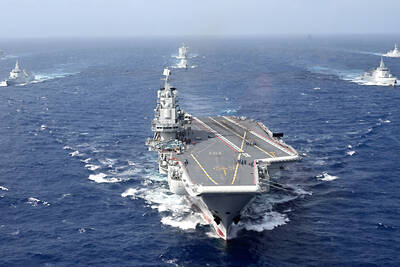
PROVOCATIVE: Chinese Deputy Ambassador to the UN Sun Lei accused Japan of sending military vessels to deliberately provoke tensions in the Taiwan Strait China denounced remarks by Japan and the EU about the South China Sea at a UN Security Council meeting on Monday, and accused Tokyo of provocative behavior in the Taiwan Strait and planning military expansion. Ayano Kunimitsu, a Japanese vice foreign minister, told the Council meeting on maritime security that Tokyo was seriously concerned about the situation in the East China and South China seas, and reiterated Japan’s opposition to any attempt to change the “status quo” by force, and obstruction of freedom of navigation and overflight. Stavros Lambrinidis, head of the EU delegation to the UN, also highlighted South China Sea
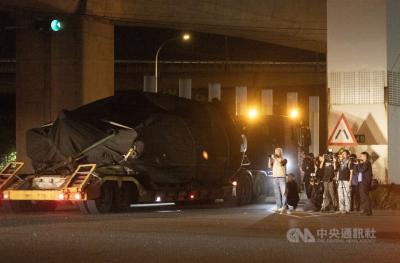
The final batch of 28 M1A2T Abrams tanks purchased from the US arrived at Taipei Port last night and were transported to the Armor Training Command in Hsinchu County’s Hukou Township (湖口), completing the military’s multi-year procurement of 108 of the tanks. Starting at 12:10am today, reporters observed more than a dozen civilian flatbed trailers departing from Taipei Port, each carrying an M1A2T tank covered with black waterproof tarps. Escorted by military vehicles, the convoy traveled via the West Coast Expressway to the Armor Training Command, with police implementing traffic control. The army operates about 1,000 tanks, including CM-11 Brave Tiger
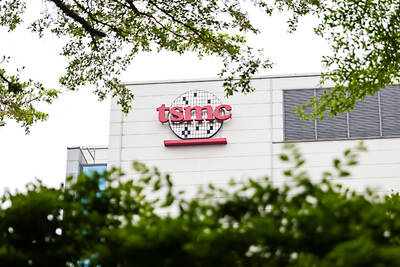
Taiwan Semiconductor Manufacturing Co (TSMC, 台積電), the world’s largest contract chipmaker, said it expects its 2-nanometer (2nm) chip capacity to grow at a compound annual rate of 70 percent from this year to 2028. The projection comes as five fabs begin volume production of 2-nanometer chips this year — two in Hsinchu and three in Kaohsiung — TSMC senior vice president and deputy cochief operating officer Cliff Hou (侯永清) said at the company’s annual technology symposium in Silicon Valley, California, last week. Output in the first year of 2-nanometer production, which began in the fourth quarter of last year, is expected to
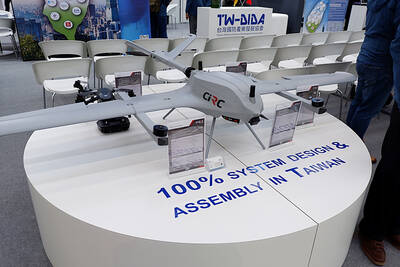
Taiwan’s drone exports surged past US$100 million in the first quarter, exceeding last year’s full-year total, with the Czech Republic emerging as the largest buyer, the Ministry of Economic Affairs said. Exports of complete drones reached US$115.85 million in the period, about 1.2 times the total recorded for all of last year, the ministry said in a report. Exports to the Czech Republic accounted for about US$100 million, far outpacing other markets. Poland, last year’s top destination, recorded about US$11.75 million in the first quarter. Taiwan’s drone exports have expanded rapidly in the past few years, with last year’s total


 RSS
RSS