


The Mainland Affairs Council (MAC) confirmed yesterday that eight DPP legislators were still awaiting visas to travel to Hong Kong for ROC National Day celebrations, while nine KMT and PFP lawmakers in the same delegation have already received theirs.
But Chen Chung-hong (
"The Hong Kong government usually rejects visa applications from DPP officials. We should not read too much into this particular instance," Chen said.
The 18-member delegation hopes to attend activities related to the Hsinhai Revolution (
However, only one DPP legislator, Chang Chin-fang (
Since President Chen Shui-bian (
KMT and PFP lawmakers have not experienced such difficulties.
Only one TSU lawmaker has ever succeeded in obtaining a visa to Hong Kong and China, while at least half of the party's 13 lawmakers have had their visa applications rejected.
Chen Chung-hong (陳崇弘), the director of the MAC's Department of Information and Liaison, said that the eight DPP lawmakers in the delegation have gone to Macau to wait for their visas.
"If they get their visas approved in time, they will go to Hong Kong to participate in those activities. Otherwise they will come back to Taiwan," Chen Chung-hong said.
Meanwhile, Director of the DPP's Chinese Affairs Department Chen Chung-hsin (
Chen Chung-hsin assumed his current party post at the end of July, the same time as Chen Shui-bian took over the party chairmanship.
"I have a lot of things to do here in Taiwan. And I turned my visa application in very late last Friday. It is not necessary to think about things in a complicated way," he told the Taipei Times, declining to comment further.
According to the MAC, the DPP lawmakers who are still waiting for visas are Lee Chen-nan (李鎮楠), Lee Ming-hsien (李明憲), Chiu Chuang-chin (邱創進), Chen Mao-nan (陳茂男), Ho Chin-sung (何金松), Tang Hou-sheng (湯火聖), Chang Hua-kuan (張花冠) and Wang Shu-hui (王淑慧).
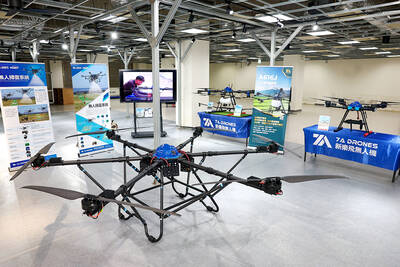
DRONE CENTRAL: Taiwan aims to become Asia’s democratic hub for drones, with most exports focused on high-quality military-grade models, an official said Taiwan’s drone industry is expected to expand significantly by 2030, producing 100,000 units per month and exporting half of them, the Ministry of Economic Affairs said yesterday. Current drone production capacity is about 15,000 units per month, but the industry can quickly scale up as demand increases, Industrial Development Administration Director-General Chiou Chyou-huey (邱求慧) told a news conference in Taipei. Taiwan’s drone output grew 2.5-fold last year to NT$12.9 billion (US$408.3 million) under a government program to develop the uncrewed vehicle sector, he said. The Executive Yuan in October last year approved plans to invest NT$44.2 billion into domestic production of uncrewed aerial
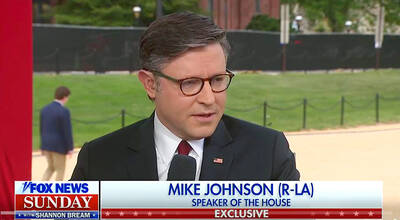
RESOLUTE BACKING: Two Republican senators are planning to introduce legislation that would impose immediate sanctions on China if it attempts to invade Taiwan US House of Representatives Speaker Mike Johnson on Sunday reaffirmed US congressional support for Taiwan, saying the US and “all freedom-loving people” have a stake in preventing China from seizing Taiwan by force. Johnson made the remarks in an interview with Fox News Sunday on US President Donald Trump’s summit with Chinese President Xi Jinping (習近平) last week. In an interview that aired on Friday on Fox News, just as Trump wrapped up a high-stakes visit to China, he said he has yet to green-light a new US$14 billion arms package to Taiwan and that it “depends on China.” “It’s a very good
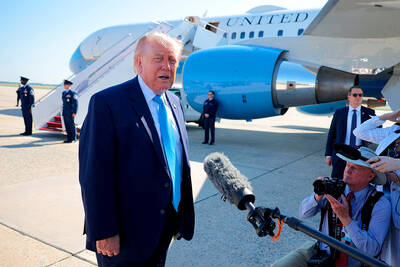
US President Donald Trump yesterday said he would speak to President William Lai (賴清德) as his administration considers whether to move ahead with a US$14 billion weapons sale to Taiwan — a potential arms deal that has drawn criticism from China. “Well, I’ll speak to him. I speak to everybody,” Trump told reporters yesterday when asked if he had any plans to call his counterpart, although he did not offer a time frame for when such a conversation could take place. Trump previously said he would speak to the person “that’s running Taiwan,” without specifying who he meant. “We have that situation very

‘NON-NEGOTIABLE’: Failure to follow through with US obligations to Taiwan could cost countless lives and trigger a global economic downturn, a US senator warned A bipartisan group of US senators on Friday introduced a resolution reaffirming the Taiwan Relations Act (TRA) and the US’ obligation to provide arms of a defensive nature to Taiwan, amid reports that the White House might pause a planned US$14 billion arms sale. Since his meeting with Chinese President Xi Jinping (習近平) earlier this month, US President Donald Trump has declined to say whether his administration would move forward with the sale, saying that it is a “very good negotiating chip for us.” On Thursday, The Hill reported that a Pentagon official told a US Senate subcommittee that Washington was pausing


 RSS
RSS