


A US military planning document calls for air, land and sea-based forces to attack Iraq from three directions -- the north, south and west -- in a campaign to topple President Saddam Hussein, said a person familiar with the document.
The document envisions tens of thousands of marines and soldiers probably invading from Kuwait. Hundreds of warplanes based in as many as eight countries, possibly including Turkey and Qatar, would unleash a huge air assault against thousands of targets, including airfields, roadways and fiber-optics communications sites.
Special operations forces or covert CIA operatives would strike at depots or laboratories storing or manufacturing Iraq's suspected weapons of mass destruction and the missiles to launch them.
None of the countries identified in the document as possible staging areas have been formally consulted about playing such a role, officials said, underscoring the preliminary nature of the planning. Secretary of Defense Donald Rumsfeld visited US bases in Kuwait and Qatar and the Fifth Fleet in Bahrain on his most recent trip to the Persian Gulf region in June.
The existence of the document that outlined significant aspects of a "concept" for a war against Iraq as it stood about two months ago indicates an advanced state of planning in the military even though President George W. Bush continues to state in public and to his allies that he has no fine-grain war plan on his desk for an invasion of Iraq.
Yet the concept for such a plan is now highly evolved and is apparently working its way through military channels. Once a consensus is reached on the concept, steps toward assembling a final war plan and the element of timing for ground deployments and commencement of an air war, represent the final sequencing that Bush will have to decide.
Bush has received at least two briefings from General Tommy Franks, the head of the Central Command, on the broad outlines, or "concept of operations," for a possible attack against Iraq. The most recent briefing was on June 19, according to the White House.
"Right now, we're at the stage of conceptual thinking and brainstorming," a senior defense official said. "We're pretty far along."
The highly-classified document, entitled "CentCom Courses of Action," was prepared by planners at the Central Command in Tampa, Florida, according to the person familiar with the document.
Officials say it has already undergone revisions, but is a snapshot of an important, but preliminary stage, in a comprehensive process that translates broad ideas into the detailed, step-by-step blueprint for combat operations that the Pentagon defines as a "war plan."
Still, the document, compiled in a long set of briefing slides, offers a rare glimpse into the inner sanctum of the war planners assigned to think about options for defeating Iraq.
"It is the responsibility of the Department of Defense to develop contingency plans and, from time to time, to update them," said Victoria Clarke, Pentagon spokeswoman. "In fact, we have recently issued new general planning guidance, and that generates activity at the staff level."
Officials said neither Rumsfeld, nor the Joint Chiefs of Staff or Franks had been briefed on this specific document as yet.
The source familiar with the document described its contents to The New York Times on the condition of anonymity, expressing frustration that the planning reflected at least in this set of briefing slides was insufficiently creative, and failed to incorporate fully the advances in tactics and technology that the military has made since the Persian Gulf war in 1991.
Administration officials say they are still weighing options other than war to dislodge Hussein. But most military and administration officials believe that a coup in Iraq would be unlikely to succeed, and that a proxy battle using local forces would not be enough to drive the Iraqi leader from power.
Nothing in the Central Command document or in interviews with senior military officials suggests that an attack on Iraq is imminent.
Indeed, senior administration officials continue to say that any offensive would probably be delayed until early next year, allowing time to create the right military, economic and diplomatic conditions.
Nonetheless, there are several signs that the military is preparing for a major air campaign and land invasion.
The Central Command document, as described by the source familiar with it, is significant not just for what it contains, but also for what it leaves out.
The document describes in precise detail specific Iraqi bases, surface-to-air missile sites, air defense networks and fiber-optics communications to be attacked. "The target list is so huge it's almost egregious," the source said. "It's obvious that we've been watching these guys for an awfully long time."
Dozens of slides are devoted to organizational details, like the precise tonnage of American munitions stored at various bases around the Persian Gulf, deployment time lines for troops leaving East and West Coast ports for the gulf region, and the complexities of interwoven intelligence, surveillance and reconnaissance networks.
At the same time, according to the source, the document is silent on, or barely mentions, other important aspects of any operation, suggesting that there are several highly classified documents that address different parts of the planning.
For instance, the "Courses of Action" document does not mention other coalition forces, casualty estimates, how Hussein may himself be a target, or what political regime might follow the Iraqi leader if an American-led attack was successful, the source said.
Nor does the document discuss the sequencing of air and ground campaigns, the precise missions of special operations forces or the possibility of urban warfare in downtown Baghdad, with Iraqi forces possibly deploying chemical weapons.
In fact, the discussion about Iraq's weapons of mass destruction is relatively terse. The document discusses the broad threat such weapons pose to American forces and surrounding countries, the need to deter Baghdad from using them, and, failing that, devising ways to counter them.
It describes the number of Marine and Army divisions, air expeditionary forces, and aircraft carriers. These and other forces add up to as many as 250,000 troops, the source familiar with the document said, but there is little detail about those forces beyond that.
The Central Command document does not contain a time line of when American forces could start flowing to the Gulf or how long it would take to put all the forces in place. Nor does it answer one of the big questions administration officials are wrestling with: how will Hussein react if there is a large buildup of conventional forces, such as the US had in the Gulf War.
"The Iraqis aren't just going to sit on their butts while we put in 250,000 people," a military analyst said.

LEVERAGE: China did not ‘need to fire a shot’ to deny Taiwan airspace over Africa when it owns ‘half the continent’s debt,’ a US official said, calling it economic warfare The EU has raised concerns about overflight rights following the delay of President William Lai’s (賴清德) planned state visit to the Kingdom of Eswatini after three African nations denied overflight clearance for his charter at the last minute. Taiwanese allies Paraguay and Saint Kitts and Nevis, as well as several US lawmakers and the Inter-Parliamentary Alliance on China (IPAC) condemned China for allegedly pressuring the countries. Lai was scheduled to fly directly to Taiwan’s only African ally from yesterday to Sunday to celebrate the 40th anniversary of King Mswati III’s accession and his 58th birthday, but Seychelles, Mauritius and Madagascar suddenly revoked
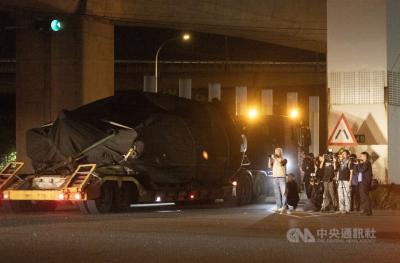
The final batch of 28 M1A2T Abrams tanks purchased from the US arrived at Taipei Port last night and were transported to the Armor Training Command in Hsinchu County’s Hukou Township (湖口), completing the military’s multi-year procurement of 108 of the tanks. Starting at 12:10am today, reporters observed more than a dozen civilian flatbed trailers departing from Taipei Port, each carrying an M1A2T tank covered with black waterproof tarps. Escorted by military vehicles, the convoy traveled via the West Coast Expressway to the Armor Training Command, with police implementing traffic control. The army operates about 1,000 tanks, including CM-11 Brave Tiger
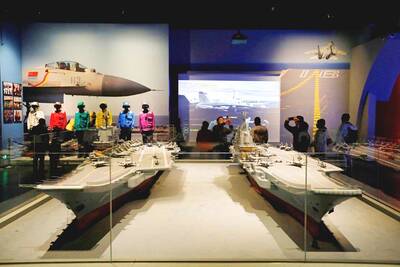
China on Wednesday teased in a video an aircraft carrier that could be its fourth, and the first using nuclear power, while making an allusion to Taiwan and vowing to further build up its islands, as it looks to boost maritime power, secure resources and bolster territorial claims. The video, issued on the eve of the 77th founding anniversary of the Chinese People’s Liberation Army Navy, featured fictional officers with names that are homophones of three commissioned aircraft carriers, the Liaoning (遼寧), Shandong (山東) and Fujian (福建). Titled Into the Deep, it showed a 19-year-old named “Hejian” (何劍) joining the group, sparking

BIG YEAR: The company said it would also release its A12 chip the same year to keep a ‘reliable stream of new silicon technologies’ flowing to its customers Taiwan Semiconductor Manufacturing Co (TSMC, 台積電) yesterday said its newest A13 chip is to enter volume production in 2029 as the chipmaker seeks to hold onto its tech leadership and demand for next-generation chips used in artificial intelligence (AI), high-performance-computing (HPC) and mobile applications. TSMC, the world’s biggest contract chipmaker, also unveiled its A12 chip at its annual technology symposium in Santa Clara, California. The A12 chip, which features TSMC’s super-power-rail technology to provide backside power delivery for AI and HPC applications, is also to enter volume production in 2029, a year after the scheduled release of the A14 chip. The technology moves


 RSS
RSS