


As a member of the global village, Taiwan has every right to join the WHO to provide its 23 million people the best medical care and to give back to the world what Taiwan has received, President Chen Shui-bian (陳水扁) said yesterday.
"Taiwan realizes the true meaning of `healthcare without borders' after the devastating earthquake that rocked the island on Sept. 21, 1999," Chen said. "We've managed to get back on our feet again and are ready to give back to the world what the world has given us."
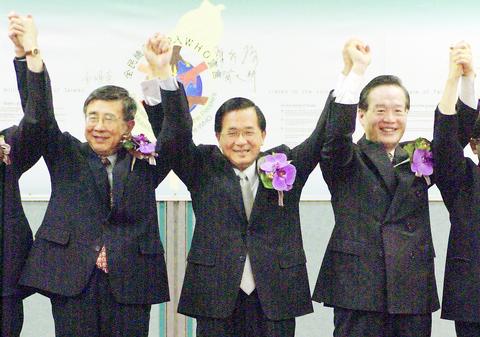
PHOTO: LIAO RAY-SHANG, TAIPEI TIMES
Chen made the remark during the opening ceremony of the "Strategy and Role Assignment of People's Mobilization to Join the WHO" symposium yesterday morning.
The one-day event, co-organized by the Ministry of Foreign Affairs, the Department of Health and 26 non-governmental organizations (NGO), drew about 500 people to the International Convention Center in Taipei.
Although it took Taiwan 12 years to join the WTO, Chen said that he expects it will not take as long to get accession to the WHO.
"I believe it won't take as long as 12 years to become a member of the global public-health body as long as the government and its people work hand in hand, braving difficulties and grasping every possible opportunity," he said.
Chen said that both the government and NGOs should emulate the spirit of the Nobel Peace Prize winning NGO, Medecins Sans Frontieres, to offer needy countries Taiwan's most advanced medical and public health know-how and resources.
"Because it not only saves lives but also builds friendship as well as upgrades Taiwan's international profile," Chen said.
Chen also expressed appreciation for the recent international support for Taiwan's bid to join the WHO.
"It's encouraging to see that the European Parliament passed a resolution on March 14 to call on the World Health Assembly (WHA) -- the WHO's highest decision-making body -- to accept Taiwan in the capacity of an observer," Chen said. "The US Congress also passed an act on March 19 in support of Taiwan's accession to the WHA as an observer."
Minister of Foreign Affairs, Eugene Chien (
"While there's still much room for improvement, we're thrilled to see some positive results since the government began its bid to gain observer status at the WHO in 1997," Chien said.
Lee Ming-liang (
"I hope to see our hard work eventually bear fruit in the near future," he said.
DPP Legislator Lai Ching-teh (
"We have to let the international community understand how Taiwan will suffer if we cannot get access to the most immediate and advanced medical information and relief resources if such deadly diseases like the enterovirus and devastating disasters such as earthquake strike," he said.

National Taiwan University (NTU) yesterday said it disqualified a person from an entrance examination for using AI smart glasses to cheat, along with two others for making untruthful statements in their curriculum vitae. The three applicants were given null scores, Taiwan’s highest-ranked university said, calling on prospective students to be honest in the admissions process. NTU registrar Lee Hung-sen (李宏森) said that the cheating applicant wore a hat and thick-rimmed glasses to the second written exam for medical school, claiming that they felt cold. Suspicions were aroused when the applicant stared oddly at the test for long stretches while steadily bringing the paper
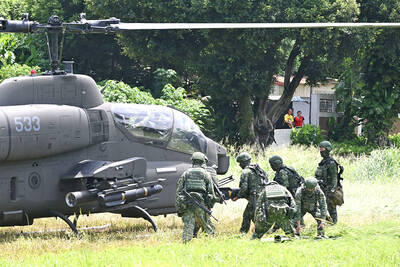
MILITARY ISSUES: A partisan divide between the Cabinet and the legislature ‘raised questions about Taiwan’s ability to adequately fund its defense,’ the report said Taiwan’s defense budget, military personnel numbers and resilience are challenges to its ability to meet national defense goals, the US Naval Institute said in a report published on Tuesday. In response to the perception of a growing military threat posed by China, Taiwan has embarked on an effort to enhance the capabilities needed to deter an attempt by Beijing to annex the nation by force, the institute said in the US Congressional Research Service report, titled Taiwan: Defense and Military Issues, which was filed on Thursday last week. Taiwan’s defense budget increased by about 7.5 percent from 2024 to last year, it
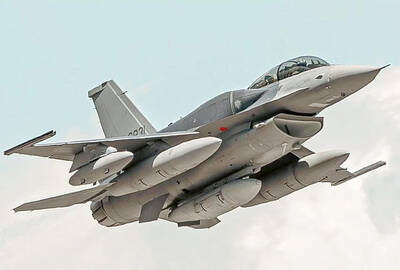
66 FIGHTER JETS: The aircraft is likely undergoing preparations for its transfer to Taiwan — a significant step forward in the nation’s modernization program, a lawmaker said The first of Taiwan’s order of F-16V Block 70 aircraft has been sighted in Texas ahead of delivery, Democratic Progressive Party (DPP) Legislator Wang Ting-yu (王定宇) said. Taiwan’s first F-16V Block 70 two-seat aircraft, tail number 6831, was seen flying from Lockheed Martin’s production facility in Greenville, South Carolina, to Naval Air Station Joint Reserve Base Fort Worth in Texas, Wang wrote on Facebook yesterday. The plane is likely undergoing preparations for its transfer to Taiwan, marking a significant step forward in the Republic of China Air Force’s modernization program, Wang said, citing military analysts. The F-16V Block 70 is a new-build version
NOT JUST NUMBERS: What matters to intelligence work is crucial, reliable information, so even a few credible leads can be highly valuable to national security, a legislator said The National Security Bureau (NSB) yesterday said it has finished the establishment of an information-reporting channel for Chinese nationals, the aim of which is to broaden intelligence gathering on China’s political, military, economic and social developments. Chinese nationals can submit information on the Web page, https://report.nsb.gov.tw, the NSB said in a statement. The move aims to expand the bureau’s diverse intelligence sources and is pursuant to the National Intelligence Services Act (國家情報工作法), it said, adding that it referenced practices adopted by intelligence agencies in the US, the UK and Israel. An increasing number of people are approaching Taiwanese agencies to provide information, as


 RSS
RSS