


Two DPP city councilors questioned the true colors of Taipei City Mayor Ma Ying-jeou (
City councilors Duan Yi-kang (
In the lead up to the AFC Women's Championship, held from Dec. 4 to 11, Ma asked soccer fans not to bring the national flag to the games. That upset many Taiwanese, who brought the flags to games in protest.
At a press conference yesterday, fans who attended the games said it was unfair that Taiwanese weren't allowed to wave their national flag at a sporting event held in Taipei.
"In the stadium, policemen came over and forcefully tried to snatch away my flag," said one of the fans, who wished to remain anonymous. "They ended up breaking the pole off my flag."
The tournament was held in accordance with the rules of the International Olympic Committee, which bars fans from displaying flags of countries that are not members of the organization. Taiwan participates in the Olympics under the name "Chinese Taipei" and has a separate flag for Olympic events.
"The [policemen] told us that by waving the flag we were doing harm to our country," said another fan at the press conference. "That was ridiculous and very disappointing to hear from a government official."
Officials have argued that if the flag isn't banned at international sporting matches in Taiwan, China will pressure event organizers not to hold tournaments in Taiwan.
"It's incredibly frustrating. We are not allowed to wave our national flag in our own country, but the Chinese can wave their flag," another fan said.
Duan said the city government had ignored a statement issued by the National Council on Physical Fitness and Sports, which said that "fans who want to carry their national flag into the stadium must be allowed to do so under Olympic rules."
The councilors said that Ma had compromised Taiwan's dignity and forced policemen to act like "servants of China."
Ma said he was simply following requirements set by the Chinese Taipei Soccer Association, which follows Olympic rules. "The city government had no other motive than to maintain order."
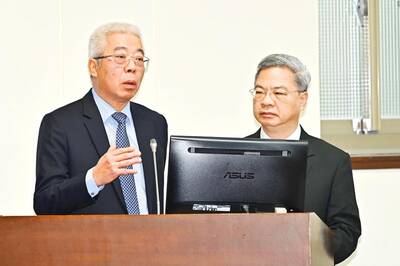
Taiwan has arranged for about 8 million barrels of crude oil, or about one-third of its monthly needs, to be shipped from the Red Sea this month to bypass the Strait of Hormuz and ease domestic supply pressures, CPC Corp, Taiwan (CPC, 台灣中油) said yesterday. The state-run oil company has worked with Middle Eastern suppliers to secure routes other than the Strait of Hormuz, through which about 20 percent of the world’s oil and liquefied natural gas typically passes, CPC chairman Fang Jeng-zen (方振仁) said at a meeting of the legislature’s Economics Committee in Taipei. Suppliers in Saudi Arabia have indicated they
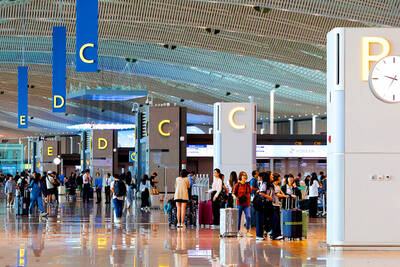
South Korea has adjusted its electronic arrival card system to no longer list Taiwan as a part of China, a move that the Ministry of Foreign Affairs said would help facilitate exchanges between the two sides. South Korea previously listed “Taiwan” as “Taiwan (China)” in the drop-down menus of its online arrival card system, where people had to fill out where they came from and their next destination. The ministry had requested South Korea make a revision and said it would change South Korea’s name on Taiwan’s online immigration system from “Republic of Korea” to “Korea (South),” should the issue not be

CCP ‘PAWN’? Beijing could use the KMT chairwoman’s visit to signal to the world that many people in Taiwan support the ‘one China’ principle, an academic said Chinese Nationalist Party (KMT) Chairwoman Cheng Li-wun (鄭麗文) yesterday arrived in China for a “peace” mission and potential meeting with Chinese President Xi Jinping (習近平), while a Taiwanese minister detailed the number of Chinese warships currently deployed around the nation. Cheng is visiting at a time of increased Chinese military pressure on Taiwan, as the opposition-dominated Legislative Yuan stalls a government plan for US$40 billion in extra defense spending. Speaking to reporters before going to the airport, Cheng said she was going on a “historic journey for peace,” but added that some people felt uneasy about her trip. “If you truly love Taiwan,

Tainan, Taipei and New Taipei City recorded the highest fines nationwide for illegal accommodations in the first quarter of this year, with fines issued in the three cities each exceeding NT$7 million (US$220,639), Tourism Administration data showed. Among them, Taipei had the highest number of illegal short-term rental units, with 410. There were 3,280 legally registered hotels nationwide in the first quarter, down by 14 properties, or 0.43 percent, from a year earlier, likely indicating operators exiting the market, the agency said. However, the number of unregistered properties rose to 1,174, including 314 illegal hotels and 860 illegal short-term rental


 RSS
RSS